
On this page0% through guide
Cell Structure and Function
Cells manage exchange and reactions by organizing matter across boundaries.
What you’ll learn
- Connect organelle structure to function.
- Predict transport using permeability and electrochemical gradients.
- Calculate surface-area-to-volume ratios and water potential.
Before you begin
A gradient is a change in a quantity across space. Net movement means the difference between opposing movements, not the only direction particles travel. A selectively permeable membrane allows some substances through more readily than others; always name which substances can cross.
Explain these starting ideas in your own words. Revisit them whenever a later step feels unclear.
A cell is organized, not homogeneous
All cells have a plasma membrane, cytosol, genetic material, and ribosomes. Eukaryotic cells also have membrane-bound organelles. Compartmentalization allows different chemical conditions and concentrates reactants, supporting reactions that would interfere with one another in a single uniform space.
A secreted protein can be synthesized on a ribosome associated with rough endoplasmic reticulum, enter the ER, move in a vesicle to the Golgi, and then reach the plasma membrane in a secretory vesicle. Free and ER-associated ribosomes have the same basic translation function; targeting information in the protein helps determine its destination.
- Rough ERSynthesis and initial processing of many secreted proteins.
- GolgiModification and sorting.
- Vesicle → membraneTransport and exocytosis.
Read figure values as text
6/L: 1: 6; 1.1458333333333333: 5.236363636363636; 1.2916666666666667: 4.64516129032258; 1.4375: 4.173913043478261; 1.5833333333333335: 3.789473684210526; 1.7291666666666665: 3.4698795180722897; 1.875: 3.2; 2.020833333333333: 2.969072164948454; 2.166666666666667: 2.7692307692307687; 2.3125: 2.5945945945945947; 2.458333333333333: 2.440677966101695; 2.604166666666667: 2.304; 2.75: 2.1818181818181817; 2.895833333333333: 2.0719424460431655; 3.0416666666666665: 1.9726027397260275; 3.1875: 1.8823529411764706; 3.3333333333333335: 1.7999999999999998; 3.4791666666666665: 1.7245508982035929; 3.625: 1.6551724137931034; 3.7708333333333335: 1.591160220994475; 3.9166666666666665: 1.5319148936170213; 4.0625: 1.476923076923077; 4.208333333333334: 1.4257425742574255; 4.354166666666666: 1.3779904306220097; 4.5: 1.3333333333333333; 4.645833333333334: 1.2914798206278024; 4.791666666666666: 1.2521739130434784; 4.9375: 1.2151898734177216; 5.083333333333333: 1.180327868852459; 5.229166666666667: 1.147410358565737; 5.375: 1.1162790697674418; 5.520833333333333: 1.0867924528301887; 5.666666666666667: 1.0588235294117647; 5.8125: 1.032258064516129; 5.958333333333333: 1.006993006993007; 6.104166666666667: 0.9829351535836177; 6.25: 0.96; 6.395833333333333: 0.9381107491856678; 6.541666666666667: 0.9171974522292993; 6.6875: 0.897196261682243; 6.833333333333333: 0.8780487804878049; 6.979166666666667: 0.8597014925373134; 7.125: 0.8421052631578947; 7.270833333333333: 0.8252148997134671; 7.416666666666667: 0.8089887640449438; 7.5625: 0.7933884297520661; 7.708333333333333: 0.7783783783783784; 7.854166666666667: 0.7639257294429708; 8: 0.75
Membranes are selective and dynamic
Phospholipids form a bilayer with hydrophilic heads contacting water and hydrophobic tails sheltered inside. Embedded proteins provide transport, recognition, signaling, and enzymatic functions. Small nonpolar molecules pass through the bilayer much more readily than ions or large polar molecules.
Cis-unsaturated tails reduce close packing. Cholesterol modifies fluidity in animal membranes, restraining motion at high temperature and disrupting tight packing at low temperature. A membrane must be fluid enough for functions without becoming indiscriminately permeable. When predicting transport, consider both the molecule and the available channels or carriers.
Gradient direction and energy source
Simple diffusion and facilitated diffusion are passive: net movement follows a concentration gradient, or an electrochemical gradient for ions. A channel can accelerate passive movement without providing energy. An electrical gradient can reinforce or oppose an ion’s concentration gradient.
Primary active transport uses an energy input, often ATP hydrolysis, to move a substance against its electrochemical gradient. Secondary active transport couples uphill movement of one substance to downhill movement of another. Endocytosis and exocytosis move material in vesicles and require cellular energy. A transport protein’s presence does not by itself prove active transport.
PAUSE & TRY IT
A pump stops but a cotransporter briefly continues. Why?
Reveal answer
A previously established ion gradient can continue to drive secondary transport until it dissipates.
Water potential makes osmosis predictable
Net water movement occurs from higher water potential to lower water potential across a membrane that permits water movement. In common cell problems, total water potential is the sum of solute and pressure potentials. Adding solute makes solute potential more negative; positive pressure raises water potential.
For an ideal dilute solution, solute potential depends on the number of dissolved particles, molar concentration, gas constant, and absolute temperature. Use consistent units and kelvin. A plant cell wall permits pressure to develop as water enters. At equilibrium, water molecules still move in both directions even though there is no net movement.
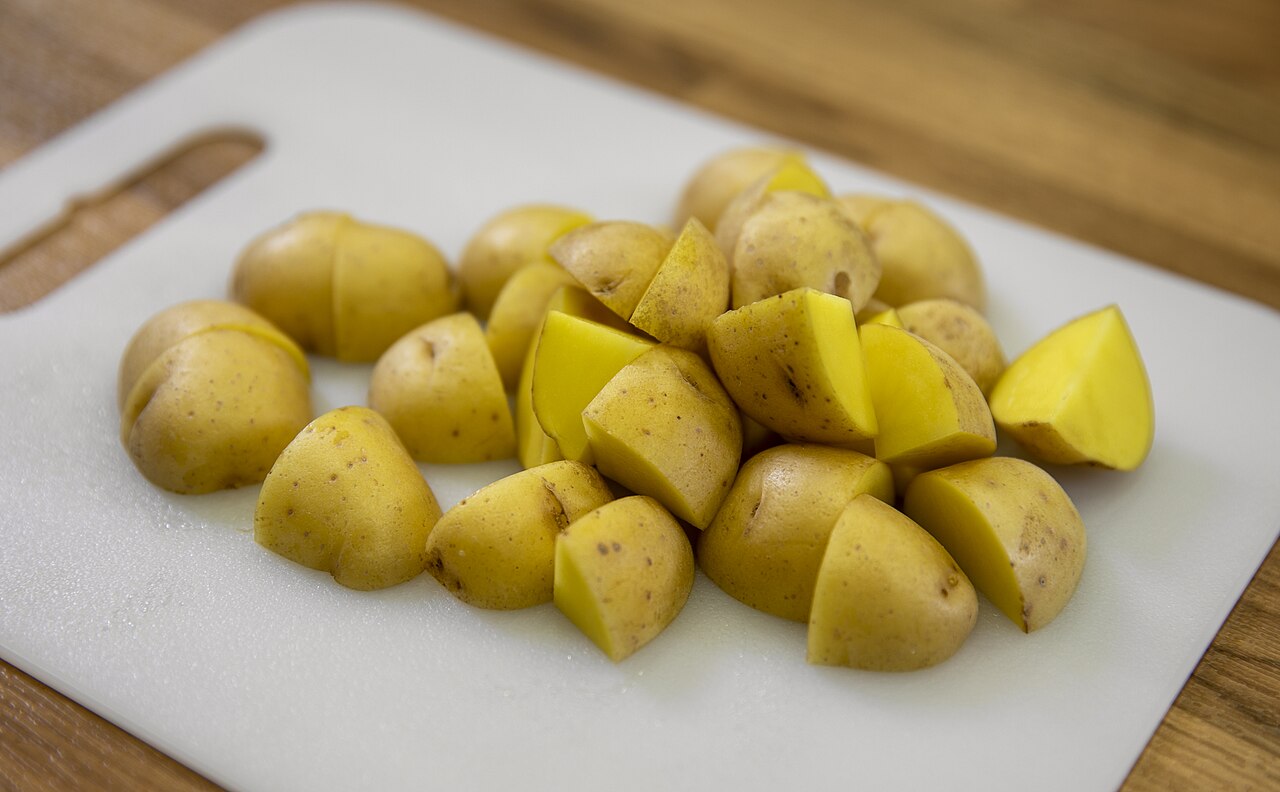
Equal-sized tissue samples can be weighed before and after exposure to solutions. Control time, temperature, and preparation. The photograph is context, not a measurement of water potential.
Photo: Alabama Extension / Janet Guynn · Source · CC0 1.0 · Unmodified.PAUSE & TRY IT
Does a cell at osmotic equilibrium stop exchanging water?
Reveal answer
No. Water moves in both directions at equal rates, giving no net movement.
Scale changes the exchange problem
Surface area grows with length squared, while volume grows with length cubed. As a similarly shaped cell grows, it has less exchange surface per unit of internal volume. Folding, flattening, branching, or dividing into smaller cells can increase relative exchange area or reduce transport distances.
Mitochondrial inner-membrane folds and chloroplast thylakoids provide extensive reaction surfaces. Mitochondria and chloroplasts also have features consistent with endosymbiotic ancestry, including their own DNA, bacterial-like ribosomes, and division. These observations together are stronger evidence than merely noting that the organelles have membranes.
PAUSE & TRY IT
Why might mitochondrial membrane damage reduce ATP production?
Reveal answer
It can dissipate the proton gradient required to couple proton movement to ATP synthesis.
A guided tour from genetic information to secretion
The nucleus contains most eukaryotic DNA and supports transcription. Ribosomes translate an RNA message into a polypeptide. Many proteins destined for secretion or membranes enter the rough ER during synthesis, where processing and folding begin. Vesicles transport them to the Golgi, which modifies and sorts cargo. Fusion with the plasma membrane releases secreted cargo outside the cell. These steps provide different experimental targets.
If a drug prevents ribosome function, new protein production falls broadly. If a different drug disrupts Golgi trafficking, proteins might still be synthesized but accumulate in an earlier compartment. Compare the location and amount of labeled protein at several times to distinguish these effects. Lysosomes contain hydrolytic enzymes in an acidic compartment; separating those reactions helps protect other cell components. The cytoskeleton helps position structures and transport cargo, not merely keep the cell rigid.
PAUSE & TRY IT
Why is a transport-rate plateau insufficient evidence for active transport?
Reveal answer
Both passive carriers and active transporters have limited capacity. Direction relative to the gradient and energy coupling distinguish them.
Tonicity, permeant solutes, and the condition of a cell
Tonicity predicts the sustained effect of a solution on cell volume and depends on solutes that do not readily cross the membrane. A solution can have a high total solute concentration yet produce a different volume response if its solute enters the cell. State permeability assumptions before calling a solution hypertonic or hypotonic relative to a cell.
In a hypotonic environment, an animal cell can swell and lyse because it lacks a cell wall. A plant cell develops turgor pressure as its wall resists expansion. In a hypertonic environment, a plant cell can lose water and its membrane can pull away from the wall. Pressure is why “equal water potential” does not always mean “equal solute concentration.” Graphs of percent mass change across solution concentrations can estimate the isotonic point where the fitted line crosses zero.
PAUSE & TRY IT
Why should a transport-inhibitor experiment include membrane-integrity measurements?
Reveal answer
A damaged membrane could change transport independently of the specific mechanism being tested.
Use transport evidence to discriminate mechanisms
A transport rate that increases linearly with a concentration difference may fit simple diffusion over the tested range. A plateau suggests a limited number of carriers or another rate-limiting step. A plateau alone does not establish that ATP is used: facilitated diffusion through carriers can also saturate. To distinguish mechanisms, combine rate data with movement relative to the electrochemical gradient and evidence of an energy source.
A useful experiment compares intact cells with cells exposed to a metabolic inhibitor, while checking that the inhibitor has not simply destroyed the membrane. Include a membrane-integrity measurement and use the same temperature and external solute concentration. If a sodium gradient drives a cotransporter, disrupting the sodium pump can indirectly reduce transport even if the cotransporter does not hydrolyze ATP itself.
The bilayer separates aqueous environments. A channel provides a path for certain particles; the arrow illustrates transport through a protein, not passage through the lipid interior.
Start with what cells share
Cells have a plasma membrane, cytoplasm, genetic information and ribosomes. Ribosomes make polypeptides from information carried by RNA. A cell can possess DNA without enclosing it in a nucleus. Avoid treating one eukaryotic organelle as the defining requirement for every cellular process.
Eukaryotic cells enclose most of their DNA in a membrane-bound nucleus and contain other membrane-bound compartments. Prokaryotic cells lack a membrane-bound nucleus; their chromosome occupies a nucleoid region. This distinction concerns organization, not whether the cell is living or whether it can carry out sophisticated chemistry.
Size alone does not establish cell type because size ranges can overlap. A clearly bounded nucleus provides stronger evidence for eukaryotic organization. A cell wall alone is not decisive: many bacteria and plants have walls, although composition differs. Use multiple observations and state what each actually supports.
No nucleus does not mean no DNA or no ribosomes.
Match a compartment to its job
Rough endoplasmic reticulum has associated ribosomes producing many proteins destined for secretion, membranes or the endomembrane system. The Golgi apparatus modifies and sorts cargo. Lysosomes provide an environment for digestion of suitable materials. The organelle’s function helps predict why its abundance may differ among cell types.
Mitochondria participate in aerobic energy transformations; chloroplasts perform photosynthesis in appropriate plant and algal cells. A large central vacuole can contribute to storage and plant-cell water balance. Plant cells can contain both mitochondria and chloroplasts. Photosynthesis does not remove the need for respiration.
Many mitochondria are consistent with high ATP demand, but an image alone does not measure ATP production rate. More rough ER may support protein export, but direct cargo measurements strengthen the conclusion. Structure suggests capacity; actual activity depends on substrates, regulation and conditions.
Explain why a structure’s function fits the cell’s workload.
Trace a protein to the outside
Many secreted proteins are made by ribosomes associated with rough ER and enter the ER as they are produced. Not every cellular protein enters this pathway: proteins used in the cytosol can be made on free ribosomes. The ribosomes are not fundamentally different machines; the destination depends on information associated with the protein and its targeting.
Transport vesicles carry appropriate cargo from the ER to the Golgi. Cargo can be modified and sorted through the Golgi before entering vesicles directed to the plasma membrane. The cargo does not simply diffuse through every membrane’s nonpolar interior. Membrane budding and fusion preserve a controlled route between compartments.
During exocytosis, a secretory vesicle fuses with the plasma membrane and releases its contents outside. The vesicle membrane contributes to the cell surface. A block at one step can cause cargo to accumulate upstream. Predicting the location of accumulation helps turn a pathway diagram into an experimental hypothesis.
Trace rough ER → transport vesicle → Golgi → secretory vesicle → outside.
PAUSE & TRY IT
A protein acting in the cytosol generally need not pass through…
Reveal answer
The Golgi Many cytosolic proteins do not enter the ER–Golgi pathway.
Measure the cost of getting bigger
For a cube with side length L, surface area is 6L2 and volume is L3. The ratio is . Doubling length multiplies area by four and volume by eight, so surface area per unit volume falls by half. A growing cell has more total surface but less surface relative to the volume that needs resources and produces wastes.
If exchange occurs across the outer membrane and demand scales with volume, falling surface-area-to-volume ratio can constrain supply. Diffusion distance also increases as a compact cell becomes larger. These models hold relevant factors constant; real cells can change shape, membrane folds, transport activity or internal organization.
Flattening, elongation or surface projections can increase area relative to volume compared with a compact shape. Such structures may support absorption or exchange. Do not say a large cell cannot function: explain the predicted constraint and the adaptation that could reduce it. Geometry describes a pressure on design, not an absolute size rule.
More total area does not mean more area per unit volume.
Build a selective boundary
The phospholipid bilayer has polar head regions facing water and a largely nonpolar interior. Small nonpolar molecules such as O2 can cross this interior relatively readily. Charged ions face a substantial barrier despite their small size. Size alone therefore does not determine permeability; charge and polarity matter too.
Channels and carriers provide pathways for particular substances. A channel can permit ions to move through a hydrophilic route; a carrier binds cargo and changes conformation. Transport proteins do not make the membrane equally permeable to everything. Their abundance, specificity and state influence movement.
The fluid mosaic model describes a mobile lipid environment with proteins and other components. Membranes are not rigid walls of stationary molecules. Fluidity depends on composition and temperature. Selective permeability and fluidity are related to structure but are different properties: a membrane can be fluid while still restricting an ion.
Nonpolar tails form the bilayer interior. A channel provides a hydrophilic route for compatible particles; its presence does not by itself determine transport direction.
Predict permeability using chemical properties and available proteins.
Separate random motion from net movement
Individual particles move randomly. When concentration differs across a permeable boundary, more particles tend to move from the more concentrated side to the less concentrated side, producing net diffusion. This does not mean every individual particle travels down the concentration gradient at every moment. Net movement is the difference between opposing movements.
Channels and carriers can support passive movement down an electrochemical gradient without direct energy input to move the cargo uphill. A carrier can be selective and saturate because binding sites are limited. Neither protein involvement nor saturation alone proves active transport. Ask about the driving gradient and energy coupling.
At equilibrium, opposing fluxes balance and there is no net movement for the process considered. Molecules still move. For ions, both electrical and concentration differences contribute to the electrochemical gradient, so equal concentrations are not always required for equilibrium across an electrically polarized membrane.
Protein use is not the distinction between passive and active transport.
PAUSE & TRY IT
A carrier moves glucose down its concentration gradient without energy coupling. This is…
Reveal answer
Facilitated diffusion Protein-mediated downhill transport is facilitated diffusion.
Predict water movement across a selective barrier
Osmosis is net water movement across a selectively permeable membrane. In a simple equal-pressure comparison with impermeant solute, water tends to move toward the side with the higher effective solute concentration. Water moves in both directions; the prediction concerns the net result. A diagram should identify both the membrane and which substances can cross.
Hypertonic, hypotonic and isotonic describe a solution’s effect relative to a cell, depending especially on effectively nonpenetrating solutes. A permeant solute can redistribute over time, so total concentration alone may not predict the final volume. State the time scale and permeability assumptions instead of memorizing “more solute means shrinkage” without qualification.
Animal cells can swell or shrink as water moves. A plant cell wall resists expansion, allowing pressure to build as water enters. In a sufficiently hypertonic environment, the plasma membrane can pull away from the wall as the cell loses water. A wall modifies the volume response; it does not eliminate osmosis.
Water movement depends on permeability, solute effects and pressure.
Combine solute and pressure into water potential
In the simplified cellular model, water potential is Ψ=Ψs+Ψp: solute potential plus pressure potential. Net water movement is from higher water potential to lower water potential when a permeable path exists. “Higher” includes less negative values: −0.2 MPa is higher than −0.7 MPa. Compare the sums rather than just the solute terms.
For an ideal dilute solution, Ψs=−iCRT, using consistent units, absolute temperature and the appropriate ionization factor. Adding solute makes this term more negative. Pressure can offset that effect. In a typical turgid plant cell, positive pressure potential contributes to the total even though the solute potential is negative.
Suppose the cell has Ψs=−0.8 MPa and Ψp=+0.5 MPa, so total Ψ=−0.3 MPa. An external solution at −0.3 MPa can be in water-potential equilibrium with it. Equal total water potential need not mean equal solute concentration or absence of molecular movement. The wall’s resistance helps support the pressure difference.
Water moves down total water potential, not necessarily toward the largest solute concentration.
Use one gradient to build another
Moving a substance against its electrochemical gradient requires an energy source. Primary active transport couples transport to a direct energy input such as ATP hydrolysis. This can establish an ion gradient across a membrane. The membrane and selective pathways allow the resulting imbalance to be maintained rather than immediately dissipated.
Secondary active transport couples the downhill movement of one substance to uphill movement of another. An ion gradient established by an ATP-powered pump can therefore drive a cotransporter that does not itself hydrolyze ATP. The absence of ATP binding at that cotransporter does not make uphill transport passive.
If the primary pump stops, a preexisting gradient may briefly continue to drive coupled transport. As the gradient dissipates, that transport can decline. An immediate complete stop is not required. Separate the transporter’s direct energy coupling from the cell’s upstream maintenance of the driving gradient.
Direct ATP use and indirect dependence on an ATP-maintained gradient differ.
PAUSE & TRY IT
A cotransporter couples downhill H+ entry to uphill sugar entry. This is…
Reveal answer
Secondary active transport The proton gradient supplies the coupled driving force.
Move cargo without sending it through the lipid core
During endocytosis, membrane encloses external material in an internal vesicle. Phagocytosis involves engulfing relatively large particles; receptor-mediated uptake concentrates suitable ligands through recognition. These processes differ from moving individual small solutes through channels or carriers. The vesicle membrane separates its contents from cytosol.
Exocytosis occurs when an internal vesicle fuses with the plasma membrane and releases contents outside. This also adds membrane components to the surface. Endocytosis removes surface membrane into vesicles, while recycling pathways can return components. Membrane area is dynamic rather than permanently fixed.
Receptor binding can make uptake selective, but binding alone is not the same as completed internalization. Bulk membrane processes involve coordinated cellular machinery and energy use. To locate a defect, distinguish ligand binding, vesicle formation, internal movement and delivery to the destination.
Enclosure and fusion move bulk cargo while preserving membrane boundaries.
Create different conditions in one cell
Membranes create compartments with different chemical conditions and contents. A compartment can concentrate enzymes and substrates, separate potentially incompatible reactions, and maintain a local pH. These differences depend on selective transport and regulation; a membrane alone does not automatically create the desired environment.
Digestive enzymes in lysosomal compartments function in an acidic environment. Proton transport contributes to maintaining that environment. If the pH rises, some digestive activity can decline even when enzyme molecules remain present. Enzyme abundance and enzyme activity are separate measurements.
Compartments exchange materials through controlled pathways. A useful model traces what enters, what changes inside and what leaves. Complete isolation would prevent many essential exchanges. The benefit is regulated separation, not the absence of communication among compartments.
A compartment’s chemistry matters as much as its contents.
Evaluate evidence for endosymbiosis
Endosymbiotic theory proposes that ancestors of mitochondria and chloroplasts originated from bacteria living within another cell lineage. Over evolutionary time, integration and gene transfer produced the organelles seen today. The theory concerns ancestry and integration, not a claim that present-day organelles can necessarily live independently.
Their own DNA, bacterial-like ribosomes, division behavior, membrane organization and molecular similarities support the explanation. No single resemblance is the entire argument. Converging evidence is stronger than merely noticing that two structures have similar shapes. Molecular sequence relationships can be especially informative about ancestry.
Current mitochondria and chloroplasts depend extensively on proteins encoded in the nucleus and imported into the organelle. Ancestral bacterial origin does not mean every organelle gene remained in place or that the organelle contains every gene needed for independent life. Explain both the evidence for origin and the consequences of later integration.
Use multiple lines of evidence and distinguish ancestry from current autonomy.
PAUSE & TRY IT
Which supports endosymbiotic ancestry most directly?
Reveal answer
Molecular similarity to bacterial systems alongside organelle DNA Molecular and genetic similarities provide relevant ancestry evidence.
FROM IDEA TO APPLICATION
Worked examples
Follow the water
A plant cell has Ψs = −0.8 MPa and Ψp = 0.3 MPa. The surrounding solution has Ψ = −0.2 MPa. Which way does water initially move?
Reveal worked solution
- Cell total: −0.8 + 0.3 = −0.5 MPa.
- Outside −0.2 MPa is higher than inside −0.5 MPa.
- Net water enters the cell. Pressure potential may then increase.
Water initially moves into the cell; equilibrium requires equal total water potentials, not equal solute concentrations.
A larger cube
A cube-shaped cell increases its side length from 2 to 4 arbitrary units. Compare volume and surface-area-to-volume ratio.
Reveal worked solution
- Volume changes from 8 to 64: an eightfold increase.
- Surface area changes from 24 to 96: a fourfold increase.
- SA/V decreases from 3 to 1.5.
Volume increases faster than surface area, so the exchange area per unit volume halves.
Estimate an isotonic concentration
Tissue gains 4% mass in 0.20 M sucrose and loses 2% in 0.35 M sucrose. Assume a locally linear relationship. Estimate the zero-change concentration.
Reveal worked solution
- The concentration interval is 0.15 M and mass change falls by 6 percentage points.
- Zero lies of the way from +4% to −2%.
- Add ()(0.15)=0.10 M to 0.20 M.
Approximately 0.30 M. This is an estimate over the tested range; replication and uncertainty matter.
Match a compartment to its job
A secretory cell has extensive rough ER and Golgi membranes.
Reveal worked solution
- Its workload includes making and processing exported proteins.
- Rough ER supports entry of many such proteins into the secretory pathway.
- Golgi processing and sorting prepare cargo for appropriate destinations.
Relate abundance to a specific task, while distinguishing capacity from measured rate.
Build a selective boundary
Na+ movement rises after a specific ion channel opens.
Reveal worked solution
- The nonpolar bilayer interior is a barrier to the charged ion.
- The channel supplies a suitable pathway.
- Opening it changes permeability, while the ion’s electrochemical gradient determines the favored direction.
A pathway and a driving force are both needed.
Combine solute and pressure into water potential
Inside: Ψs=−0.6 MPa and Ψp=+0.2 MPa. Outside: Ψ=−0.1 MPa. Predict initial net movement.
Reveal worked solution
- Inside Ψ=−0.4 MPa.
- Outside −0.1 MPa is higher than −0.4 MPa.
- Water tends to enter the cell.
Add the components before comparing signed values.
Create different conditions in one cell
A lysosomal compartment contains normal enzyme amounts but has an abnormally high pH.
Reveal worked solution
- Enzymes can remain present while conditions change.
- Changed protonation or structure can reduce their activity.
- Measure pH and degradation rate rather than inferring activity from abundance alone.
A changed environment can explain a functional defect.
MAKE THE DISTINCTION
Common mistakes, clearer reasoning
The trapWater always moves toward the more concentrated solution.
The better explanationThat prediction assumes relevant pressure effects are equal and solute permeability is considered; total water potential governs direction.
The trapA membrane protein means active transport.
The better explanationChannels and carriers can mediate passive transport. Determine the direction relative to the gradient and energy source.
RETRIEVE BEFORE YOU REVEAL
Practice checkpoints
Revisit the quick checks from this guide without looking back. Explain why, then reveal the answer.
1. A pump stops but a cotransporter briefly continues. Why?
Reveal answer
A previously established ion gradient can continue to drive secondary transport until it dissipates.
2. Why might mitochondrial membrane damage reduce ATP production?
Reveal answer
It can dissipate the proton gradient required to couple proton movement to ATP synthesis.
3. Does a cell at osmotic equilibrium stop exchanging water?
Reveal answer
No. Water moves in both directions at equal rates, giving no net movement.
4. Why is a transport-rate plateau insufficient evidence for active transport?
Reveal answer
Both passive carriers and active transporters have limited capacity. Direction relative to the gradient and energy coupling distinguish them.
5. Why should a transport-inhibitor experiment include membrane-integrity measurements?
Reveal answer
A damaged membrane could change transport independently of the specific mechanism being tested.
6. A protein acting in the cytosol generally need not pass through…
Reveal answer
The Golgi Many cytosolic proteins do not enter the ER–Golgi pathway.
7. A carrier moves glucose down its concentration gradient without energy coupling. This is…
Reveal answer
Facilitated diffusion Protein-mediated downhill transport is facilitated diffusion.
8. A cotransporter couples downhill H+ entry to uphill sugar entry. This is…
Reveal answer
Secondary active transport The proton gradient supplies the coupled driving force.
9. Which supports endosymbiotic ancestry most directly?
Reveal answer
Molecular similarity to bacterial systems alongside organelle DNA Molecular and genetic similarities provide relevant ancestry evidence.
Key language
- Electrochemical gradient
- The combined chemical and electrical tendency of an ion to move.
- Facilitated diffusion
- Passive movement through a membrane protein.
- Water potential
- A measure used to predict the direction of net water movement.
- Compartmentalization
- Separation into spaces with specialized reaction conditions.
- Tonicity
- The effect of a solution on cell volume due mainly to effectively nonpenetrating solutes.
- Turgor pressure
- Pressure of cell contents against a plant cell wall.
Membrane organization supports energy conversion in Unit 3 and signal reception in Unit 4.