
On this page0% through guide
Cell Communication and Cell Cycle
Cells convert information into regulated responses—and divide only under appropriate conditions.
What you’ll learn
- Trace reception, transduction, and response.
- Predict effects of altered signaling components.
- Connect feedback and cell-cycle regulation to homeostasis.
Before you begin
A receptor is a molecule that binds a suitable signal. A phosphate group can change a protein’s activity when added or removed; phosphorylation does not always turn a protein on. Negative feedback counteracts a deviation, while positive feedback amplifies a change until another event stops the process.
Explain these starting ideas in your own words. Revisit them whenever a later step feels unclear.
A signal needs a matching receiver
A cell responds to a signal only if it has suitable recognition machinery. Local signals can diffuse to nearby cells, while endocrine signals can travel through the body. Contact-dependent interactions require cells or surface molecules to meet. Signal range does not determine the size of the response.
Hydrophilic ligands often bind cell-surface receptors because they cannot freely cross the lipid bilayer. Some small hydrophobic signals bind intracellular receptors. Binding changes receptor activity and begins transduction. The same extracellular signal can cause different responses in cells with different downstream proteins or transcriptional states.
Read figure values as text
Response: 0: 0; 0.3125: 1.07342206955775; 0.625: 4.159733777038269; 0.9375: 8.896797153024911; 1.25: 14.792899408284024; 1.5625: 21.338340730624786; 1.875: 28.089887640449437; 2.1875: 34.71238311136299; 2.5: 40.98360655737705; 2.8125: 46.777546777546775; 3.125: 52.03996669442132; 3.4375: 56.76487145805967; 3.75: 60.97560975609756; 4.0625: 64.7112880992495; 4.375: 68.01776790671849; 4.6875: 70.94211123723042; 5: 73.52941176470588; 5.3125: 75.82117745828523; 5.625: 77.85467128027682; 5.9375: 79.66281225174332; 6.25: 81.2743823146944; 6.5625: 82.71438217420662; 6.875: 84.00444321021938; 7.1875: 85.16324296477558; 7.5: 86.20689655172414; 7.8125: 87.1493111718445; 8.125: 88.00249947927514; 8.4375: 88.77685225778167; 8.75: 89.48137326515705; 9.0625: 90.12388014917056; 9.375: 90.71117561683599; 9.6875: 91.2491929051616; 10: 91.74311926605505; 10.3125: 92.19750076196281; 10.625: 92.61633123958467; 10.9375: 93.00312794193567; 11.25: 93.3609958506224; 11.5625: 93.69268252621205; 11.875: 94.00062493490262; 12.1875: 94.28698951126981; 12.5: 94.55370650529501; 12.8125: 94.8024994924316; 13.125: 95.03491078355314; 13.4375: 95.25232335304663; 13.75: 95.45597980435468; 14.0625: 95.64699880972624; 14.375: 95.82638939207304; 14.6875: 95.9950633593492; 15: 96.15384615384616
Transduction changes existing molecules
A signaling cascade may activate protein kinases, second messengers, or other intermediates. Kinases transfer phosphate groups, often from ATP, to target proteins; phosphatases remove phosphate groups. Phosphorylation can activate or inhibit a protein depending on that protein’s structure.
Amplification occurs when one activated component influences many downstream molecules. A small amount of signal can therefore produce a large response. Pathways must also be turned off: ligand removal, GTP hydrolysis, messenger breakdown, and phosphatase activity can restore the resting state. Persistent signaling is not automatically beneficial.
- ReceptionA ligand binds an appropriate receptor.
- TransductionIntermediates transmit and may amplify the signal.
- ResponseExisting protein activity or gene expression changes.
- ResetTermination mechanisms limit duration.
PAUSE & TRY IT
Why can a receptor-bearing cell fail to respond to a ligand?
Reveal answer
A downstream component may be missing, inactive, or inhibited; receptor presence alone is insufficient.
Use disruptions to order a pathway
If a receptor inhibitor prevents a response but a downstream activator restores it, the downstream component may bypass the inhibited step. This logic helps place components in a pathway. It does not prove direct physical contact between every consecutive component.
A convincing experiment compares a treatment with an appropriate control and measures a defined response, such as reporter expression or phosphorylated protein abundance. Control solvent, dose, exposure time, cell number, and background activity. A failure to respond could result from toxicity rather than specific pathway inhibition, so viability may need a separate control.
Feedback describes the direction of correction
Negative feedback reduces deviation from a regulated condition. A response opposing increased blood glucose, for example, can help restore a range rather than a single perfectly fixed value. Positive feedback amplifies a change until an outside event or limiting condition ends the loop. Positive does not mean healthy, and negative does not mean harmful.
Homeostatic models include a variable, a detection mechanism, a response, and an effect on the original variable. When explaining a loop, state each link. Merely writing “homeostasis occurs” does not explain how a change is corrected.
PAUSE & TRY IT
What makes a feedback loop negative?
Reveal answer
The response counteracts the initial change in the regulated variable.
DNA replication and division are separate events
During interphase, a cell grows, replicates DNA in S phase, and prepares for division. Mitosis separates replicated chromosomes into daughter nuclei, while cytokinesis divides the cytoplasm. Count chromosomes by centromeres under the usual convention: DNA replication doubles DNA content without immediately doubling chromosome number.
Cyclins and cyclin-dependent kinases help regulate progression. Checkpoints can delay division when DNA is damaged, replication is incomplete, or chromosomes are not properly attached to the spindle. Loss of growth-control mechanisms can contribute to cancer. Apoptosis is regulated cell death that can remove damaged or unnecessary cells; it is not the same as accidental tissue injury.
PAUSE & TRY IT
How could loss of a DNA-damage checkpoint affect descendants?
Reveal answer
Cells may divide with unrepaired mutations and pass those changes to daughter cells.
Translate a signal into a specific cellular response
A signaling molecule is a ligand. A hydrophilic ligand generally binds a receptor at the cell surface because it does not readily cross the lipid bilayer. Some small hydrophobic ligands cross the membrane and bind intracellular receptors. Receptor binding changes receptor activity, which initiates a sequence of intracellular events. Different cells can respond differently to the same ligand if they have different receptors or downstream machinery.
A kinase transfers phosphate groups to target molecules; a phosphatase removes them. Second messengers such as cyclic AMP or calcium can distribute and amplify a signal. Amplification means one activated molecule can influence many downstream molecules, not that the original ligand becomes more concentrated. Signal termination is as important as activation: ligand removal, receptor inactivation, messenger breakdown, and dephosphorylation help prevent persistent inappropriate responses.
PAUSE & TRY IT
Can the same hormone produce different responses in two tissues?
Reveal answer
Yes. Receptor identity and downstream signaling components can differ between cell types.
Reason from a pathway perturbation
Suppose a pathway is receptor → kinase A → kinase B → transcription factor. If an active form of B restores the response when A is inhibited, B can plausibly act downstream of A. If adding more ligand cannot restore the response when the receptor is absent, the receptor is required for normal signal reception. These are conditional conclusions about the tested model, not proof that the cell has no alternative pathways.
Always distinguish a loss-of-function treatment from a constitutively active component. Blocking a protein tells you what fails without it. Activating a downstream protein can bypass an upstream requirement. Include untreated and vehicle controls and confirm that cells remain viable. A treatment that kills cells can reduce every measured response without specifically implicating the proposed pathway.
PAUSE & TRY IT
Why is cell viability an important control in a signaling experiment?
Reveal answer
A loss of response caused by cell death cannot identify a specific signaling defect.
Track chromosome number through the cell cycle
During G1, each chromosome contains one DNA molecule. DNA replication in S phase produces two sister chromatids per chromosome. The chromosome count does not double merely because DNA amount doubles; sister chromatids remain joined. During mitosis, chromosomes condense, align, and separate into daughter nuclei. Cytokinesis divides the cell contents. Distinguishing chromosome count, chromatid count, and DNA quantity prevents many graph-reading mistakes.
Cyclin-dependent kinases and regulatory signals coordinate checkpoints. DNA damage can delay progression, and severe damage can trigger programmed cell death. Uncontrolled division can arise when growth-promoting signals become persistently active or when inhibitory pathways fail. Cancer is not simply “mitosis happening”; normal tissues use mitosis. The important distinction is a breakdown of regulation, repair, or appropriate responses to the surrounding tissue.
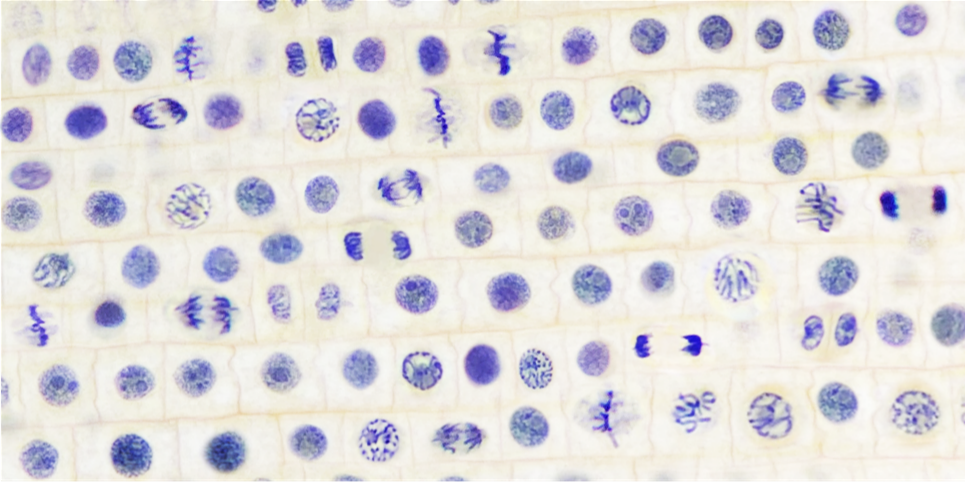
Look for condensed chromosomes and compare cells at different stages. This digitally enhanced composite combines cells from different regions; do not use it to estimate stage frequencies in a random tissue sample.
Photo: ELaurent (EunLau) · Source · CC BY-SA 4.0 · Unmodified.Choose a route for the message
Cells can communicate through direct contact, local signals or signals transported over longer distances. A locally released signal may act on nearby cells, while a hormone can reach distant tissues through circulation. Delivery describes how a signal reaches a potential target, not whether that target is able to respond.
A cell typically needs a suitable receptor and functioning downstream machinery to respond. Two cells exposed to the same signal may differ because they express different receptors or intracellular components. Presence of the signal in a tissue is therefore not proof that every cell in that tissue responds.
A failed response could arise because a signal was not delivered, a receptor is missing, or later steps failed. An experiment that supplies the signal directly can help test delivery, but it does not by itself isolate receptor function. Design comparisons that distinguish stages instead of treating communication as one indivisible event.
A signal reaches a cell; a receptor and pathway determine whether it responds.
Match the receptor’s location to the signal
Large or strongly polar signals often cannot freely cross the nonpolar membrane interior and can bind cell-surface receptors. Some small hydrophobic signals can enter and bind intracellular receptors. These are useful chemical patterns rather than permission to infer a complete pathway from one property alone.
A ligand binds an appropriate receptor through compatible molecular interactions. Binding can change the receptor’s conformation or activity, initiating downstream events. The signal does not have to become a nutrient or be physically carried all the way to the final response site. Recognition can trigger information transfer across the membrane.
Even normal ligand binding may fail to produce a response if the receptor cannot activate downstream machinery. Conversely, a receptor might become active without its normal ligand after a structural change. Measure binding and downstream activity separately to locate which function has changed.
Signal chemistry suggests a route; separate binding from activation.
Trace reception, transduction and response
Reception is detection of the signal by an appropriate receptor. Transduction converts that event into intracellular changes through one or more relay steps. The response is the resulting cellular change, such as altered enzyme activity, secretion or gene expression. These labels describe functions within a pathway; real pathways can branch and interact.
Some responses modify proteins already present and can occur relatively quickly. Others alter transcription and subsequent protein production. A rapid response does not necessarily require a change in DNA sequence or synthesis of a new receptor. Interpret timing using the actual mechanism under study.
Blocking a relay may prevent downstream responses while leaving ligand binding intact. Artificially activating a later step may restore part of the response without repairing the blocked upstream step. Such bypass experiments help infer order, provided the manipulation is sufficiently specific and suitable controls are used.
Trace the causal change, not a claim that the ligand travels through every step.
PAUSE & TRY IT
Changing an enzyme’s activity after receptor activation is an example of…
Reveal answer
A possible cellular response A response can alter existing protein activity.
Use reversible changes to regulate proteins
A protein kinase transfers a phosphate group, commonly from ATP, to a target protein. The modification can alter conformation, interactions or activity. It is inaccurate to assume phosphorylation always activates a protein: the effect depends on the target and modified site. A pathway diagram should specify which state is active.
Protein phosphatases remove phosphate groups from suitable targets. Reversibility allows signals to turn on, change strength and turn off. A phosphatase is not simply “the inhibitor” in every pathway; removing phosphate may activate some proteins and inhibit others. Track the stated relationship for each target.
A cell can change activity without changing total protein abundance. Measurements of total protein and phosphorylated protein answer different questions. A rise in phosphorylation supports a state change, but predicting the functional direction requires knowing what phosphorylation does to that particular protein.
Phosphorylation is a regulatory change whose effect is target-specific.
Relay information with small intracellular signals
Second messengers are intracellular signaling molecules or ions, such as cAMP or Ca2+ in suitable pathways. They can influence downstream proteins and distribute a signal within the cell. Their concentration and location are regulated; the cell does not simply accumulate every messenger indefinitely.
One activated component can influence multiple downstream molecules, and successive stages can expand the response. This is amplification of the effect of a recognition event, not creation of energy. The reactions use available molecules and appropriate energy sources. Actual amplification depends on rates, available targets and regulation.
Messenger degradation, ion transport and removal of activating modifications can return the system toward baseline. A messenger may stay elevated if removal is impaired even after the initiating signal falls. A time course can reveal persistence that a single endpoint would miss.
Amplification uses many downstream events; shutoff controls how long they persist.
Explain different responses to the same signal
Different receptor types can recognize related signals and connect to different internal routes. Even cells with similar receptors can differ in relay proteins, transcription factors or effector enzymes. Specificity is distributed through the pathway rather than determined solely by where the ligand was produced.
An activated pathway may branch, affecting several targets. One branch can change an enzyme quickly while another influences gene expression over a longer interval. A treatment blocking one branch need not eliminate all responses to the original signal. Distinguish a measured endpoint from the complete cellular response.
Physical organization can bring suitable signaling components together and limit inappropriate interactions. The same chemical modification can therefore have different effects depending on which proteins meet and where. Predictions should refer to the actual components and context given rather than assuming identical wiring in all cells.
Cellular components and pathway branches shape the response.
PAUSE & TRY IT
Same receptor but different effectors can lead to…
Reveal answer
Different cellular responses Downstream components influence the output.
Separate growth, copying and division
Interphase includes G1, S and G2 in a typical cycling cell. The cell grows and carries out functions; DNA is replicated during S phase, and preparation continues before division. Interphase is not a period when the cell is inert. Some cells leave the active cycle into a nondividing state rather than repeatedly cycling at one fixed rate.
Replication produces sister chromatids associated as a duplicated chromosome. Mitosis then distributes the duplicated genetic material into nuclei. Cytokinesis partitions the cytoplasm. Copying DNA, dividing a nucleus and dividing a cell are related but distinct events that can be separately disrupted.
Different cell types and conditions produce different phase durations. A diagram drawn with equal-sized phase sectors does not establish equal time in each phase. Experimental measurements are needed to infer duration, and a snapshot sample requires additional assumptions before percentages are converted into times.
G₁ → S → G₂ → mitosis, with cytokinesis partitioning the cell.
Trace one duplicated chromosome through mitosis
As mitosis begins, chromosomes condense and the spindle forms. In typical open mitosis, the nuclear envelope breaks down and spindle microtubules interact with chromosomes through kinetochores. At metaphase, chromosomes are arranged for segregation. A drawing of alignment is a snapshot of a dynamic attachment system, not a static decorative line.
During anaphase, sister chromatids separate and move toward opposite poles. Once separated, each chromatid is counted as a chromosome. This distribution normally gives each daughter nucleus one copy of each chromosome present before replication, assuming normal segregation and no preceding mutation or chromosome abnormality.
In telophase, chromosomes arrive at the poles, nuclear organization is re-established and chromosomes decondense. Cytokinesis commonly overlaps late mitosis but is conceptually distinct. Failure of cytokinesis can leave multiple nuclei in one cell rather than automatically preventing nuclear division.
Track sister chromatids and nuclei separately from the cell boundary.
Count chromosomes without confusing DNA amount
Before sister chromatids separate, a duplicated chromosome is still counted as one chromosome with two sister chromatids. Thus a diploid cell with 2n=6 typically has six chromosomes before and after S phase, but twelve chromatids after replication. DNA amount has doubled even though the chromosome count under this convention has not.
At anaphase, separated sisters become individual chromosomes. Before the cell divides, the whole cell temporarily contains twelve chromosomes in this example, with six moving toward each pole. After normal division, each daughter has six chromosomes. Specify whether the question asks about the whole cell, one pole or one daughter nucleus.
Ploidy describes sets of homologous chromosomes, not the total amount of DNA. S phase does not normally convert a diploid cell into a tetraploid one simply by making sisters. Homologs and sisters describe different relationships: homologs carry corresponding gene loci; sisters arise through replication of a chromosome.
Replication doubles DNA; separation changes what counts as an individual chromosome.
PAUSE & TRY IT
After S phase, a normal 2n=8 cell before anaphase has…
Reveal answer
8 chromosomes and 16 chromatids Each of the eight chromosomes has two sisters.
Regulate transitions with changing protein activity
Cyclin-dependent kinases participate in regulating cell-cycle transitions. Their activity depends on suitable cyclin partners and additional regulatory conditions. Cyclin abundance can rise and fall during the cycle. A constant kinase amount therefore does not imply constant kinase activity or constant permission to divide.
Active complexes modify targets that help coordinate transitions. Regulation can involve synthesis, degradation and activating or inhibitory modifications. The exact response depends on the proteins in the pathway. Do not infer a complete transition solely from one measured protein’s total concentration.
Preventing degradation of a regulator may prolong its influence, but the outcome depends on its role and other controls. Measure activity and downstream events, not just abundance. When analyzing a proposed mechanism, identify what changes, what remains, and which transition should be affected.
Abundance, partner binding and activity are different variables.
Use checkpoints to protect the sequence
Cell-cycle controls can respond to DNA damage, completion of replication and appropriate chromosome attachment. Delaying a transition can provide time for repair or prevent faulty segregation. A checkpoint is a regulatory process, not a physical place where the cell waits.
Anaphase should not proceed normally before chromosomes are appropriately attached for segregation. Defective attachment can activate a delay. If the control fails, chromosome distribution may be abnormal. A treatment causing an arrest and a mutation that abolishes arrest can have very different consequences even if both alter cell division.
An accumulation of cells before a transition may reflect a working checkpoint responding to another defect. It does not prove the treatment directly binds the checkpoint regulator. Distinguish the initiating damage, the sensor/control response and the downstream arrest.
Separate the initiating problem from the checkpoint’s protective response.
Distinguish repair, arrest and cell elimination
Cells can activate repair processes, delay the cycle, enter a persistent nondividing state or undergo programmed cell death, depending on damage and regulatory context. A short observation window may show arrest without revealing the final fate. Follow cells over time to distinguish temporary delay from a more persistent outcome.
Apoptosis is a regulated cell-death process involving coordinated cellular changes. It can help remove damaged or unneeded cells. It is not synonymous with every kind of cell damage or accidental rupture. A decrease in cell number alone does not establish apoptosis without additional evidence.
Measure viability, cycling and relevant molecular or structural indicators rather than treating one endpoint as a complete diagnosis of cell fate. A treatment that lowers population growth might slow division, increase death or do both. Counts over time and appropriate markers help distinguish the contributions.
Reduced population growth is not a unique cell-fate mechanism.
PAUSE & TRY IT
A lower cell count by itself shows…
Reveal answer
A population difference requiring further mechanistic evidence The count does not isolate division or death mechanisms.
FROM IDEA TO APPLICATION
Worked examples
Locate a defect
Ligand L activates receptor R, which activates kinase K. A cell with inactive R does not respond to L, but an artificially active K restores the response. What does this support?
Reveal worked solution
- The rescue occurs despite inactive R.
- Active K can therefore act downstream of, or bypass, the receptor-dependent step.
- The result does not show that L binds directly to K.
The evidence supports K functioning downstream of receptor activation in this response; further experiments are needed to establish direct molecular interactions.
DNA amount versus chromosome number
A diploid cell has 12 chromosomes in G1. How many chromosomes and DNA molecules are present after S phase but before mitosis?
Reveal worked solution
- The number of centromeres remains 12.
- Each replicated chromosome contains two sister chromatids.
- Each chromatid contains one double-stranded DNA molecule.
12 chromosomes and 24 DNA molecules.
Read DNA-content measurements
A diploid cell has 12 chromosomes in G1. How many chromosomes and DNA molecules are present after S phase but before mitosis?
Reveal worked solution
- Replication makes a sister chromatid for each chromosome.
- The joined sister chromatids are still counted as one chromosome.
- Each chromatid contains one DNA molecule.
12 chromosomes and 24 DNA molecules. The cell remains diploid.
Match the receptor’s location to the signal
A surface receptor binds its ligand normally but fails to activate an internal relay.
Reveal worked solution
- The recognition step still occurs.
- The activation or coupling step may be defective.
- A binding assay alone would miss this signaling failure.
Reception contains recognition and functional activation.
Relay information with small intracellular signals
A messenger rises normally after stimulation but falls slowly after signal removal.
Reveal worked solution
- Production or release occurred during stimulation.
- Slow removal or sustained production could prolong the level.
- Measure production and removal separately to distinguish the mechanisms.
Duration is evidence about regulation, not only activation.
Trace one duplicated chromosome through mitosis
Nuclear division finishes, but cytokinesis is blocked.
Reveal worked solution
- Chromosomes may still have been distributed into two nuclei.
- The cytoplasm has not divided normally.
- A single cell can retain two nuclei.
A failure after segregation need not undo segregation.
Use checkpoints to protect the sequence
A spindle-disrupting treatment causes cells to accumulate before anaphase.
Reveal worked solution
- Attachment or spindle function is impaired.
- A control can delay separation in response.
- The arrest may show checkpoint action rather than direct destruction of the checkpoint.
A response to a defect is different from the defect itself.
MAKE THE DISTINCTION
Common mistakes, clearer reasoning
The trapPhosphorylation always activates a protein.
The better explanationIts effect depends on the protein; it can activate, inhibit, or change interactions.
The trapS phase doubles the chromosome count.
The better explanationIt doubles DNA content; replicated sister chromatids remain associated until separation.
RETRIEVE BEFORE YOU REVEAL
Practice checkpoints
Revisit the quick checks from this guide without looking back. Explain why, then reveal the answer.
1. Why can a receptor-bearing cell fail to respond to a ligand?
Reveal answer
A downstream component may be missing, inactive, or inhibited; receptor presence alone is insufficient.
2. What makes a feedback loop negative?
Reveal answer
The response counteracts the initial change in the regulated variable.
3. How could loss of a DNA-damage checkpoint affect descendants?
Reveal answer
Cells may divide with unrepaired mutations and pass those changes to daughter cells.
4. Can the same hormone produce different responses in two tissues?
Reveal answer
Yes. Receptor identity and downstream signaling components can differ between cell types.
5. Why is cell viability an important control in a signaling experiment?
Reveal answer
A loss of response caused by cell death cannot identify a specific signaling defect.
6. Changing an enzyme’s activity after receptor activation is an example of…
Reveal answer
A possible cellular response A response can alter existing protein activity.
7. Same receptor but different effectors can lead to…
Reveal answer
Different cellular responses Downstream components influence the output.
8. After S phase, a normal 2n=8 cell before anaphase has…
Reveal answer
8 chromosomes and 16 chromatids Each of the eight chromosomes has two sisters.
9. A lower cell count by itself shows…
Reveal answer
A population difference requiring further mechanistic evidence The count does not isolate division or death mechanisms.
Key language
- Ligand
- A molecule that binds a particular target, such as a receptor.
- Second messenger
- An intracellular signaling molecule that relays a signal.
- Checkpoint
- A control mechanism that regulates cell-cycle progression.
- Apoptosis
- Regulated cell death.
- Ligand
- A molecule that binds a receptor or other target.
- Second messenger
- An intracellular signal carrier used in a signaling pathway.
Signaling controls gene expression in Unit 6; failures in cell-cycle regulation connect inheritance and evolution at the cellular level.