
On this page0% through guide
Applications of Integration
Build an integral from the quantity accumulated, its units, and its geometry.
What you’ll learn
- Distinguish net change, total change, and average value.
- Find areas between curves.
- Set up volumes using cross-sections and washers.
Before you begin
An integral adds contributions over an interval. The integrand must represent the quantity per unit of the integration variable. A geometric region’s area is nonnegative even when a graph lies below the horizontal axis.
Explain these starting ideas in your own words. Revisit them whenever a later step feels unclear.
Initial amount plus accumulated rate gives final amount
If a rate R describes change in a quantity, its definite integral over time gives net change. Add the initial amount to obtain the final amount. When inflow and outflow are both given, integrate their difference for net storage change; integrate each separately if the question asks total entering or leaving.
A positive final amount does not imply the amount increased throughout the interval. Extrema of an accumulation function occur among endpoints and places where its net rate is zero or undefined. Use a sign change or compare values to justify a maximum.
Read figure values as text
y=x: 0: 0; 1: 1 • y=x²: 0: 0; 0.025: 0.0006250000000000001; 0.05: 0.0025000000000000005; 0.075: 0.005625; 0.1: 0.010000000000000002; 0.125: 0.015625; 0.15: 0.0225; 0.175: 0.030624999999999996; 0.2: 0.04000000000000001; 0.225: 0.050625; 0.25: 0.0625; 0.275: 0.07562500000000001; 0.3: 0.09; 0.325: 0.10562500000000001; 0.35: 0.12249999999999998; 0.375: 0.140625; 0.4: 0.16000000000000003; 0.425: 0.18062499999999998; 0.45: 0.2025; 0.475: 0.225625; 0.5: 0.25; 0.525: 0.275625; 0.55: 0.30250000000000005; 0.575: 0.33062499999999995; 0.6: 0.36; 0.625: 0.390625; 0.65: 0.42250000000000004; 0.675: 0.45562500000000006; 0.7: 0.48999999999999994; 0.725: 0.525625; 0.75: 0.5625; 0.775: 0.6006250000000001; 0.8: 0.6400000000000001; 0.825: 0.6806249999999999; 0.85: 0.7224999999999999; 0.875: 0.765625; 0.9: 0.81; 0.925: 0.8556250000000001; 0.95: 0.9025; 0.975: 0.9506249999999999; 1: 1
PAUSE & TRY IT
What must be added to an accumulated rate to obtain a final amount?
Reveal answer
The initial amount.
Displacement and distance use different integrands
The integral of velocity gives displacement. Total distance integrates speed |v|, requiring a split where velocity changes sign if working by hand. Integrating acceleration gives velocity change, not directly position change. Track the level of differentiation carefully.
An integral’s units provide a strong check. Acceleration in integrated over seconds gives . If an answer to a distance question still has velocity units, the wrong rate or accumulation was used.
Average value is an area-based average
The average value of f on [a,b] is its definite integral divided by interval length. It is not generally the average of endpoint values, except in special cases such as a linear function. A continuous function attains its average value somewhere on the interval.
For a rate, average value has the original rate units. For a temperature function over time, the integral has temperature-times-time units, and dividing by elapsed time returns temperature. The denominator is b − a, not the number of displayed sample points.
Read figure values as text
Upper: y=x: 0: 0; 0.020833333333333332: 0.020833333333333332; 0.041666666666666664: 0.041666666666666664; 0.0625: 0.0625; 0.08333333333333333: 0.08333333333333333; 0.10416666666666667: 0.10416666666666667; 0.125: 0.125; 0.14583333333333334: 0.14583333333333334; 0.16666666666666666: 0.16666666666666666; 0.1875: 0.1875; 0.20833333333333334: 0.20833333333333334; 0.22916666666666666: 0.22916666666666666; 0.25: 0.25; 0.2708333333333333: 0.2708333333333333; 0.2916666666666667: 0.2916666666666667; 0.3125: 0.3125; 0.3333333333333333: 0.3333333333333333; 0.3541666666666667: 0.3541666666666667; 0.375: 0.375; 0.3958333333333333: 0.3958333333333333; 0.4166666666666667: 0.4166666666666667; 0.4375: 0.4375; 0.4583333333333333: 0.4583333333333333; 0.4791666666666667: 0.4791666666666667; 0.5: 0.5; 0.5208333333333334: 0.5208333333333334; 0.5416666666666666: 0.5416666666666666; 0.5625: 0.5625; 0.5833333333333334: 0.5833333333333334; 0.6041666666666666: 0.6041666666666666; 0.625: 0.625; 0.6458333333333334: 0.6458333333333334; 0.6666666666666666: 0.6666666666666666; 0.6875: 0.6875; 0.7083333333333334: 0.7083333333333334; 0.7291666666666666: 0.7291666666666666; 0.75: 0.75; 0.7708333333333334: 0.7708333333333334; 0.7916666666666666: 0.7916666666666666; 0.8125: 0.8125; 0.8333333333333334: 0.8333333333333334; 0.8541666666666666: 0.8541666666666666; 0.875: 0.875; 0.8958333333333334: 0.8958333333333334; 0.9166666666666666: 0.9166666666666666; 0.9375: 0.9375; 0.9583333333333334: 0.9583333333333334; 0.9791666666666666: 0.9791666666666666; 1: 1 • Lower: y=x²: 0: 0; 0.020833333333333332: 0.00043402777777777775; 0.041666666666666664: 0.001736111111111111; 0.0625: 0.00390625; 0.08333333333333333: 0.006944444444444444; 0.10416666666666667: 0.010850694444444446; 0.125: 0.015625; 0.14583333333333334: 0.021267361111111115; 0.16666666666666666: 0.027777777777777776; 0.1875: 0.03515625; 0.20833333333333334: 0.04340277777777778; 0.22916666666666666: 0.052517361111111105; 0.25: 0.0625; 0.2708333333333333: 0.07335069444444443; 0.2916666666666667: 0.08506944444444446; 0.3125: 0.09765625; 0.3333333333333333: 0.1111111111111111; 0.3541666666666667: 0.1254340277777778; 0.375: 0.140625; 0.3958333333333333: 0.15668402777777776; 0.4166666666666667: 0.17361111111111113; 0.4375: 0.19140625; 0.4583333333333333: 0.21006944444444442; 0.4791666666666667: 0.22960069444444448; 0.5: 0.25; 0.5208333333333334: 0.27126736111111116; 0.5416666666666666: 0.29340277777777773; 0.5625: 0.31640625; 0.5833333333333334: 0.34027777777777785; 0.6041666666666666: 0.36501736111111105; 0.625: 0.390625; 0.6458333333333334: 0.4171006944444445; 0.6666666666666666: 0.4444444444444444; 0.6875: 0.47265625; 0.7083333333333334: 0.5017361111111112; 0.7291666666666666: 0.5316840277777777; 0.75: 0.5625; 0.7708333333333334: 0.5941840277777778; 0.7916666666666666: 0.626736111111111; 0.8125: 0.66015625; 0.8333333333333334: 0.6944444444444445; 0.8541666666666666: 0.7296006944444444; 0.875: 0.765625; 0.8958333333333334: 0.8025173611111112; 0.9166666666666666: 0.8402777777777777; 0.9375: 0.87890625; 0.9583333333333334: 0.9184027777777779; 0.9791666666666666: 0.958767361111111; 1: 1
Area between curves uses consistent slices
With vertical slices, area is the integral of upper minus lower y-values over x. With horizontal slices, use right minus left x-values over y. Find intersections and determine which boundary is larger throughout each subinterval.
A curve can switch roles across an intersection, requiring a split. Squaring a negative difference does not repair an area setup. Choose the slicing direction that gives a clear single-valued description and the fewest necessary pieces.
PAUSE & TRY IT
Why split an area integral at some curve intersections?
Reveal answer
The upper and lower boundaries can exchange roles.
Volumes accumulate cross-sectional area
A solid with known perpendicular cross-sections has volume ∫A(x)dx or the corresponding y integral. If a slice is a square, its area is side2; if it is a semicircle, identify whether the given distance is a diameter or radius before using the formula.
For revolution with washers, subtract inner disk area from outer disk area: π(R2 − r2). Radii are distances to the axis, not simply raw function values unless the axis makes that true. Rotation around a shifted horizontal or vertical line requires adjusted distances.
PAUSE & TRY IT
What are the units of ∫A(x)dx when A is in m2 and x in m?
Reveal answer
Cubic meters.
Choose net change or total change deliberately
If R(t) is a net rate of change, an initial amount plus ∫R(t)dt gives the later amount. If separate input and output rates are given, subtract output from input before integrating. To locate the largest amount, examine where the net rate changes sign and compare candidates with endpoints. The largest inflow rate need not occur at the largest accumulated amount.
For motion on a line, integrating velocity gives displacement. Integrating its absolute value gives total distance. Split the interval at velocity zeros where sign changes occur, or use an appropriate numerical absolute-value integral. A particle can travel far and return to its starting point, so displacement can be zero while distance is positive.
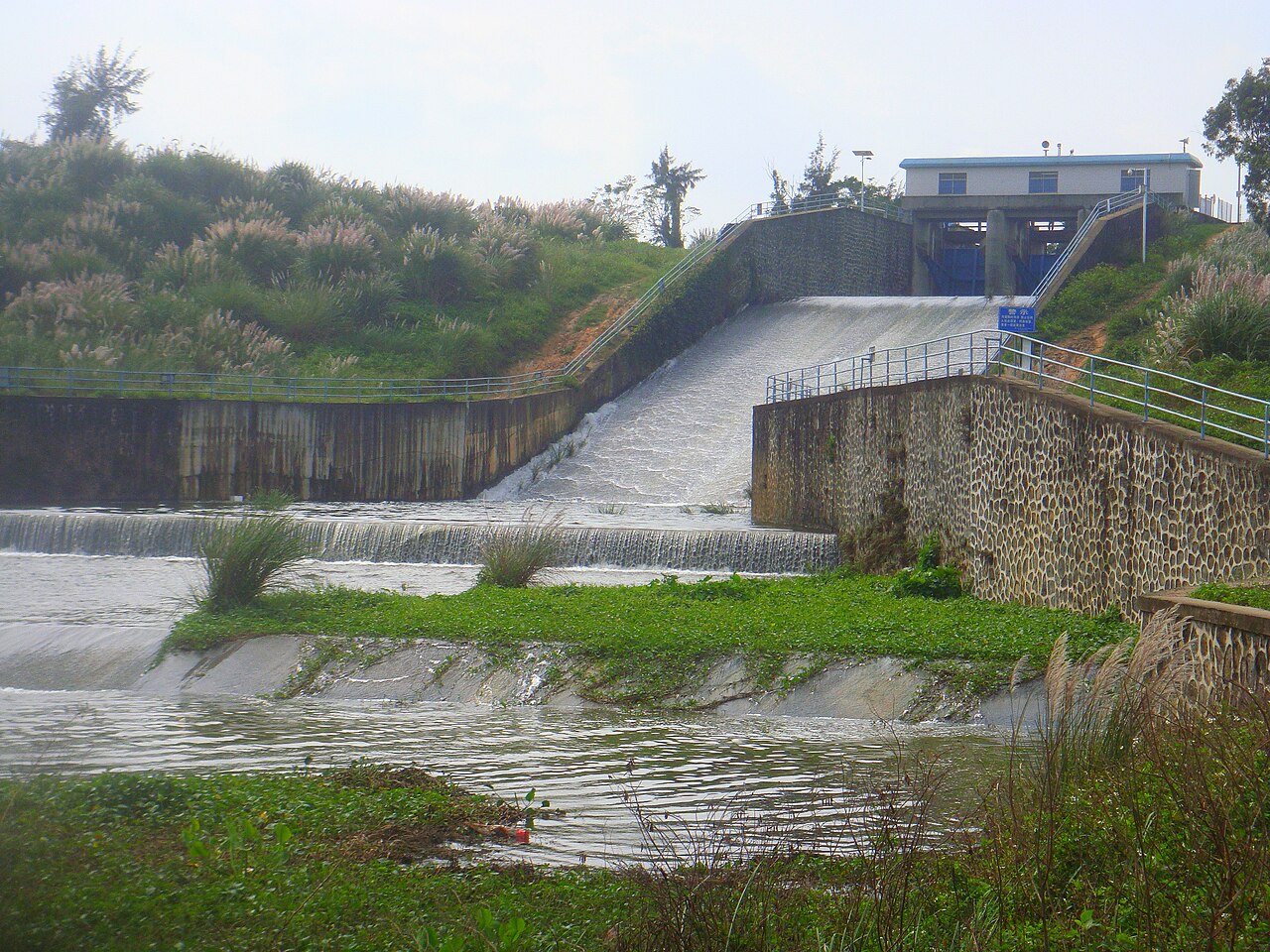
A reservoir’s stored volume depends on its initial volume and net flow over time. The photograph provides context; the small-system numbers used in worked examples are not measurements of this reservoir.
Photo: Anna Frodesiak · Source · CC0 1.0 · Unmodified.PAUSE & TRY IT
Why is π(R−r)2 not a washer area?
Reveal answer
A washer is an outer disk minus an inner disk, so subtract their squared-radius areas.
Area between curves is a slicing decision
A vertical slice has height top minus bottom and width dx. Find intersections to determine interval boundaries and whether the top curve changes. A horizontal slice instead uses right minus left and dy. Choose the orientation that produces simpler boundaries and fewer pieces, but express every boundary in the chosen variable.
The average value of f on [a,b] is the integral divided by b−a. Its units are the same as f, because the interval width cancels the integration variable’s units. Average value is not generally the average of endpoint values. It is the constant height that would give the same signed area over the interval.
PAUSE & TRY IT
If inflow equals outflow at one instant, does the tank contain zero water?
Reveal answer
No. Its instantaneous net rate is zero; its accumulated amount depends on the initial amount and earlier rates.
Build a volume formula from the cross section
For known cross sections, V=∫A(x)dx or ∫A(y)dy. First determine the length supplied by the base region, then convert that length into area using the stated shape. A square with side s has area s2; an equilateral triangle with side s has area √3 . A semicircle whose diameter is s has radius , so its area is , not .
For washers, identify the distances from the rotation axis to the outer and inner boundaries. The area is π(R2−r2), not π(R−r)2. If the axis is shifted, the radii are distances from that shifted axis. Sketch one representative slice and label both radii before writing the integral; this step prevents most setup errors.
Choose net change, total change, or average value
If r(t) is a rate, the final amount equals initial amount plus ∫r(t)dt. The integral alone gives change, not the final amount. When r is velocity, this is displacement; total distance uses ∫|r(t)|dt. Find sign changes before removing the absolute value.
The average value of f on [a,b] is ()∫f. It has the same units as f. Average rate of change instead uses endpoint difference divided by interval length. These formulas answer different questions even when both are called an average in ordinary language.
For inflow and outflow, integrate their difference to get net storage change. Integrating only the inflow gives total incoming quantity, not remaining quantity. A maximum stored amount can occur when the net rate changes from positive to negative, requiring a derivative sign argument.
PAUSE & TRY IT
Why is ∫ inflow dt not necessarily the final tank volume?
Reveal answer
It omits the initial volume and any outflow. Final volume is initial volume plus the integral of inflow minus outflow.
Set up area using consistent slices
Area between curves uses top minus bottom for vertical slices or right minus left for horizontal slices. Find intersections and determine ordering on each interval. If ordering changes, split the integral or use a correctly handled absolute value.
A sketch helps choose the variable and detect whether one curve changes its role. The bounds are values of the integration variable, not automatically the coordinates first given in the problem. For horizontal slices, rewrite boundaries as x-functions of y where needed.
A numerical answer should have square units. Signed cancellation is not appropriate for geometric area, so a negative area result indicates an ordering or bound problem. Symmetry can simplify work only when the region actually has the claimed symmetry.
Build volume from cross-sectional area
Volume is ∫A(x)dx or ∫A(y)dy. Identify the cross-sectional shape and express its area using the slice’s dimensions. For a square, area is side squared; for an equilateral triangle, a different area factor is required. A labeled base length is not necessarily a radius.
For rotation with washers, use π(R2−r2), where radii are distances from the axis of rotation. Rotating around y=3 changes those distances; do not simply square the original curve values. The outer radius is determined geometrically and can switch across intervals.
Check dimensions and limiting cases. A cross-sectional area has square units and integration adds one length unit. If the inner radius is zero, the washer becomes a disk. Sketching one representative slice is often more useful than drawing an elaborate solid.
Use a representative slice to decide the integral
For a volume with known cross-sections, first draw one cross-section perpendicular to the stated axis. Determine its base or radius from the bounding curves. Then apply the area formula for that shape and integrate along the direction in which the slices accumulate.
If the region between y=x and y=x2 on [0,1] forms square cross-sections perpendicular to the x-axis, each side is x−x2 and area is (x−x2)2. Integrating only x−x2 would give the planar region’s area, not the solid’s volume. A dimension check distinguishes the two immediately.
For washers around a horizontal line, radii are vertical distances. Around a vertical line with horizontal slices, radii are horizontal distances. Choose slices that produce a clear area expression and bounds; the picture’s orientation alone does not dictate the variable.
Locate extrema of an accumulated physical quantity
If an amount Q(t) changes at net rate r(t), then Q′=r. Candidate interior extrema occur where r=0 or is undefined, provided Q is defined. A positive-to-negative rate change gives a local maximum of the amount. The largest rate instead indicates the fastest increase, not necessarily the largest amount.
For an absolute maximum over a fixed time interval, compare the amount at all relevant candidates and endpoints. Add the initial value if actual amounts are needed. If only comparisons are required, the same initial constant cancels, but explain that reasoning rather than silently omitting it.
For total distance, total consumption magnitude, or total variation, signs may need absolute values. In a physical inflow–outflow model, distinguish total inflow, total outflow, and net stored change. They can all be positive numbers while representing different integrals.
PAUSE & TRY IT
Where can a stored amount have a local maximum from a rate graph?
Reveal answer
Where its net rate changes from positive to negative, with the amount defined there. Also compare endpoints for an absolute maximum.
FROM IDEA TO APPLICATION
Worked examples
Average value
Find the average value of f(x) = x2 on [0,3].
Reveal worked solution
- The integral is [] from 0 to 3 = 9.
- Divide by interval length 3.
The average value is 3, not the endpoint average 4.5.
Area between curves
Find the area between y = x and y = x2 on [0,1].
Reveal worked solution
- On this interval, x ≥ x2.
- Integrate x − x2 from 0 to 1.
- Evaluate − .
square unit.
Washer radii
Rotate the region between y = 2 and y = 1 on 0 ≤ x ≤ 3 about the x-axis. Find volume.
Reveal worked solution
- Outer radius is 2 and inner radius is 1.
- Cross-sectional area is π(4 − 1) = 3π.
- Integrate the constant area over length 3.
9π cubic units.
Washers around a shifted horizontal axis
The region between y=x and y=x2 on 0≤x≤1 is rotated around y=−1. Set up and evaluate its volume.
Reveal worked solution
- On this interval x≥x2. Distances from y=−1 give outer radius x+1 and inner radius x2+1.
- V=π∫ from 0 to 1 of [(x+1)2−(x2+1)2]dx.
- Expand to 2x−x2−x4 and integrate.
V=π(1−−)= cubic units.
Displacement versus distance
Velocity is v(t)=t−2 on 0≤t≤5.
Reveal worked solution
- The sign changes at t=2.
- Displacement = ∫05(t−2)dt = 2.5.
- Distance = −∫02(t−2)dt + ∫25(t−2)dt = 2+4.5=6.5.
Displacement is 2.5 length units; distance is 6.5.
Square cross-section volume
The base lies between y=x and y=x2 for 0≤x≤1. Cross-sections perpendicular to x are squares.
Reveal worked solution
- Side length is x−x2.
- V=∫01(x−x2)2dx=∫01(x2−2x3+x4)dx.
- Evaluate −+.
V= cubic units.
Average value is not average rate
Find the average value of f(x)=x2 on [0,3].
Reveal worked solution
- Integral ∫03x2dx=9.
- Divide by interval length 3.
Average value is 3; average rate of change is =3 here by coincidence, not because the definitions are identical.
MAKE THE DISTINCTION
Common mistakes, clearer reasoning
The trapThe integral of velocity always gives distance.
The better explanationIt gives signed displacement; distance uses |v|.
The trapWasher area is π(R − r)².
The better explanationSubtract disk areas: π(R² − r²).
RETRIEVE BEFORE YOU REVEAL
Practice checkpoints
Revisit the quick checks from this guide without looking back. Explain why, then reveal the answer.
1. What must be added to an accumulated rate to obtain a final amount?
Reveal answer
The initial amount.
2. Why split an area integral at some curve intersections?
Reveal answer
The upper and lower boundaries can exchange roles.
3. What are the units of ∫A(x)dx when A is in m2 and x in m?
Reveal answer
Cubic meters.
4. Why is π(R−r)2 not a washer area?
Reveal answer
A washer is an outer disk minus an inner disk, so subtract their squared-radius areas.
5. If inflow equals outflow at one instant, does the tank contain zero water?
Reveal answer
No. Its instantaneous net rate is zero; its accumulated amount depends on the initial amount and earlier rates.
6. Why is ∫ inflow dt not necessarily the final tank volume?
Reveal answer
It omits the initial volume and any outflow. Final volume is initial volume plus the integral of inflow minus outflow.
7. Where can a stored amount have a local maximum from a rate graph?
Reveal answer
Where its net rate changes from positive to negative, with the amount defined there. Also compare endpoints for an absolute maximum.
Key language
- Net change
- Signed final-minus-initial change.
- Average value
- Integral divided by interval length.
- Cross-section
- A slice perpendicular to a chosen axis.
- Washer
- An annular cross-section formed by subtracting an inner disk from an outer disk.
Accumulation unifies motion, geometry, and changing quantities; BC extends it to additional integration methods and arc length.