
On this page0% through guide
Properties of Substances and Mixtures
Particle motion and attractions explain phases, gases, and solutions.
What you’ll learn
- Explain physical properties through intermolecular interactions.
- Use gas and solution relationships with their assumptions.
- Interpret chromatography and spectroscopy evidence.
Before you begin
Temperature measures an aspect of particle kinetic-energy distribution, while heat is energy transferred because of a temperature difference. Molarity is moles of solute per liter of solution. Gas-law temperatures must be absolute temperatures in kelvin.
Explain these starting ideas in your own words. Revisit them whenever a later step feels unclear.
Intermolecular attractions compete with motion
All atoms and molecules have London dispersion interactions arising from fluctuations in electron distribution. Greater polarizability and suitable contact area can strengthen these attractions. Polar molecules also have dipole-related interactions; hydrogen bonding is important when appropriate donors and acceptors are present.
Boiling a molecular liquid primarily separates molecules; it does not normally break their covalent bonds. Stronger attractions generally increase boiling point and reduce vapor pressure at a given temperature, but compare structure, size, and shape rather than using one force label as an absolute ranking rule.
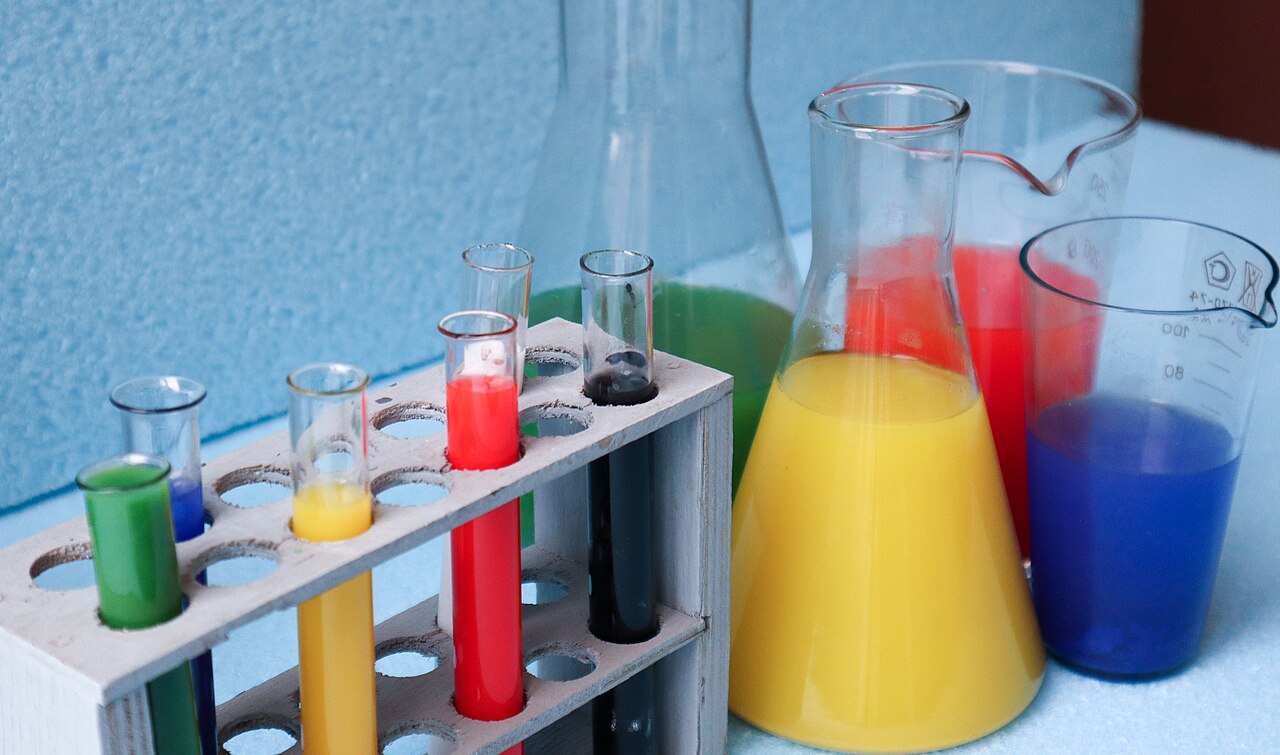
Choose apparatus suited to the measurement: preparation, transfer, and measurement are different tasks. The photograph does not establish the identity, concentration, or equilibrium state of a solution.
Photo: Belikov Maxim · Source · CC BY 4.0 · Unmodified.Phase changes are energy and equilibrium processes
At a fixed external pressure, boiling occurs when vapor pressure equals that pressure. Evaporation can occur below the boiling point because some surface molecules have enough energy to escape. In a closed container, vapor and liquid can reach dynamic equilibrium when evaporation and condensation rates are equal.
During a phase change at constant pressure for a pure substance, supplied energy can change intermolecular arrangement rather than temperature. Temperature measures average kinetic energy in the model, not the total energy of all particles in the sample. More material can have more total thermal energy at the same temperature.
PAUSE & TRY IT
Why can a liquid evaporate below its boiling point?
Reveal answer
Some surface molecules have sufficient energy to escape even when vapor pressure is below external pressure.
Ideal gases are a useful limiting model
The ideal-gas equation connects pressure, volume, amount, and absolute temperature. Use compatible units for R and convert temperature to kelvin. At the same temperature, different gases have the same average translational kinetic energy, but lighter particles have a greater average speed.
Real gases deviate when particle volume and attractions are important, especially at high pressure and low temperature. Partial pressures add for an ideal mixture. A gas collected over water includes water vapor, so subtract its vapor pressure from the measured total before calculating the amount of dry gas.
Read figure values as text
Constant n and T: 2: 6; 2.25: 5.333333333333333; 2.5: 4.8; 2.75: 4.363636363636363; 3: 4; 3.25: 3.6923076923076925; 3.5: 3.4285714285714284; 3.75: 3.2; 4: 3; 4.25: 2.823529411764706; 4.5: 2.6666666666666665; 4.75: 2.526315789473684; 5: 2.4; 5.25: 2.2857142857142856; 5.5: 2.1818181818181817; 5.75: 2.0869565217391304; 6: 2; 6.25: 1.92; 6.5: 1.8461538461538463; 6.75: 1.7777777777777777; 7: 1.7142857142857142; 7.25: 1.6551724137931034; 7.5: 1.6; 7.75: 1.5483870967741935; 8: 1.5; 8.25: 1.4545454545454546; 8.5: 1.411764705882353; 8.75: 1.3714285714285714; 9: 1.3333333333333333; 9.25: 1.2972972972972974; 9.5: 1.263157894736842; 9.75: 1.2307692307692308; 10: 1.2; 10.25: 1.170731707317073; 10.5: 1.1428571428571428; 10.75: 1.1162790697674418; 11: 1.0909090909090908; 11.25: 1.0666666666666667; 11.5: 1.0434782608695652; 11.75: 1.0212765957446808; 12: 1
Dissolving involves several energetic changes
Solution formation involves separating solute particles, separating some solvent particles, and forming solute–solvent interactions. A substance dissolves favorably only when the combined energetic and dispersal effects favor the process. “Like dissolves like” is a useful pattern, not a complete thermodynamic explanation.
Molarity is moles of solute per liter of solution. Dilution changes concentration by changing solution volume without changing solute amount, provided none is lost or reacts. A preparation should dissolve the solute and then bring the final solution to the mark, rather than add the stated final volume of water to the solid.
Separation and light reveal particle interactions
Chromatography separates components because they interact differently with stationary and mobile phases. Greater attraction to the stationary phase generally reduces travel under otherwise matched conditions. A retention or travel value is meaningful only with the method and solvent system specified.
Absorbance can be proportional to concentration and path length under suitable Beer–Lambert conditions. A calibration curve should use a blank and standards across an appropriate range. Electronic, vibrational, and other energy transitions depend on the kind of radiation and the substance; the observed spectrum is evidence about allowed energy differences.
PAUSE & TRY IT
Why does a stronger stationary-phase interaction reduce chromatographic travel?
Reveal answer
The component spends more time associated with the stationary phase and less time moving with the mobile phase.
PAUSE & TRY IT
What happens to absorbance if concentration doubles in the linear calibration range?
Reveal answer
Absorbance doubles if path length and molar absorptivity remain constant.
Compare intermolecular forces without using one label as a ranking
All atoms and molecules exhibit London dispersion forces. Polar molecules can also have dipole interactions, and suitable N–H, O–H, or F–H groups can participate in hydrogen bonding with appropriate partners. The existence of one force type does not remove the others. Large, polarizable electron clouds can produce strong dispersion even in nonpolar substances.
To compare boiling points, consider the total attractions, molecular size, shape, and contact area. Boiling separates molecules into a gas; it does not normally break their internal covalent bonds. A branched and an unbranched molecule of the same formula may differ in surface contact and therefore in physical properties. Use several pieces of structural evidence rather than a memorized force hierarchy alone.
PAUSE & TRY IT
At equal temperature, do helium and argon atoms have equal average speeds?
Reveal answer
No. They have equal average translational kinetic energy; lighter helium atoms move faster on average.
Gas mixtures and departures from the ideal model
The ideal-gas model neglects particle volume and attractions. It works best at relatively low pressure and high temperature, where particles are far apart compared with their size. At high pressure, finite particle volume matters; at lower temperature, attractions can substantially influence measured pressure. Explain which assumption fails instead of merely saying a gas is “not ideal.”
For an ideal mixture, total pressure is the sum of partial pressures, and a gas’s partial pressure equals its mole fraction times total pressure. Gases at the same temperature have the same average translational kinetic energy, but lighter particles have greater characteristic speeds. Equal temperature therefore does not mean equal speed.
PAUSE & TRY IT
Why should an absorbance measurement stay within the calibrated range?
Reveal answer
The relationship may deviate from linearity or become unreliable outside that range.
Choose an analytical method from particle interactions
Chromatography separates components because they interact differently with the stationary and mobile phases. A component strongly attracted to the stationary phase travels less under the same conditions. Distillation uses differences in volatility; filtration separates a suitable solid from a fluid but cannot remove dissolved ions simply because they are unwanted.
Absorbance measurements can estimate concentration using a calibration relationship such as A=εbc over an appropriate range. Use a blank to account for solvent and apparatus contributions. Dilute a sample whose signal lies outside the reliable calibration range, then account for the dilution factor. A calibration line is an empirical relationship with limits, not permission to extrapolate indefinitely.
Read figure values as text
Calibration: 0: 0; 0.20833333333333334: 0.016666666666666666; 0.4166666666666667: 0.03333333333333333; 0.625: 0.05; 0.8333333333333334: 0.06666666666666667; 1.0416666666666667: 0.08333333333333334; 1.25: 0.1; 1.4583333333333333: 0.11666666666666667; 1.6666666666666667: 0.13333333333333333; 1.875: 0.15; 2.0833333333333335: 0.16666666666666669; 2.2916666666666665: 0.18333333333333332; 2.5: 0.2; 2.7083333333333335: 0.21666666666666667; 2.9166666666666665: 0.23333333333333334; 3.125: 0.25; 3.3333333333333335: 0.26666666666666666; 3.5416666666666665: 0.2833333333333333; 3.75: 0.3; 3.9583333333333335: 0.3166666666666667; 4.166666666666667: 0.33333333333333337; 4.375: 0.35000000000000003; 4.583333333333333: 0.36666666666666664; 4.791666666666667: 0.38333333333333336; 5: 0.4; 5.208333333333333: 0.41666666666666663; 5.416666666666667: 0.43333333333333335; 5.625: 0.45; 5.833333333333333: 0.4666666666666667; 6.041666666666667: 0.4833333333333334; 6.25: 0.5; 6.458333333333333: 0.5166666666666666; 6.666666666666667: 0.5333333333333333; 6.875: 0.55; 7.083333333333333: 0.5666666666666667; 7.291666666666667: 0.5833333333333334; 7.5: 0.6; 7.708333333333333: 0.6166666666666667; 7.916666666666667: 0.6333333333333334; 8.125: 0.65; 8.333333333333334: 0.6666666666666667; 8.541666666666666: 0.6833333333333333; 8.75: 0.7000000000000001; 8.958333333333334: 0.7166666666666667; 9.166666666666666: 0.7333333333333333; 9.375: 0.75; 9.583333333333334: 0.7666666666666667; 9.791666666666666: 0.7833333333333333; 10: 0.8
Compare intermolecular forces using all relevant features
All atoms and molecules exhibit dispersion interactions. Their importance increases with polarizability and depends on contact geometry. Polar molecules can also exhibit dipole–dipole interactions. Hydrogen bonding is a particular strong interaction involving suitable donors and acceptors; in common course examples, hydrogen covalently attached to N, O or F can act as a donor.
Do not rank substances by the name of one force alone. A large, highly polarizable nonpolar molecule can have stronger total attractions than a small polar one. Compare molar mass, shape and functional groups before explaining boiling behavior. Within a useful controlled comparison, stronger intermolecular attractions generally require more energy to separate molecules and are associated with lower vapor pressure at a given temperature.
A phase change does not normally break the covalent bonds within intact molecules. During a boiling plateau at fixed pressure, supplied energy supports phase change rather than raising temperature. Evaporation can occur below the boiling point because a distribution of molecular energies includes molecules able to escape from the surface.
Explain gas equations with a particle model
Pressure results from collisions with container walls. At fixed temperature, compressing a fixed amount of ideal gas increases collision frequency per area and raises pressure. Raising absolute temperature increases average translational kinetic energy. Equal temperatures imply equal average kinetic energies, not equal average molecular speeds for gases of different molar masses.
Use kelvin in proportional gas relationships and keep pressure, volume and R units consistent. In an ideal mixture, each component’s partial pressure depends on its own amount at the shared volume and temperature. Adding an inert gas at fixed volume raises total pressure without changing the partial pressure of an unchanged component.
Real gases depart from the idealization when particle volume and intermolecular attractions matter. High density makes finite volume significant; attractions can reduce the pressure relative to a simple ideal prediction in an appropriate regime. State which neglected feature explains the particular observation rather than asserting that all deviations have one sign.
PAUSE & TRY IT
Equal-temperature He and Ar samples have the same average kinetic energy. Must they have the same average speed?
Reveal answer
No. The lighter He particles move faster on average to have the same average translational kinetic energy.
Treat solutions and analytical measurements quantitatively
Molarity uses moles of solute per liter of solution, not per liter of solvent initially poured. A dilution conserves solute amount when no solute is lost or reacts: the concentration falls as total solution volume rises. Dissolving may involve breaking solute–solute and solvent–solvent attractions and forming new interactions. Solubility depends on the overall balance, not on one attractive interaction alone.
Chromatography separates substances by differences in their interactions with mobile and stationary phases. Greater retention in the stationary phase generally means less travel under the same conditions. A spot starting below the solvent surface can dissolve into the reservoir and invalidate the intended comparison. Interpret distances relative to the solvent front and the stated procedure.
For a valid Beer–Lambert calibration, absorbance is proportional to concentration when path length and other relevant conditions are fixed. Use a blank to account for the solvent and apparatus baseline. A sample outside the validated concentration range should be diluted and its dilution factor retained; extrapolating a convenient straight line does not establish that the detector or chemistry stays linear.
Explain phase changes through particle interactions
During boiling, molecules separate from one another; their internal covalent bonds ordinarily remain intact. Stronger intermolecular attractions generally require more energy to separate comparable particles, but compare size, shape, polarizability, and hydrogen-bonding opportunities together rather than using one label mechanically.
At a phase-change plateau under appropriate constant-pressure conditions, added energy changes phase rather than increasing temperature. Particle kinetic-energy interpretations therefore differ from those during warming within one phase. Use the correct equation for each segment: mcΔT for temperature change and an amount times phase-change enthalpy for a transition.
A liquid’s equilibrium vapor pressure increases with temperature. Boiling occurs when vapor pressure matches external pressure, so changing external pressure changes boiling temperature. A lower boiling point at high altitude does not imply that the water molecules have changed chemical identity.
Model gases and solutions with explicit quantities
PV=nRT requires absolute temperature and consistent units for R. Use pressure in the units matched to the chosen gas constant and volume in the corresponding units. For a mixture behaving ideally, partial pressures sum and each component’s partial pressure is related to its mole fraction.
Ideal behavior becomes less accurate when particle volume and intermolecular interactions matter strongly, often at high pressure or low temperature. A deviation is explained through those assumptions, not by saying the gas law randomly fails. Compare the actual conditions and species.
Molarity is moles of solute per liter of solution. Dilution conserves the amount of solute only if no reaction or loss occurs. The final solution volume is not always the arithmetic sum of liquid volumes in precise work, so use the stated or measured final volume.
PAUSE & TRY IT
Why use Kelvin in PV=nRT?
Reveal answer
The model uses absolute temperature, proportional to the relevant kinetic-energy scale. Celsius has an offset zero.
FROM IDEA TO APPLICATION
Worked examples
Prepare a dilution
How much 0.50 M stock is needed to make 250 mL of 0.080 M solution?
Reveal worked solution
- M1V1 = M2V2 gives V1 = (0.080).
- V1 = 40 mL.
- Measure the stock and dilute to a total volume of 250 mL.
Use 40 mL stock, then add solvent to the final 250 mL mark.
Correct a gas pressure
Gas collected over water has total pressure 755 torr. Water vapor pressure is 24 torr. Find the dry-gas pressure.
Reveal worked solution
- Total pressure includes both the collected gas and water vapor.
- P(dry gas) = 755 − 24.
731 torr. Convert this pressure if the chosen gas constant uses other units.
A dilution with a measured concentration
A 5.00 mL sample is diluted to 50.0 mL. The diluted sample has concentration 0.0120 M. Find the original concentration.
Reveal worked solution
- The dilution factor is =10.0.
- Moles are conserved during dilution when no reaction occurs.
- Multiply the diluted concentration by the dilution factor.
0.120 M.
Connect dilution to a calibration
A sample is diluted from 5.00 mL to 50.0 mL. The diluted concentration from a valid calibration is 0.0120 M. Find the original concentration.
Reveal worked solution
- The dilution factor is =10.0.
- The diluted sample contains the same solute amount as the original aliquot.
- Original concentration is 10.0×0.0120=0.120 M.
The original sample is 0.120 M, assuming no reaction or solute loss.
Partial pressure
An ideal mixture contains 2 mol of gas A and 3 mol of gas B at total pressure 4 atm.
Reveal worked solution
- Mole fraction of A is .
- PA=()(4)=1.6 atm.
- PB=2.4 atm and the sum is 4 atm.
Partial pressures follow mole fractions under the ideal-mixture model.
A dilution amount
How much 0.50 M stock makes 250 mL of 0.10 M solution?
Reveal worked solution
- M1V1=M2V2.
- V1==50 mL.
Use 50 mL stock and dilute to a final volume of 250 mL, not by adding 250 mL water.
MAKE THE DISTINCTION
Common mistakes, clearer reasoning
The trapEqual temperature means equal molecular speed.
The better explanationIt means equal average translational kinetic energy; speed depends on particle mass.
The trapDilution changes the number of moles of solute.
The better explanationIdeal dilution changes volume and concentration while preserving solute amount.
RETRIEVE BEFORE YOU REVEAL
Practice checkpoints
Revisit the quick checks from this guide without looking back. Explain why, then reveal the answer.
1. Why does a stronger stationary-phase interaction reduce chromatographic travel?
Reveal answer
The component spends more time associated with the stationary phase and less time moving with the mobile phase.
2. What happens to absorbance if concentration doubles in the linear calibration range?
Reveal answer
Absorbance doubles if path length and molar absorptivity remain constant.
3. Why can a liquid evaporate below its boiling point?
Reveal answer
Some surface molecules have sufficient energy to escape even when vapor pressure is below external pressure.
4. At equal temperature, do helium and argon atoms have equal average speeds?
Reveal answer
No. They have equal average translational kinetic energy; lighter helium atoms move faster on average.
5. Why should an absorbance measurement stay within the calibrated range?
Reveal answer
The relationship may deviate from linearity or become unreliable outside that range.
6. Equal-temperature He and Ar samples have the same average kinetic energy. Must they have the same average speed?
Reveal answer
No. The lighter He particles move faster on average to have the same average translational kinetic energy.
7. Why use Kelvin in PV=nRT?
Reveal answer
The model uses absolute temperature, proportional to the relevant kinetic-energy scale. Celsius has an offset zero.
Key language
- Polarizability
- How readily an electron distribution is distorted.
- Vapor pressure
- The pressure of vapor in equilibrium with its condensed phase.
- Molarity
- Moles of solute per liter of solution.
- Absorbance
- A logarithmic measure of light attenuation by a sample.
Particle interactions and concentration underpin reaction rates, equilibrium, and acid–base chemistry.