
On this page0% through guide
Compound Structure and Properties
Bonding models connect electron distribution to shape and bulk behavior.
What you’ll learn
- Distinguish bonding within substances from attractions between molecules.
- Build and evaluate Lewis structures.
- Connect molecular geometry and polarity to properties.
Before you begin
Valence electrons are the electrons most directly involved in bonding. A Lewis structure tracks electron pairs; it is not a literal picture of fixed electron positions. Molecular geometry and electron-domain geometry are related but not identical when lone pairs are present.
Explain these starting ideas in your own words. Revisit them whenever a later step feels unclear.
Attractions lower energy at a preferred separation
A chemical bond reflects a balance of attractive and repulsive interactions. As two suitable atoms approach, attraction can lower potential energy; at very short separation, repulsion raises it steeply. The equilibrium bond length occurs near the energy minimum. Breaking a bond requires energy; bond formation releases energy.
Ionic, covalent, and metallic descriptions emphasize different electron arrangements. Ionic solids contain extended arrays of ions, not isolated molecules of each formula unit. Metallic bonding involves mobile electrons and an extended lattice, helping explain conductivity and malleability. Covalent bonding involves shared electron density, with unequal sharing when the bonded atoms differ in electronegativity.
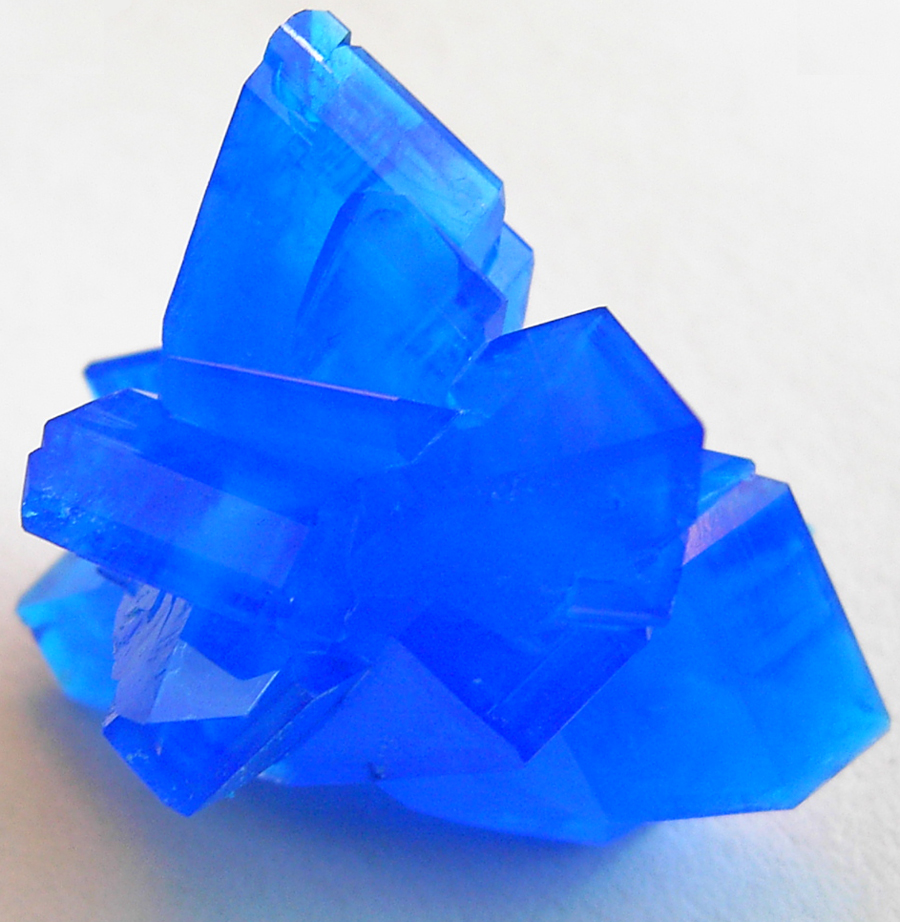
Crystal faces reflect an ordered internal structure. This is copper(II) sulfate pentahydrate; the photograph does not resolve individual ions or water molecules.
Photo: Stephanb · Source · CC BY-SA 3.0 · Unmodified.Attraction between oppositely charged ions extends through a three-dimensional lattice. The diagram is a simplified slice, not the specific crystal structure of every salt.
Lewis structures account for electrons
Count total valence electrons, adjusting for overall charge. Connect atoms, place remaining electrons, and consider multiple bonds when needed. Formal charge is an accounting tool that can help compare plausible structures; it is not the same as a directly measured partial charge. Structures must preserve the total electron count.
Some species require resonance descriptions. Resonance structures are alternative drawings of one delocalized electronic structure, not molecules rapidly switching between ordinary single and double bonds. Equivalent bonds in the actual species can have lengths between typical single and double bonds.
Read figure values as text
Pair potential: 0.95: 1.9609746568876094; 0.9927083333333333: 0.18761438199889113; 1.0354166666666667: -0.6117752199917073; 1.078125: -0.9251715286199331; 1.1208333333333333: -0.9999234286308314; 1.1635416666666667: -0.9623663858956454; 1.2062499999999998: -0.8769682283171136; 1.2489583333333332: -0.7761925724614348; 1.2916666666666665: -0.6758437745344839; 1.3343749999999999: -0.5830625161449072; 1.3770833333333332: -0.5005336843203265; 1.4197916666666666: -0.42871247462217615; 1.4625: -0.3670010610654993; 1.5052083333333333: -0.31436475845057316; 1.5479166666666666: -0.26964747041957665; 1.5906249999999997: -0.23172592363807545; 1.6333333333333333: -0.19957815910559246; 1.6760416666666664: -0.1723072714955305; 1.71875: -0.14914264644177722; 1.7614583333333331: -0.12943069150631614; 1.8041666666666667: -0.11262142632557309; 1.8468749999999998: -0.09825420751233468; 1.8895833333333332: -0.08594417790746006; 1.9322916666666665: -0.07537012215476864; 1.9749999999999999: -0.06626393434341543; 2.017708333333333: -0.05840166514098634; 2.060416666666667: -0.051596007219727444; 2.103125: -0.045690038353175554; 2.145833333333333: -0.040552037643058876; 2.1885416666666666: -0.03607120335474343; 2.2312499999999997: -0.03215412074177863; 2.2739583333333333: -0.02872184975913614; 2.3166666666666664: -0.025707523097685068; 2.359375: -0.023054363376728428; 2.402083333333333: -0.020714044243327144; 2.4447916666666667: -0.01864533357891987; 2.4875: -0.016812968221502154; 2.5302083333333334: -0.015186718860340401; 2.5729166666666665: -0.013740611343967604; 2.6156249999999996: -0.012452276835268419; 2.658333333333333: -0.011302408292154618; 2.701041666666667: -0.010274304856036774; 2.74375: -0.009353489066879167; 2.786458333333333: -0.008527384536881542; 2.8291666666666666: -0.0077850439226024885; 2.8718749999999997: -0.007116918833601204; 2.9145833333333333: -0.006514664782268524; 2.9572916666666664: -0.0059709754774145; 3: -0.0054794417442387755
PAUSE & TRY IT
What must the sum of formal charges equal?
Reveal answer
The overall charge of the species.
Electron domains predict geometry
Electron domains repel and tend to arrange to reduce repulsions. A single, double, or triple bond counts as one domain in a basic VSEPR description. Molecular geometry describes the positions of atoms, while electron-domain geometry also includes lone pairs. Two species with the same number of domains can therefore have different molecular shapes.
Lone pairs can compress bond angles relative to idealized values because their electron density occupies space near the central atom. Use the actual electron-domain count and lone-pair arrangement rather than inferring shape from the number of attached atoms alone.
PAUSE & TRY IT
Does a double bond count as two VSEPR domains?
Reveal answer
No. It counts as one electron domain for the basic geometry model.
Molecular polarity is a vector result
A polar bond has an uneven electron distribution. A molecule’s overall dipole depends on both bond dipoles and geometry. Symmetrically arranged dipoles can cancel; an asymmetric shape can leave a net dipole. The statement “contains polar bonds” is not sufficient to conclude that a molecule is polar.
For example, ideal linear CO2 has two opposing C–O bond dipoles and no net permanent molecular dipole. Bent H2O has bond dipoles that do not cancel. Geometry also matters in molecular recognition because a binding site encounters a three-dimensional arrangement of charge and shape.
Extended structures determine bulk properties
Network covalent solids have covalent connections across an extended structure and often require substantial energy to disrupt. Molecular solids are held together by intermolecular attractions between discrete molecules, while ionic solids are stabilized by electrostatic interactions among ions. These structural categories help explain melting points and conductivity.
Solid ionic compounds generally do not conduct well because the ions are fixed in place. Melting or dissolving can make ions mobile. A molecular liquid does not become an electrolyte simply because it is liquid; mobile charged particles are needed. Identify the particles that carry charge in each phase.
PAUSE & TRY IT
Why can molten NaCl conduct when solid NaCl does not?
Reveal answer
The molten phase has mobile ions; the solid lattice restricts their motion.
A complete Lewis-structure procedure
Count all valence electrons, adding for negative charge and subtracting for positive charge. Choose a reasonable skeleton, connect atoms with single bonds, complete outer-atom octets where appropriate, and place remaining electrons on the central atom. If needed, form multiple bonds while respecting relevant octet exceptions. Recount the electrons at the end.
Formal charge assigns half of each bonding pair to each bonded atom. Compare plausible structures using charge placement and chemical context, but do not confuse formal charge with actual partial charge. Resonance structures differ in electron placement while retaining the same atomic connections. The real molecule is not rapidly switching between drawings; the drawings contribute to a model of delocalized electron density.
PAUSE & TRY IT
Does a double bond count as two electron domains in VSEPR?
Reveal answer
No. It is one region of electron density around the central atom.
From electron domains to molecular polarity
A single, double, or triple bond counts as one electron domain in the usual VSEPR model. Lone pairs also count as domains and can alter bond angles. First determine the arrangement of all domains, then describe the positions of atoms to name the molecular shape. For example, four domains can produce tetrahedral, trigonal-pyramidal, or bent molecular shapes depending on lone pairs.
Bond dipoles are vectors. A molecule with polar bonds can be nonpolar when the geometry makes their effects cancel. Conversely, an asymmetric arrangement can give a net dipole. Use the actual three-dimensional geometry rather than a flat Lewis drawing. A claim about polarity should name both the polar bonds and whether their orientations cancel.
PAUSE & TRY IT
What remains fixed between resonance structures?
Reveal answer
The atomic connectivity remains fixed; electron placement changes.
Explain bulk behavior with the correct structural model
Ionic solids consist of extended arrangements of ions. Molecular solids contain discrete molecules attracted to one another. Network covalent solids contain extended covalent bonding, and metals contain mobile electrons in an extended structure. These categories lead to different explanations of melting, conductivity, and mechanical behavior.
An ionic solid can fail to conduct while solid because its ions cannot move freely, yet conduct when molten or dissolved if mobile ions are present. A metal conducts through mobile electrons. Melting a molecular solid generally overcomes intermolecular attractions rather than breaking every covalent bond within each molecule. Select the particles and interactions actually present before explaining a macroscopic property.
Construct a structure before assigning properties
Count total valence electrons, adjusting for overall charge. Establish atom connectivity, place bonds, complete appropriate outer shells, and then check the central atom and total electron count. Hydrogen has a duet, not an octet. A plausible drawing must account for every electron and the stated net charge. Formal charge is a bookkeeping model that helps compare contributors; it is not generally identical to a measured localized ionic charge.
Resonance contributors preserve atom positions and differ in electron placement. The molecule does not switch back and forth between isolated drawings. Equivalent contributors can predict equivalent bond lengths intermediate between simple single- and double-bond expectations. Do not move an atom or change total charge while claiming merely to draw another resonance contributor.
Before applying a trend, identify the species. A molecular ion, a neutral molecule, a metal and an ionic lattice are different structural situations. In an ionic solid, a formula such as NaCl describes a ratio throughout an extended structure, not a collection of isolated diatomic molecules.
Connect electron domains to shape and net polarity
VSEPR uses regions of electron density around a central atom. A single, double or triple bond each counts as one domain for the basic geometry. Lone pairs count in the electron-domain arrangement but are omitted when naming the arrangement of atoms. Thus an atom with three bonds and one lone pair has four domains, a tetrahedral domain arrangement and a trigonal-pyramidal molecular geometry.
Bond polarity follows unequal electron sharing, but molecular polarity is a vector sum. Symmetrically arranged equal bond dipoles can cancel. CO2 has polar bonds yet no permanent molecular dipole in its linear structure; a bent arrangement can prevent cancellation. A formula alone may not reveal the geometry, so establish the Lewis model first.
Use the complete argument: electronegativity difference gives bond dipoles; geometry determines their directions; their vector sum determines a net dipole. Merely stating “it has a lone pair” or “it contains oxygen” is not a generally sufficient polarity explanation. Consider whether the actual arrangement has symmetry and whether the surrounding atoms are equivalent.
Relate bulk properties to the particles that can move
Conductivity requires mobile charged particles. Ions in an ordinary ionic crystal are constrained, while melting or dissolving can allow them to move. A metal conducts through mobile electrons in its bonding model. A molecular substance can dissolve without producing appreciable ions, so solubility and electrical conductivity are not synonyms.
Melting a molecular solid usually overcomes attractions between molecules; breaking a covalent network disrupts bonding throughout an extended structure. This distinction explains why a small molecular substance and a network solid made from similar elements can have very different properties. Avoid calling all attractions “bonds” without specifying which particles are interacting.
A potential-energy curve has a minimum at a preferred separation because attractive and repulsive contributions balance there. At much shorter distances, repulsion becomes large. The depth of the energy well relates to separation energy, whereas the position of the minimum relates to bond length. Neither axis alone establishes every macroscopic property of a substance.
PAUSE & TRY IT
Why can molten NaCl conduct while solid NaCl conducts poorly?
Reveal answer
Melting permits ionic motion. The solid contains charges too, but they are not free to carry current through the lattice in the same way.
Build a Lewis structure and then predict geometry
Count total valence electrons, adjusting for ionic charge. Choose a plausible skeleton, connect atoms, complete appropriate outer shells, and place remaining electrons. If needed, use multiple bonds to satisfy electron requirements while evaluating formal charges. A structure must conserve the total electron count.
Formal charge is an accounting tool, not the same as measured partial charge. Resonance structures share atom positions and differ in electron placement; the actual molecule is not rapidly switching between separate drawings. Equivalent resonance can make bonds intermediate between simple single and double descriptions.
Electron-domain geometry counts bonding regions and lone pairs around a center, while molecular geometry describes atom positions. A double bond counts as one domain for this purpose. Lone pairs affect shape and bond angles, and molecular polarity depends on vector cancellation of bond dipoles in the actual geometry.
PAUSE & TRY IT
Does a double bond count as two electron domains in VSEPR?
Reveal answer
No. It is one region of electron density for electron-domain counting.
Connect microscopic bonding to bulk evidence
An ionic solid’s rigid lattice prevents ions from moving freely, while molten or dissolved ions can carry current if mobile charged species are present. A metal conducts through mobile electrons. A molecular solid can contain polar molecules yet be a poor conductor because polarity alone does not supply freely mobile charge carriers.
Network covalent solids contain extended bonded structures rather than separate small molecules held together only by intermolecular forces. Their properties depend on the network and bonding; avoid assigning all solids to the same melting or conductivity rule.
For a bond-energy curve, the minimum indicates a stable separation in the model. Shorter distances produce strong repulsion; separating the pair from the minimum requires energy. The depth of the potential well and the position of its minimum represent different properties, so a shorter bond is not simply the same statement as a deeper well.
FROM IDEA TO APPLICATION
Worked examples
Geometry before polarity
Compare CO2 and H2O. Both have two atoms bonded to a central atom. Why is only one polar?
Reveal worked solution
- CO2 has two bonding domains around carbon and is linear.
- H2O has two bonding domains and two lone pairs around oxygen, giving a bent molecular shape.
- Opposing equal dipoles cancel in CO2; the angled O–H dipoles do not cancel in water.
H2O is polar; CO2 is nonpolar despite its polar bonds.
Bond-energy accounting
A model reaction breaks bonds requiring 600 kJ per mole of reaction and forms bonds releasing 740 kJ. Estimate the reaction enthalpy.
Reveal worked solution
- Use energy required for breaking minus energy released by formation.
- 600 − 740 = −140 kJ per mole of reaction.
Approximately −140 kJ/mol of reaction: exothermic. Bond energies are average values, so this is an estimate.
Polar bonds without a polar molecule
Explain why CO2 can be nonpolar even though each C–O bond is polar.
Reveal worked solution
- The two bonding domains around carbon produce a linear molecular geometry.
- The two equal bond dipoles point in opposite directions.
- Their vector sum cancels.
The molecule has no net dipole in its symmetric linear structure; the individual bonds remain polar.
Use a structure to predict polarity
Compare BF3 and NH3 using electron domains and bond-dipole directions.
Reveal worked solution
- BF3 has three bonding domains around boron and a trigonal-planar molecular arrangement in the basic model.
- Its three equivalent bond dipoles cancel by symmetry.
- NH3 has three bonds and one lone pair around nitrogen, producing a trigonal-pyramidal arrangement. Its bond dipoles do not cancel.
BF3 is nonpolar in this model; NH3 has a net molecular dipole.
Shape and net polarity
Compare BF3 and NH3 using their ideal molecular geometries.
Reveal worked solution
- BF3 is trigonal planar with equivalent surrounding atoms; bond dipoles cancel by symmetry.
- NH3 is trigonal pyramidal because of a lone pair; its bond dipoles do not cancel.
BF3 is nonpolar in the ideal geometry, while NH3 has a net dipole.
Conduction evidence
A solid does not conduct, but its melt does. What model is consistent with this?
Reveal worked solution
- An ionic lattice holds ions in fixed positions in the solid.
- Melting allows ions to move and carry charge.
The evidence is consistent with an ionic solid, though additional evidence may be needed for identification.
MAKE THE DISTINCTION
Common mistakes, clearer reasoning
The trapBreaking bonds releases stored energy.
The better explanationBreaking bonds costs energy. Net reaction energy depends on both bonds broken and bonds formed.
The trapResonance drawings are separate rapidly interconverting molecules.
The better explanationThey represent one delocalized structure that a single localized drawing does not fully describe.
RETRIEVE BEFORE YOU REVEAL
Practice checkpoints
Revisit the quick checks from this guide without looking back. Explain why, then reveal the answer.
1. Why can molten NaCl conduct when solid NaCl does not?
Reveal answer
The molten phase has mobile ions; the solid lattice restricts their motion.
2. Does a double bond count as two VSEPR domains?
Reveal answer
No. It counts as one electron domain for the basic geometry model.
3. What must the sum of formal charges equal?
Reveal answer
The overall charge of the species.
4. Does a double bond count as two electron domains in VSEPR?
Reveal answer
No. It is one region of electron density around the central atom.
5. What remains fixed between resonance structures?
Reveal answer
The atomic connectivity remains fixed; electron placement changes.
6. Why can molten NaCl conduct while solid NaCl conducts poorly?
Reveal answer
Melting permits ionic motion. The solid contains charges too, but they are not free to carry current through the lattice in the same way.
7. Does a double bond count as two electron domains in VSEPR?
Reveal answer
No. It is one region of electron density for electron-domain counting.
Key language
- Formal charge
- A bookkeeping assignment of electrons to atoms.
- Resonance
- Use of multiple valid electron drawings to represent delocalization.
- Dipole
- A separation of positive and negative charge.
- Network solid
- A solid with an extended covalent bonding structure.
Geometry and charge distribution determine the intermolecular forces used to explain liquids, solutions, and gases.