
On this page0% through guide
Chemical Reactions
Represent chemical change at particle, symbolic, and quantitative levels.
What you’ll learn
- Write balanced molecular and net ionic equations.
- Identify limiting reagents and calculate yields.
- Connect titration and redox measurements to stoichiometry.
Before you begin
A balanced equation conserves atoms and charge. Coefficients give mole ratios, not mass ratios. A spectator ion appears unchanged on both sides of a complete ionic equation and is omitted from the net ionic equation.
Explain these starting ideas in your own words. Revisit them whenever a later step feels unclear.
Conserve atoms and charge
A chemical equation represents rearrangement of atoms, not conversion of one ordinary element into another. Balance by changing coefficients, not subscripts in chemical formulas. In an ionic equation, both total atom count and total charge must be conserved. Include phases because they determine which species are separated into ions.
A particle diagram can distinguish a limiting reactant from an excess reactant. The reactant with the smaller amount is not automatically limiting: compare available amounts relative to their stoichiometric coefficients. Leftover excess reactant can remain after the reaction reaches its limiting-reactant yield.
Net ionic equations isolate the chemical event
Strong aqueous electrolytes are represented as separated ions in a complete ionic equation. Weak electrolytes, solids, liquids such as water, and gases remain intact. Spectator ions appear unchanged on both sides and cancel from the net ionic equation.
Precipitation forms a low-solubility solid from dissolved species. Acid–base reactions transfer protons, and redox reactions transfer electrons. Some reactions fit more than one descriptive category. Use the actual species and conditions instead of assuming every mixture reacts simply because two solutions are combined.
- Balanced equationCoefficients set mole ratios, not mass ratios.
- Available molesConvert each reactant amount using molar mass or concentration × volume.
- Limiting amountCompare possible product amounts, then determine yield and excess.
PAUSE & TRY IT
What is the net ionic equation for strong acid plus strong base?
Reveal answer
H+(aq) + OH-(aq) → H2O(l), or an equivalent hydronium-based equation.
PAUSE & TRY IT
Why must precipitates remain intact in an ionic equation?
Reveal answer
They are not dissolved freely moving ions; forming the solid is the chemical event.
Stoichiometry links measurements to amount
Convert measured mass or concentration and volume to moles, apply the balanced-equation ratio, and convert to the requested quantity. The theoretical yield assumes complete limiting-reactant conversion by the stated reaction. Percent yield compares isolated actual product to that theoretical amount.
A yield above 100% usually indicates that the collected material contains solvent, impurities, or another measurement problem; it is not evidence that atoms were created. Trace an experimental error through the amount calculation. Loss of product during transfer lowers isolated yield even if the reaction itself proceeded well.
PAUSE & TRY IT
What would residual water on a collected product do to measured yield?
Reveal answer
It adds measured mass and can make the apparent yield too high.
Titration depends on reaction stoichiometry
At equivalence, the added titrant and analyte have reacted in the balanced-equation ratio. Equal moles apply only to a 1:1 reaction. The endpoint is the experimental signal used to estimate equivalence; an indicator or instrument should respond near the desired reaction completion.
Read a buret by subtracting initial from final volume. Rinse equipment appropriately and remove air bubbles from the tip. Overshooting an acid sample with extra base makes the calculated acid amount too high if all delivered base is incorrectly attributed to reaction with the sample.
Read figure values as text
Stoichiometric maximum: 0: 0; 0.016666666666666666: 0.025; 0.03333333333333333: 0.05; 0.05000000000000001: 0.07500000000000001; 0.06666666666666667: 0.1; 0.08333333333333333: 0.125; 0.10000000000000002: 0.15000000000000002; 0.11666666666666668: 0.17500000000000002; 0.13333333333333333: 0.2; 0.15: 0.22499999999999998; 0.16666666666666666: 0.25; 0.18333333333333335: 0.275; 0.20000000000000004: 0.30000000000000004; 0.21666666666666667: 0.325; 0.23333333333333336: 0.35000000000000003; 0.25: 0.375; 0.26666666666666666: 0.4; 0.2833333333333334: 0.42500000000000004; 0.3: 0.44999999999999996; 0.3166666666666667: 0.4750000000000001; 0.3333333333333333: 0.5; 0.35000000000000003: 0.525; 0.3666666666666667: 0.55; 0.38333333333333336: 0.5750000000000001; 0.4000000000000001: 0.6; 0.4166666666666667: 0.6; 0.43333333333333335: 0.6; 0.45: 0.6; 0.46666666666666673: 0.6; 0.4833333333333334: 0.6; 0.5: 0.6; 0.5166666666666667: 0.6; 0.5333333333333333: 0.6; 0.55: 0.6; 0.5666666666666668: 0.6; 0.5833333333333334: 0.6; 0.6: 0.6; 0.6166666666666667: 0.6; 0.6333333333333334: 0.6; 0.65: 0.6; 0.6666666666666666: 0.6; 0.6833333333333335: 0.6; 0.7000000000000001: 0.6; 0.7166666666666667: 0.6; 0.7333333333333334: 0.6; 0.75: 0.6; 0.7666666666666667: 0.6; 0.7833333333333333: 0.6; 0.8000000000000002: 0.6
Redox requires electron accounting
Oxidation increases oxidation number and corresponds to electron loss; reduction decreases it and corresponds to electron gain. The oxidizing agent is reduced, while the reducing agent is oxidized. Oxidation numbers are an accounting model and are not always literal ionic charges.
Balance half-reactions using the stated acidic or basic conditions, then equalize electrons before adding. Electrons must cancel from the final overall equation. A species cannot be called the oxidizing agent just because it contains oxygen; inspect the change in oxidation state.
Choose what to count in a reaction mixture
Convert each reactant amount to moles, then divide by its stoichiometric coefficient to compare reaction capacity. The smaller capacity identifies the limiting reactant. Use that reactant to find the theoretical product amount; then calculate any excess reactant remaining. Comparing initial masses directly can identify the wrong limiting reactant because different substances have different molar masses.
Percent yield compares actual isolated product with theoretical product. A yield below 100% can result from incomplete reaction or product loss. A measured value above 100% often indicates wet or contaminated product, not creation of extra matter. State a specific mechanism linking the experimental issue to the measured mass.
PAUSE & TRY IT
Why is the equivalence point not necessarily the same as the observed endpoint?
Reveal answer
Equivalence is a stoichiometric condition; the endpoint is an experimental signal with possible detection error.
Net ionic equations preserve the reacting species
Separate soluble strong electrolytes into ions when writing a complete ionic equation. Keep solids, liquids, gases, and weak electrolytes intact as appropriate. Cancel only species that appear identically on both sides. The resulting equation must still balance atoms and total charge.
For a precipitation reaction, a net ionic equation may show only the ions forming the solid. For strong-acid/strong-base neutralization, H+ and OH- form water. A weak acid remains a molecular reactant in its corresponding net ionic equation. The distinction is chemical, not a stylistic choice about whether formulas look simpler as ions.
PAUSE & TRY IT
What must balance in a net ionic equation besides atoms?
Reveal answer
Total electrical charge.
Titration calculations begin with the reaction
At an equivalence point, reactants have been combined in stoichiometric proportions. Convert titrant volume to liters, calculate titrant moles, use the balanced-equation ratio, and divide analyte moles by its original volume if concentration is requested. A 1:1 shortcut fails when the reaction ratio differs.
The endpoint is an observed signal, such as an indicator color change, intended to approximate equivalence. Overshooting adds excess titrant and can bias the calculated analyte amount upward. Rinsing a buret with water and leaving droplets inside dilutes the titrant; a calculation using its nominal concentration can then be biased. Explain the chain from apparatus condition to delivered moles to reported result.
Translate among an equation, particles and laboratory evidence
A balanced equation conserves atoms and net charge. Change coefficients, not formula subscripts, when balancing: a changed subscript describes a different chemical species. Coefficients specify ratios of reacting amounts. In a particle drawing, count complete particles of each type, then compare the numbers with the stoichiometric ratio.
A molecular equation and a net ionic equation emphasize different descriptions. Split strong aqueous electrolytes appropriately, preserve weak molecular species where relevant, and remove identical spectator ions. A precipitate remains a solid species. If all ions remain unchanged in solution and no other reaction occurs, mixing does not require a fabricated net ionic reaction.
Macroscopic observations support, but do not always uniquely identify, a chemical event. Gas evolution, precipitate formation or a temperature change can motivate a model. Use the supplied reactants, states and additional evidence to determine what changed. A color change alone is not a complete balanced equation.
Organize stoichiometry around the limiting amount
Convert initial amounts into moles before comparing reactants. Divide each available amount by its stoichiometric coefficient to compare how many reaction units each can support. The smallest value determines the limiting reactant. Use that amount to predict product, then calculate what was consumed from the excess reactant.
Theoretical yield is a stoichiometric maximum under the assumed reaction. Actual recovered product can be lower because of incomplete reaction, transfer loss, side reactions or equilibrium. A wet or contaminated product can give an apparent yield above 100%; that does not show the equation created extra atoms.
For solutions, concentration times volume gives amount only when units match. After a reaction in a mixed solution, determine remaining moles first and divide by the final relevant volume. The original concentration cannot simply be carried into a larger mixture. Separate reaction bookkeeping from the concentration calculation.
Use titration and redox measurements as accounting problems
At a stoichiometric equivalence point, reactant amounts match the balanced reaction. Equal moles apply only to a 1:1 reaction. An indicator endpoint is an observed signal chosen to approximate equivalence. Overrunning it introduces extra recorded titrant and can bias a calculated analyte amount upward if the calculation assumes all that titrant reacted with the analyte.
A buret reading is a delivered-volume difference. A bubble initially occupying the tip can make some recorded delivery fill the tip rather than reach the flask. Residual water can dilute a titrant. Trace the procedural error through concentration, recorded volume and inferred moles rather than memorizing every possible error.
In redox, oxidation is electron loss and reduction is electron gain. Half-reactions must combine so electrons cancel, with atoms and charge balanced in the specified medium. The total number of electrons transferred follows the balanced process. Oxidation numbers are an accounting tool; do not assume they always represent literal localized charges in covalent molecules.
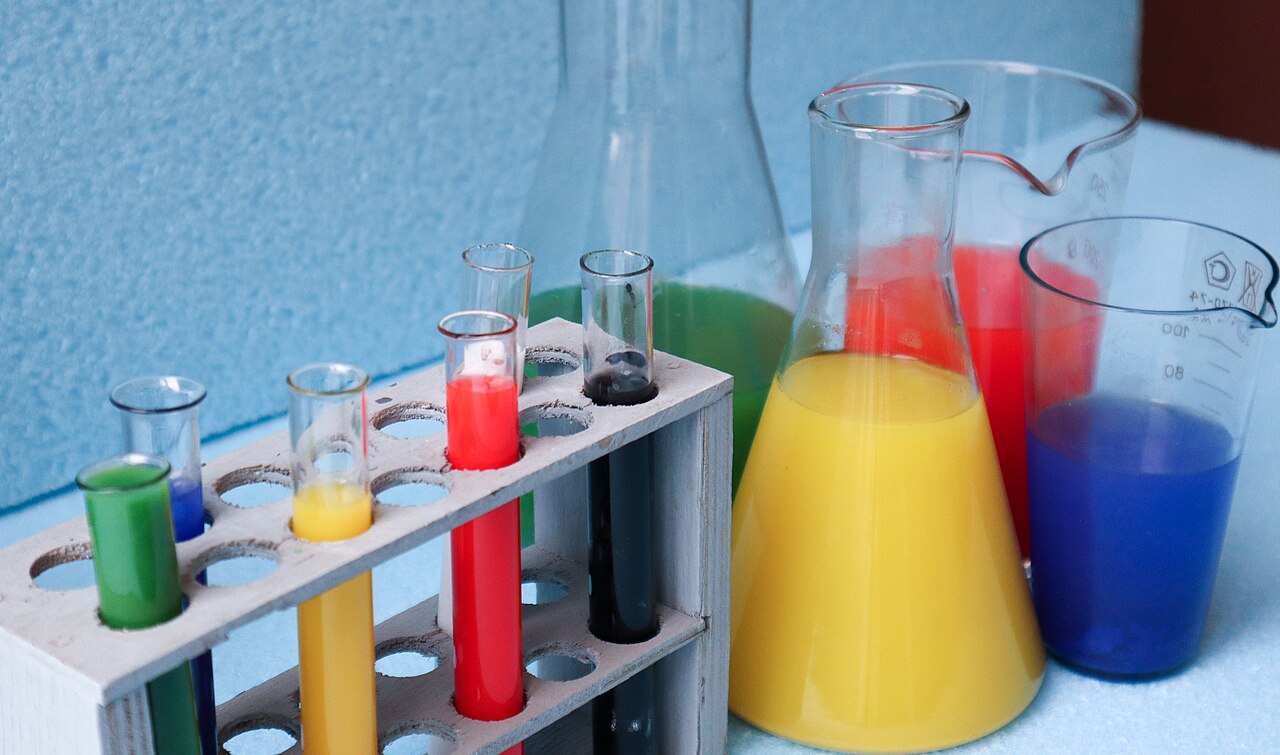
Choose apparatus suited to the measurement: preparation, transfer, and measurement are different tasks. The photograph does not establish the identity, concentration, or equilibrium state of a solution.
Photo: Belikov Maxim · Source · CC BY 4.0 · Unmodified.PAUSE & TRY IT
A diprotic acid requires two moles of OH- per mole for complete neutralization. How much acid reacts with 0.030 mol OH-?
Reveal answer
=0.015 mol acid. The mole ratio comes from the balanced reaction.
Choose a net ionic equation by tracking actual species
A molecular equation can hide spectator ions. Dissociate suitable strong aqueous electrolytes, retain solids, gases, and weak molecular species appropriately, then cancel species unchanged on both sides. Verify atom and charge balance after cancellation.
A precipitate forms when the relevant dissolved ions produce a sufficiently insoluble solid under the conditions. Acid–base reactions transfer protons; redox reactions transfer electrons and change oxidation states. A reaction can have more than one useful description, but the requested representation determines what to show.
Do not split a weak acid into fully separated ions merely because it is aqueous. The dominant species and equilibrium behavior matter. A net ionic equation should describe the chemical change rather than simply remove every symbol that appears twice.
Trace a titration or yield error to the reported quantity
At a stoichiometric equivalence point, reactants have combined in the balanced-equation ratio. Equal moles occur only for a 1:1 ratio. Convert titrant volume to liters, multiply by concentration, then use stoichiometry to infer analyte amount. An indicator endpoint approximates the intended point and can introduce error.
Percent yield compares actual recovered product with the theoretical amount from the limiting reactant. A wet product can make apparent yield too high; incomplete transfer can make it too low. A result above 100% often indicates impurities or measurement issues rather than production of matter from nothing.
For an error-direction explanation, state the affected measurement and propagate it through the calculation. “Human error” is not a mechanism. For example, excess titrant volume interpreted as analyte consumption overestimates analyte amount in an otherwise fixed setup.
PAUSE & TRY IT
Why can an overshot titration endpoint overestimate analyte concentration?
Reveal answer
If all added titrant is treated as having reacted with analyte, excess titrant is incorrectly counted as evidence of additional analyte.
FROM IDEA TO APPLICATION
Worked examples
Find a limiting reactant
For 2H2 + O2 → 2H2O, a mixture contains 5.0 mol H2 and 2.0 mol O2. Find the maximum water amount.
Reveal worked solution
- The hydrogen could make 5.0 mol water.
- The oxygen could make 4.0 mol water.
- The lower yield determines the limiting reactant: oxygen.
4.0 mol H2O, with 1.0 mol H2 remaining if the reaction completes as modeled.
A non-1:1 titration
25.0 mL of an acid H2A requires 30.0 mL of 0.100 M NaOH for complete two-proton neutralization. Find the acid concentration.
Reveal worked solution
- Base amount = 0.0300 L × 0.100 mol/L = 0.00300 mol.
- H2A requires two moles OH- per mole acid, so acid amount = 0.00150 mol.
- Divide by 0.0250 L.
0.0600 M H2A, assuming both protons are quantitatively neutralized at the measured equivalence.
A non-1:1 titration
20.0 mL of an acid H2A is completely neutralized by 30.0 mL of 0.100 M NaOH. Assume both acidic protons react. Find the acid concentration.
Reveal worked solution
- OH- moles=0.0300 L×0.100 mol/L=0.00300 mol.
- Two OH- react per H2A, so acid moles=0.00150 mol.
- Divide by 0.0200 L.
0.0750 M H2A.
Find the excess after reaction
For 2A+B→3C, a mixture contains 0.60 mol A and 0.20 mol B. Find maximum C and leftover A.
Reveal worked solution
- A supports =0.30 mol reaction units; B supports =0.20.
- B is limiting. Product C is 3(0.20)=0.60 mol.
- A consumed is 2(0.20)=0.40 mol, leaving 0.20 mol.
Maximum C is 0.60 mol and excess A is 0.20 mol under complete-reaction assumptions.
A non-1:1 titration
25.0 mL of a diprotic acid reacts completely with 30.0 mL of 0.100 M OH-. Find acid molarity under complete two-proton neutralization.
Reveal worked solution
- OH- amount=0.0300×0.100=0.00300 mol.
- Acid amount is half that: 0.00150 mol.
- Divide by 0.0250 L.
Acid concentration is 0.0600 M.
Percent yield
Theoretical product is 12.0 g and dry recovered product is 9.0 g.
Reveal worked solution
- Percent yield=×100.
75%; the theoretical amount must come from the limiting reactant.
MAKE THE DISTINCTION
Common mistakes, clearer reasoning
The trapEquivalence always means equal moles.
The better explanationEquivalence means the balanced stoichiometric ratio has been reached.
The trapThe oxidizing agent loses electrons.
The better explanationThe oxidizing agent causes another species to be oxidized and is itself reduced.
RETRIEVE BEFORE YOU REVEAL
Practice checkpoints
Revisit the quick checks from this guide without looking back. Explain why, then reveal the answer.
1. What is the net ionic equation for strong acid plus strong base?
Reveal answer
H+(aq) + OH-(aq) → H2O(l), or an equivalent hydronium-based equation.
2. Why must precipitates remain intact in an ionic equation?
Reveal answer
They are not dissolved freely moving ions; forming the solid is the chemical event.
3. What would residual water on a collected product do to measured yield?
Reveal answer
It adds measured mass and can make the apparent yield too high.
4. Why is the equivalence point not necessarily the same as the observed endpoint?
Reveal answer
Equivalence is a stoichiometric condition; the endpoint is an experimental signal with possible detection error.
5. What must balance in a net ionic equation besides atoms?
Reveal answer
Total electrical charge.
6. A diprotic acid requires two moles of OH- per mole for complete neutralization. How much acid reacts with 0.030 mol OH-?
Reveal answer
=0.015 mol acid. The mole ratio comes from the balanced reaction.
7. Why can an overshot titration endpoint overestimate analyte concentration?
Reveal answer
If all added titrant is treated as having reacted with analyte, excess titrant is incorrectly counted as evidence of additional analyte.
Key language
- Limiting reactant
- The reactant that restricts theoretical product amount.
- Spectator ion
- An ion unchanged by the net chemical reaction.
- Equivalence point
- The point at which titrant and analyte meet the reaction’s stoichiometric ratio.
- Oxidizing agent
- A species that accepts electrons and is reduced.
Stoichiometric bookkeeping must come before equilibrium calculations and electrochemical electron accounting.