
On this page0% through guide
Equilibrium
Dynamic balance explains composition without implying that reactions stop.
What you’ll learn
- Construct and interpret equilibrium expressions.
- Use Q and K to predict net direction.
- Solve concentration and solubility equilibria.
Before you begin
Dynamic equilibrium means forward and reverse processes continue at equal rates. Equilibrium concentrations need not be equal. The equilibrium constant is associated with a particular balanced reaction and temperature.
Explain these starting ideas in your own words. Revisit them whenever a later step feels unclear.
Equilibrium balances rates, not amounts
At dynamic equilibrium, forward and reverse reaction rates are equal, so macroscopic composition remains constant. Reactant and product concentrations need not be equal. A large equilibrium constant indicates product-favored equilibrium for the equation as written, not necessarily a rapid reaction.
For a concentration-based introductory expression, dissolved and gaseous species appear raised to their stoichiometric coefficients. Pure solids and pure liquids are omitted because their activities are treated as constant. Equilibrium constants are fundamentally activity based; simplified concentration expressions are model approximations.
PAUSE & TRY IT
Why is a pure solid omitted from a standard equilibrium expression?
Reveal answer
Its activity is treated as constant while that pure solid phase is present.
The reaction quotient predicts the immediate direction
Q has the same form as K but uses current rather than equilibrium values. If Q < K, net forward reaction increases the quotient toward K. If Q > K, net reverse reaction reduces it. This reasoning is more precise than memorizing that equilibrium always moves “away from a disturbance.”
At fixed temperature, adding material or changing volume can change Q but does not change K. Temperature can change K because it changes the relative thermodynamic favorability. A catalyst changes the time to approach equilibrium without changing K.
Read figure values as text
Q: 0: 0; 0.017708333333333333: 0.018027571580063625; 0.035416666666666666: 0.0367170626349892; 0.053125: 0.056105610561056105; 0.07083333333333333: 0.07623318385650224; 0.08854166666666667: 0.09714285714285714; 0.10625: 0.11888111888111887; 0.12395833333333334: 0.14149821640903687; 0.14166666666666666: 0.16504854368932037; 0.159375: 0.1895910780669145; 0.17708333333333334: 0.21518987341772153; 0.19479166666666667: 0.24191461836998707; 0.2125: 0.2698412698412698; 0.23020833333333332: 0.29905277401894453; 0.24791666666666667: 0.3296398891966759; 0.265625: 0.3617021276595745; 0.2833333333333333: 0.3953488372093023; 0.30104166666666665: 0.43070044709388966; 0.31875: 0.4678899082568807; 0.3364583333333333: 0.5070643642072212; 0.3541666666666667: 0.5483870967741936; 0.37187499999999996: 0.5920398009950247; 0.38958333333333334: 0.6382252559726963; 0.40729166666666666: 0.6871704745166959; 0.425: 0.7391304347826088; 0.4427083333333333: 0.7943925233644858; 0.46041666666666664: 0.8532818532818532; 0.47812499999999997: 0.9161676646706585; 0.49583333333333335: 0.9834710743801653; 0.5135416666666667: 1.0556745182012848; 0.53125: 1.1333333333333333; 0.5489583333333333: 1.2170900692840647; 0.5666666666666667: 1.3076923076923077; 0.584375: 1.4060150375939848; 0.6020833333333333: 1.5130890052356019; 0.6197916666666666: 1.6301369863013697; 0.6375: 1.7586206896551722; 0.6552083333333333: 1.900302114803625; 0.6729166666666666: 2.0573248407643305; 0.6906249999999999: 2.232323232323232; 0.7083333333333334: 2.428571428571429; 0.7260416666666667: 2.6501901140684416; 0.7437499999999999: 2.9024390243902425; 0.7614583333333332: 3.1921397379912646; 0.7791666666666667: 3.528301886792453; 0.796875: 3.923076923076923; 0.8145833333333333: 4.393258426966292; 0.8322916666666665: 4.962732919254654; 0.85: 5.666666666666666 • K=1: 0: 1; 0.017708333333333333: 1; 0.035416666666666666: 1; 0.053125: 1; 0.07083333333333333: 1; 0.08854166666666667: 1; 0.10625: 1; 0.12395833333333334: 1; 0.14166666666666666: 1; 0.159375: 1; 0.17708333333333334: 1; 0.19479166666666667: 1; 0.2125: 1; 0.23020833333333332: 1; 0.24791666666666667: 1; 0.265625: 1; 0.2833333333333333: 1; 0.30104166666666665: 1; 0.31875: 1; 0.3364583333333333: 1; 0.3541666666666667: 1; 0.37187499999999996: 1; 0.38958333333333334: 1; 0.40729166666666666: 1; 0.425: 1; 0.4427083333333333: 1; 0.46041666666666664: 1; 0.47812499999999997: 1; 0.49583333333333335: 1; 0.5135416666666667: 1; 0.53125: 1; 0.5489583333333333: 1; 0.5666666666666667: 1; 0.584375: 1; 0.6020833333333333: 1; 0.6197916666666666: 1; 0.6375: 1; 0.6552083333333333: 1; 0.6729166666666666: 1; 0.6906249999999999: 1; 0.7083333333333334: 1; 0.7260416666666667: 1; 0.7437499999999999: 1; 0.7614583333333332: 1; 0.7791666666666667: 1; 0.796875: 1; 0.8145833333333333: 1; 0.8322916666666665: 1; 0.85: 1
Track changes with stoichiometry
An initial–change–equilibrium table keeps concentration changes tied to the balanced coefficients. If A forms 2B, losing x of A creates 2x of B in a fixed-volume model. Substitute equilibrium expressions into K and reject roots that give physically impossible concentrations.
A small-x approximation can simplify the algebra, but check it afterward against the relevant initial concentration. A small K alone does not guarantee a valid approximation at every concentration. If an approximation fails, solve the equation without it.
PAUSE & TRY IT
What should follow a small-x approximation?
Reveal answer
A numerical check that the neglected change is sufficiently small relative to the relevant initial quantity.
Predict perturbations using the actual expression
Compressing an ideal gas mixture changes all partial pressures. If the reaction has different numbers of gaseous moles on its two sides, Q changes in a way that often favors the side with fewer gas moles after compression. If gas mole counts are equal, this simple pressure perturbation does not shift equilibrium.
Adding an inert gas at constant volume leaves reacting gases’ partial pressures unchanged in an ideal model. Adding an inert gas at constant total pressure can change volume and therefore reacting partial pressures. The constraint matters; “adding a gas” is not enough information.
Solubility is a coupled equilibrium
Ksp describes dissolution of a particular solid into its ions. Molar solubility and Ksp are not numerically interchangeable except for special stoichiometries and conditions. A common ion generally lowers solubility by changing the quotient and equilibrium concentrations.
Compare the ion product with Ksp to assess precipitation. If Qsp exceeds Ksp, precipitation is thermodynamically favored until the system adjusts. Acid–base reactions can increase solubility by consuming a dissolved ion, coupling one equilibrium to another.
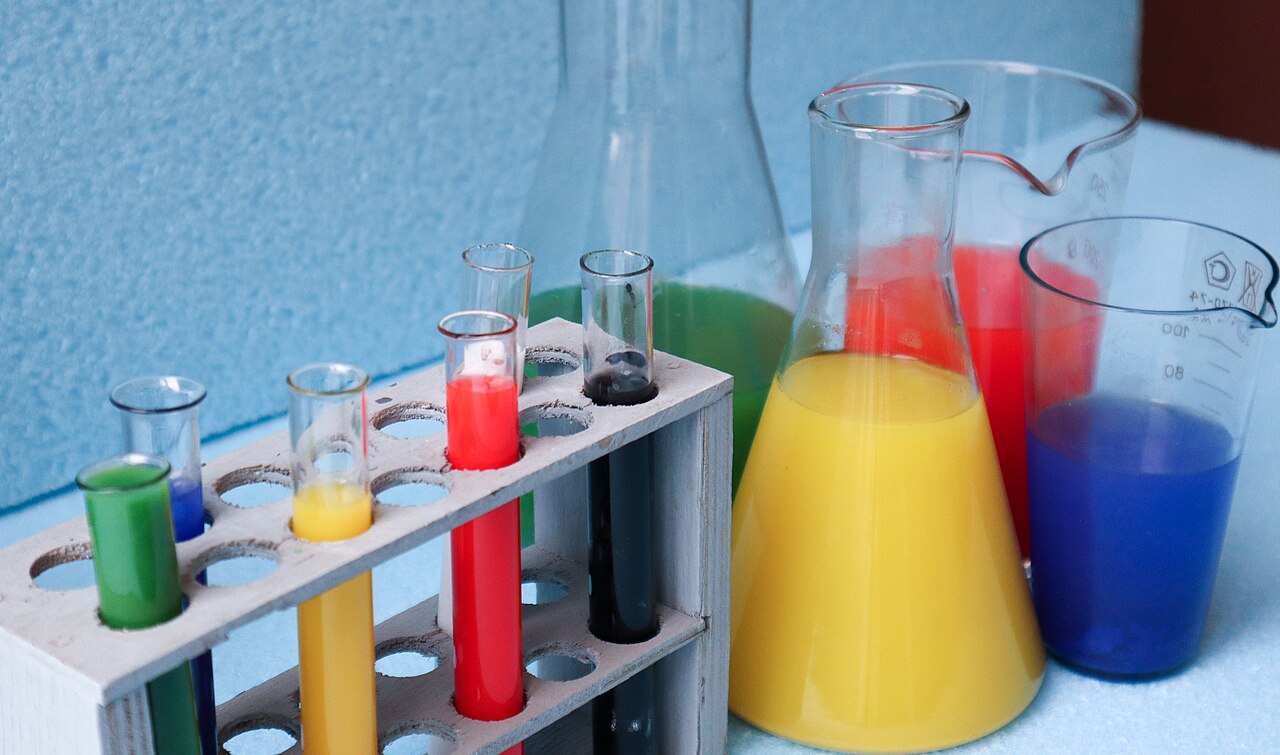
Choose apparatus suited to the measurement: preparation, transfer, and measurement are different tasks. The photograph does not establish the identity, concentration, or equilibrium state of a solution.
Photo: Belikov Maxim · Source · CC BY 4.0 · Unmodified.Read figure values as text
Forward rate: 0: 8; 0.125: 7.294981415507573; 0.25: 6.672804698428429; 0.375: 6.123735672745833; 0.5: 5.639183958275801; 0.625: 5.211568571113942; 0.75: 4.834199316446088; 0.875: 4.50117211807105; 1: 4.207276647028654; 1.125: 3.9479148041500984; 1.25: 3.7190287811611404; 1.375: 3.517037574828479; 1.5: 3.338780960890579; 1.625: 3.1814700512251646; 1.75: 3.042643660702671; 1.875: 2.920129801069571; 2: 2.812011699419676; 2.125: 2.7165978096003176; 2.25: 2.632395347371186; 2.375: 2.5580869352639812; 2.5: 2.492509991743393; 2.625: 2.4346385422055086; 2.75: 2.3835671672402454; 2.875: 2.338496837022664; 3: 2.2987224102071835; 3.125: 2.2636216017404447; 3.25: 2.232645246990332; 3.375: 2.205308709869996; 3.5: 2.181184300533911; 3.625: 2.159894584018133; 3.75: 2.1411064751360547; 3.875: 2.1245260272421986; 4: 2.109893833332405; 4.125: 2.0969809675289954; 4.25: 2.0855854034539956; 4.375: 2.075528853454604; 4.5: 2.066653979229454; 4.625: 2.058821930214931; 4.75: 2.051910171218724; 4.875: 2.0458105653131597; 5: 2.0404276819945126 • Reverse rate: 0: 0; 0.125: 0.2350061948308091; 0.25: 0.44239843385719024; 0.375: 0.6254214424180555; 0.5: 0.7869386805747332; 0.625: 0.9294771429620194; 0.75: 1.0552668945179706; 0.875: 1.1662759606429831; 1: 1.2642411176571153; 1.125: 1.3506950652833005; 1.25: 1.4269904062796197; 1.375: 1.494320808390507; 1.5: 1.5537396797031404; 1.625: 1.6061766495916119; 1.75: 1.6524521130991097; 1.875: 1.6932900663101431; 2: 1.7293294335267746; 2.125: 1.7611340634665607; 2.25: 1.7892015508762713; 2.375: 1.813971021578673; 2.5: 1.8358300027522023; 2.625: 1.8551204859314971; 2.75: 1.8721442775865849; 2.875: 1.8871677209924453; 3: 1.900425863264272; 3.125: 1.912126132753185; 3.25: 1.922451584336556; 3.375: 1.931563763376668; 3.5: 1.939605233155363; 3.625: 1.946701805327289; 3.75: 1.9529645082879818; 3.875: 1.9584913242526005; 4: 1.9633687222225316; 4.125: 1.9676730108236682; 4.25: 1.9714715321820016; 4.375: 1.974823715515132; 4.5: 1.9777820069235155; 4.625: 1.9803926899283564; 4.75: 1.9826966095937588; 4.875: 1.98472981156228; 5: 1.986524106001829
PAUSE & TRY IT
What does Qsp > Ksp predict?
Reveal answer
Precipitation is favored under the stated conditions.
Write the expression before predicting a shift
Use products over reactants, with concentrations or partial pressures raised to stoichiometric powers in the appropriate expression. Pure solids and pure liquids are omitted because their activities are effectively constant in the model. A larger amount of a solid does not enter the expression as a larger concentration.
The reaction quotient Q uses current amounts in the same form as K. If Q<K, net forward reaction moves the system toward equilibrium; if Q>K, net reverse reaction does. Changes in concentration or pressure affect Q immediately, while K changes only with temperature for the given reaction. This distinction makes predictions more precise than treating equilibrium as a vague tendency to “oppose everything.”
PAUSE & TRY IT
Does adding a catalyst change K at a fixed temperature?
Reveal answer
No. It changes how quickly equilibrium is approached, not the equilibrium constant.
Build an equilibrium table with consistent stoichiometry
List initial concentrations, changes proportional to the balanced coefficients, and equilibrium concentrations. If A forms two B, consuming x of A forms 2x of B. Substitute the equilibrium expressions into K and solve for a physically valid value. Negative equilibrium concentrations indicate an invalid root or setup.
A small-x approximation can simplify a weak-reaction calculation when the change is small relative to the initial amount. Check the approximation afterward rather than assuming it from a small K alone. The relevance of the initial concentration and stoichiometry matters. Keep extra digits until the final result, especially when subtracting similar quantities.
PAUSE & TRY IT
Why must precipitation calculations use concentrations after mixing?
Reveal answer
Mixing changes solution volume and therefore ion concentrations.
Couple solubility to the actual dissolution equation
For a salt such as MX2 dissolving into M2+ and two X-, molar solubility s gives [M2+]=s and [X-]=2s in pure water under the simple model. Ksp therefore equals s(2s)2, not s2. Molar solubility and Ksp are different quantities, and comparing Ksp values directly across different stoichiometries can be misleading.
A common ion changes the initial conditions and can reduce solubility. Precipitation is predicted when the relevant ion product exceeds Ksp. Use concentrations after mixing, because dilution changes them. Other reactions, including acid–base reactions or complex formation, can alter free-ion concentrations and therefore the dissolution equilibrium.
Write the equilibrium expression before predicting change
At dynamic equilibrium, forward and reverse rates are equal while microscopic reactions continue. Concentrations are constant under unchanged conditions, but reactant and product concentrations need not be equal. The equilibrium constant describes the appropriate ratio for the balanced reaction at a given temperature.
Use coefficients as exponents and omit pure solids and pure liquids from the usual activity-based expression. Their omission does not mean they cannot participate; their activities are treated as constant while those phases are present. Changing the written reaction changes the corresponding constant: reversal takes a reciprocal, and multiplying coefficients raises K to that power.
The reaction quotient Q uses the same expression evaluated for the current mixture. Q<K predicts net forward change; Q>K predicts net reverse change. State what “forward” means in the written equation. A change in initial composition changes Q, not K at fixed temperature.
PAUSE & TRY IT
Does adding more pure solid change Ksp at fixed temperature?
Reveal answer
No. While the solid phase is present, its activity is treated as constant. Adding solid alone does not change the temperature-dependent Ksp.
Build an equilibrium calculation with a physical root
List initial concentrations, express changes using one extent and the reaction coefficients, then substitute the equilibrium values into K. For A⇌2B at fixed volume, a decrease x in A accompanies an increase 2x in B. Using equal concentration changes would violate stoichiometry.
Small-change approximations are hypotheses to check after solving. If x is not small relative to the quantity from which it was neglected, return to the full equation. A mathematical root that gives a negative concentration or consumes more reactant than available is physically invalid. Your final values should also reproduce K within appropriate rounding.
Large K means the equilibrium ratio favors products in the specified expression, not that equilibrium is reached quickly or that every reactant molecule disappears. Kinetics determines the time scale. Very small or large equilibrium amounts may still matter when the question concerns detection, solubility or a limiting concentration.
Distinguish perturbations and coupled equilibria
Adding a reactant at fixed temperature often changes Q so reaction partially opposes the disturbance. “Partially” matters: the final concentration of the added reactant can remain above its original value even after some is consumed. An instantaneous concentration jump and the later reaction response are separate stages.
For gas mixtures, compression changes partial pressures. Adding inert gas at fixed volume does not change the partial pressures of unchanged reacting gases in the ideal model, whereas adding it at fixed total pressure expands the container and can change them. Temperature can change K; its effect depends on the reaction’s thermal behavior. A catalyst changes rates without changing K.
Solubility calculations must follow the actual dissolution stoichiometry. For MZ2, concentrations s and 2s give Ksp=4s3 in pure water under the simple model. A common ion changes the initial concentration, so the pure-water expression may no longer apply. Acid–base reactions that consume a dissolved ion can increase dissolution without changing Ksp at the same temperature.
An equilibrium calculation begins with a chemical equation
Write K using appropriate activities or the course’s concentration/pressure approximation, raising terms to stoichiometric coefficients. Pure solids and liquids are omitted from the usual expression because their activities are treated as constant. Omitting them does not mean they are chemically irrelevant or absent.
An ICE table tracks changes constrained by stoichiometry. If one reactant decreases by x and a coefficient requires twice that change for another, use 2x. Equilibrium concentrations must remain nonnegative and consistent with the initial amounts. A mathematically obtained root can be physically invalid.
A small-x approximation must be checked after solving. Compare the neglected change with the initial amount; if it is not sufficiently small for the intended accuracy, solve the more complete expression. A small K alone does not guarantee every possible initial condition justifies the approximation.
Distinguish a concentration disturbance from a temperature change
At fixed temperature, a concentration or pressure change can alter Q and drive net reaction toward restoring equilibrium, while K remains the same. A temperature change can change K. A catalyst changes the approach rate without changing the equilibrium composition for the same conditions.
For gas equilibria, volume changes alter partial pressures, but the resulting direction depends on gas stoichiometry. Adding an inert gas at fixed volume does not change the reacting gases’ ideal partial pressures, while other constraints can lead to different outcomes. State what is held fixed.
For solubility equilibria, compare the ion product with Ksp and account for stoichiometric ion ratios. A common ion can reduce solubility in the simple model, but additional acid–base or complex-ion chemistry can change the result. Use the specified model rather than assuming all salts dissolve in the same ratio.
PAUSE & TRY IT
Does adding a catalyst change K at the same temperature?
Reveal answer
No. It changes reaction pathways and rates, not the thermodynamic equilibrium constant.
FROM IDEA TO APPLICATION
Worked examples
Write the correct solubility expression
For MX2(s) ⇌ M2+(aq) + 2X-(aq), the molar solubility in pure water is s. Express Ksp in terms of s.
Reveal worked solution
- [M2+] = s and [X-] = 2s under the simple dissolution model.
- Ksp = [M2+][X-]2.
- Substitute s(2s)2.
Ksp = 4s3, assuming no other relevant ion sources or reactions.
Choose a net direction
For A ⇌ B, K = 4.0. A mixture has [A] = 0.50 M and [B] = 1.0 M. Predict the net reaction direction.
Reveal worked solution
- Q = = 2.0.
- Q is less than K.
- Forward reaction increases B and decreases A.
Net reaction proceeds toward B until the quotient reaches 4.0 at equilibrium.
Molar solubility with a 1:2 salt
For MX2(s) ⇌ M2++2X-, Ksp=4.0×10⁻¹². Find molar solubility in pure water, ignoring other equilibria.
Reveal worked solution
- Let molar solubility be s, giving ion concentrations s and 2s.
- Ksp=4s3.
- s3=1.0×10⁻¹².
s=1.0×10⁻⁴ M.
Check an equilibrium solution
For A⇌2B, initial [A]=1.00 M and [B]=0. At equilibrium [B]=0.40 M. Find Kc.
Reveal worked solution
- B increases by 2x=0.40, so x=0.20 M.
- A decreases to 1.00−0.20=0.80 M.
- Kc=[B]==0.20.
Kc=0.20 in the conventional concentration expression for this reaction.
A solubility stoichiometry
For MX2(s)⇌M2++2X- in pure water with molar solubility s, write Ksp.
Reveal worked solution
- [M2+]=s and [X-]=2s.
- Ksp=[M2+][X-]2=s(2s)2.
Ksp=4s3, not s2.
Compare Q with K
For A⇌B, K=4 and current [A]=0.5 M, [B]=1.0 M.
Reveal worked solution
- Q==2.
- Q<K, so net forward reaction increases B relative to A.
The system moves toward products until the equilibrium relation is restored.
MAKE THE DISTINCTION
Common mistakes, clearer reasoning
The trapEquilibrium means equal reactant and product concentrations.
The better explanationIt means equal forward and reverse rates and stable macroscopic composition.
The trapChanging concentration changes K.
The better explanationAt fixed temperature, it changes Q and the equilibrium position, not K.
RETRIEVE BEFORE YOU REVEAL
Practice checkpoints
Revisit the quick checks from this guide without looking back. Explain why, then reveal the answer.
1. Why is a pure solid omitted from a standard equilibrium expression?
Reveal answer
Its activity is treated as constant while that pure solid phase is present.
2. What should follow a small-x approximation?
Reveal answer
A numerical check that the neglected change is sufficiently small relative to the relevant initial quantity.
3. What does Qsp > Ksp predict?
Reveal answer
Precipitation is favored under the stated conditions.
4. Does adding a catalyst change K at a fixed temperature?
Reveal answer
No. It changes how quickly equilibrium is approached, not the equilibrium constant.
5. Why must precipitation calculations use concentrations after mixing?
Reveal answer
Mixing changes solution volume and therefore ion concentrations.
6. Does adding more pure solid change Ksp at fixed temperature?
Reveal answer
No. While the solid phase is present, its activity is treated as constant. Adding solid alone does not change the temperature-dependent Ksp.
7. Does adding a catalyst change K at the same temperature?
Reveal answer
No. It changes reaction pathways and rates, not the thermodynamic equilibrium constant.
Key language
- Dynamic equilibrium
- Equal opposing rates with constant macroscopic composition.
- Reaction quotient
- An expression using current activities or their modeled concentrations.
- Common-ion effect
- An equilibrium change caused by adding an ion already involved.
- Molar solubility
- Moles of a solid dissolved per liter of solution at saturation.
Acid–base systems and electrochemical cells are applications of equilibrium and thermodynamics.