
On this page0% through guide
Acids and Bases
Use proton-transfer equilibria to explain pH, buffers, and titration curves.
What you’ll learn
- Distinguish strength from concentration.
- Calculate pH using the appropriate chemical model.
- Explain buffer and titration behavior by species present.
Before you begin
A Brønsted–Lowry acid donates a proton and a base accepts one. Strong means extensive ionization in water, not high concentration. Conjugate acid–base partners differ by one proton.
Explain these starting ideas in your own words. Revisit them whenever a later step feels unclear.
Strength and amount answer different questions
A Brønsted–Lowry acid donates a proton and a base accepts one. Conjugate partners differ by one proton. A strong acid is extensively ionized in the relevant aqueous conditions, while a weak acid establishes an appreciable equilibrium with its conjugate base. A dilute strong acid and a concentrated weak acid cannot be ranked in pH from the strength labels alone.
Ka quantifies acid dissociation; a larger Ka indicates greater dissociation tendency for the specified equilibrium. For a conjugate acid–base pair in water, KaKb = Kw at the same temperature. Kw changes with temperature, so neutral pH is not universally exactly 7.
Select the model before calculating
For a sufficiently concentrated strong monoprotic acid, the hydronium concentration is approximately the analytical acid concentration. At extreme dilution, water autoionization cannot be neglected. For a weak acid, use an equilibrium calculation and check any approximation.
For HA in water with initial concentration C and small dissociation, Ka ≈ and x ≈ √(KaC). The approximation requires x to be small relative to C. A salt solution may be acidic or basic if an ion reacts with water; a formula containing no written H+ or OH- does not guarantee neutrality.
A buffer uses a conjugate pair
A buffer contains appreciable amounts of a weak acid and its conjugate base, or the analogous weak-base pair. Added strong base consumes the weak acid; added strong acid consumes the conjugate base. First perform that essentially complete neutralization bookkeeping, then evaluate the remaining equilibrium.
The Henderson–Hasselbalch relationship is useful when both conjugate partners remain in appreciable amounts. Buffer capacity depends on their amounts, while pH depends strongly on their ratio. Diluting both equally can leave the ratio and approximate pH similar while lowering the capacity to absorb additional acid or base.
Read figure values as text
Buffer pH: 0.1: 3.5; 0.30625: 3.986076097372589; 0.5125000000000001: 4.209693869727792; 0.71875: 4.356577857697687; 0.925: 4.4661417327390325; 1.13125: 4.5535585922132595; 1.3375000000000001: 4.626293790693266; 1.54375: 4.688576970603741; 1.7500000000000002: 4.743038048686294; 1.9562500000000003: 4.791424354890523; 2.1625: 4.834956116136852; 2.3687500000000004: 4.874519227312148; 2.575: 4.9107772333772095; 2.7812500000000004: 4.944240028325007; 2.9875: 4.975307913956194; 3.19375: 5.004300917478788; 3.4000000000000004: 5.031478917042255; 3.60625: 5.057055830499807; 3.8125000000000004: 5.081209852354842; 4.01875: 5.104090990268297; 4.225: 5.125826713285711; 4.4312499999999995: 5.146526252527142; 4.6375: 5.166283922623102; 4.84375: 5.185181719850386; 5.05: 5.203291378118662; 5.25625: 5.220676013141987; 5.4625: 5.237391449978478; 5.66875: 5.25348730440417; 5.874999999999999: 5.269007870943774; 6.08125: 5.283992857612427; 6.2875: 5.298477998063984; 6.49375: 5.312495564901253; 6.7: 5.326074802700827; 6.906249999999999: 5.339242295365205; 7.1125: 5.352022279403128; 7.31875: 5.364436912416438; 7.525: 5.376506504265881; 7.73125: 5.3882497169731955; 7.937499999999999: 5.399683738300032; 8.14375: 5.41082443305666; 8.35: 5.421686475483602; 8.55625: 5.432283465478065; 8.7625: 5.442628030974715; 8.96875: 5.452731918414086; 9.175: 5.462606072924127; 9.38125: 5.472260709587346; 9.5875: 5.481705376957038; 9.79375: 5.490949013812665; 10: 5.5
PAUSE & TRY IT
Why can a buffer fail after a large acid addition?
Reveal answer
Its conjugate-base component can be consumed, leaving insufficient capacity to neutralize more acid.
PAUSE & TRY IT
What changes when a buffer is diluted without changing its acid/base ratio?
Reveal answer
Its approximate pH may change little, but its capacity per unit volume decreases.
A titration curve is a sequence of chemical regimes
Before titrant is added, use the analyte’s own equilibrium. In a weak-acid/strong-base titration before equivalence, neutralization produces a buffer. At half-equivalence, equal conjugate amounts make pH approximately pKa. At equivalence, the weak acid has been converted to conjugate base, which can hydrolyze water.
Past equivalence, excess strong base usually dominates the pH. Equivalence is therefore not automatically pH 7. A suitable indicator changes color in the steep region near equivalence; its color change reflects its own acid–base equilibrium. Polyprotic acids require attention to successive dissociations and equivalence points.
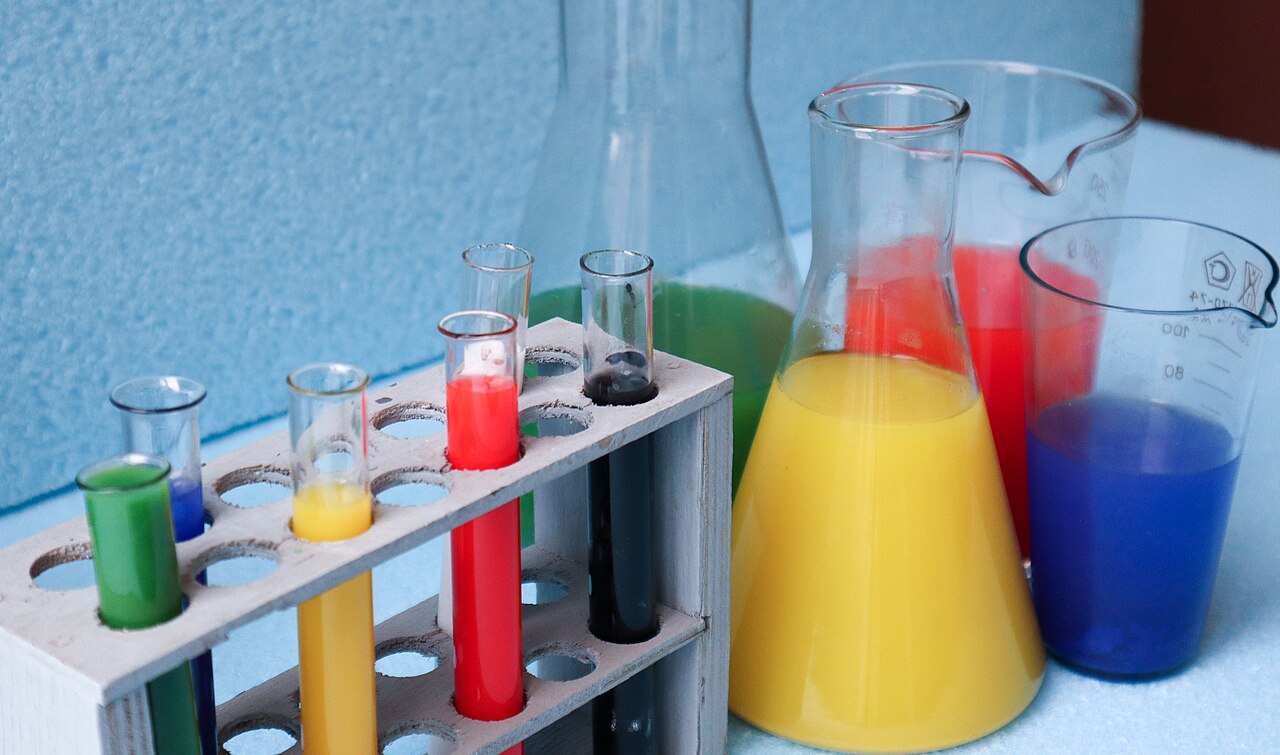
Choose apparatus suited to the measurement: preparation, transfer, and measurement are different tasks. The photograph does not establish the identity, concentration, or equilibrium state of a solution.
Photo: Belikov Maxim · Source · CC BY 4.0 · Unmodified.PAUSE & TRY IT
What is special about half-equivalence for a weak monoprotic acid titrated by strong base?
Reveal answer
Equal amounts of acid and conjugate base give pH approximately equal to pKa.
Structure explains relative acidity
An acid more readily donates a proton when the resulting conjugate base is relatively stabilized. Electronegativity, bond strength, charge distribution, and resonance can contribute, depending on the comparison. Use a mechanism appropriate to the particular family instead of one universal periodic shortcut.
For related oxyacids, electron-withdrawing atoms and delocalization can stabilize the conjugate base. For binary hydrides down a group, weaker H–element bonds can become especially important. Every claim should identify which structural feature changes and how it affects the conjugate pair.
Read figure values as text
pH from concentration: 0.1: 4; 0.34750000000000003: 3.459045191073867; 0.595: 3.2254830342714507; 0.8425: 3.0744300904566235; 1.09: 2.962573502059376; 1.3375000000000001: 2.873706209306734; 1.5850000000000002: 2.7999707334462296; 1.8325: 2.7369560166868343; 2.08: 2.6819366650372385; 2.3275: 2.63311031034662; 2.575: 2.58922276662279; 2.8225000000000002: 2.5493660494029946; 3.0700000000000003: 2.5128616245228135; 3.3175000000000003: 2.4791890684635267; 3.565: 2.4479404658121156; 3.8125: 2.418790147645158; 4.06: 2.3914739664228057; 4.3075: 2.365774713879934; 4.555: 2.341511618690983; 4.802499999999999: 2.318532626466269; 5.05: 2.2967086218813386; 5.297499999999999: 2.275929034617168; 5.545: 2.256098449514821; 5.7925: 2.2371339575379867; 6.04: 2.2189630613788682; 6.2875: 2.201522001936016; 6.535: 2.1847544080834367; 6.7825: 2.1686101975663665; 7.029999999999999: 2.153044674980176; 7.2775: 2.1380177858891516; 7.5249999999999995: 2.123493495734119; 7.772500000000001: 2.1094392692847705; 8.02: 2.0958256317158366; 8.2675: 2.0826257964142596; 8.515: 2.0698153477013803; 8.7625: 2.0573719690252847; 9.01: 2.045275209020937; 9.2575: 2.03350627927852; 9.504999999999999: 2.022047878798538; 9.7525: 2.0108840410161712; 10: 2
Select the chemical regime before doing arithmetic
For a strong monoprotic acid at an ordinary concentration, hydrogen-ion concentration is approximately the acid concentration. For a weak acid, set up its ionization equilibrium. For an acid–base mixture, perform the reaction stoichiometry first to see what remains before choosing an equilibrium expression. Using a weak-acid formula before accounting for added strong base is a common model-selection error.
At 25°C, pH+pOH=14 under the usual aqueous conditions because Kw=1.0×10⁻¹⁴. At another temperature, Kw and the neutral pH can differ. A pH calculation should identify the species controlling the solution, not merely apply a memorized equation to whichever concentration appears first.
PAUSE & TRY IT
Why can diluting a buffer preserve approximate pH but reduce capacity?
Reveal answer
The concentration ratio stays similar while the available amounts per volume decrease.
Buffers work by consuming additions chemically
A weak acid and its conjugate base can consume modest additions of strong base or acid, respectively. Track those stoichiometric changes before applying an equilibrium relation. The Henderson–Hasselbalch equation expresses pH in terms of pKa and the conjugate-base-to-acid ratio when the buffer assumptions are appropriate.
Diluting both buffer components by the same factor leaves their ratio approximately unchanged, so pH may change little, but capacity decreases because fewer moles are available per volume. A buffer can be overwhelmed. Near equal acid and conjugate-base amounts, pH is near pKa; this is not the same as claiming every buffer has pH 7.
PAUSE & TRY IT
Is a weak-acid/strong-base equivalence point necessarily neutral?
Reveal answer
No. The conjugate base can react with water and make the solution basic.
Read a titration curve as a sequence of models
Before titrant is added, the analyte’s own acid–base equilibrium controls pH. In the buffer region of a weak-acid/strong-base titration, both acid and conjugate base are present. At half-equivalence, their amounts are equal and pH≈pKa. At equivalence, the weak acid has been converted to conjugate base, whose hydrolysis can make the solution basic.
Beyond equivalence, excess strong base generally dominates the pH calculation. The equivalence volume comes from stoichiometry, while the pH at that volume comes from equilibrium. Choose an indicator whose transition range lies in the steep region near the endpoint; a color change far from equivalence produces a systematic error.
Choose the dominant chemistry before using a pH equation
An acid–base problem is first a species problem. Identify strong acids and bases that react essentially stoichiometrically under the stated conditions. Count moles, perform that reaction, and inspect what remains. Excess strong acid, excess strong base, a weak acid alone, a conjugate base alone and a buffer require different subsequent models.
Strength describes ionization tendency; concentration describes amount per volume. A concentrated weak acid and a dilute strong acid cannot be ranked by those adjectives alone. For a weak acid, Ka and formal concentration help determine equilibrium hydronium. Water autoionization can become important at very low acid or base concentrations.
Use the temperature-dependent Kw supplied or appropriate to the conditions. The familiar pH+pOH=14 relation assumes the usual 25°C value. Neutrality means equal hydronium and hydroxide concentrations, not an invariant pH of seven at every temperature. Keep logarithms and concentration units consistent.
Understand buffer action through a reaction and an equilibrium
A buffer contains appreciable amounts of a weak acid and its conjugate base, or the corresponding weak-base pair. Added OH- consumes HA and forms A-; added H3O+ consumes A- and forms HA. This chemical consumption limits the change in free hydronium compared with an unbuffered solution.
After the strong addition reacts, use the remaining conjugate amounts in an appropriate equilibrium relation. Henderson–Hasselbalch summarizes the ratio under its assumptions; it does not replace neutralization stoichiometry. If one partner is exhausted, the original buffer model no longer applies.
Buffers with the same acid/base ratio can have similar pH but different capacity. More total conjugate material can absorb a larger added amount before a major ratio change. Dilution ideally preserves the ratio approximately while reducing capacity per volume; sufficiently extreme dilution can invalidate simplifying assumptions. State which feature is being compared.
Read a titration as successive chemical regimes
Initially, a weak-acid titration contains mostly the acid and its equilibrium products. Before equivalence, partial neutralization creates a conjugate pair. At half equivalence, equal remaining acid and conjugate-base amounts give pH approximately pKa. At equivalence, the conjugate base can hydrolyze water, so pH need not be seven. Beyond equivalence, excess strong base usually controls pH.
Every stage uses the total relevant solution volume when converting remaining moles to concentration. A steep part of a curve explains why a small added volume can create a large pH change and why indicator choice matters. The endpoint is the observed indicator response; equivalence is the stoichiometric condition.
Relative acidity also has a structural basis. Compare how stable the conjugate base is, using the bonding and electron-distribution information supplied. Electronegativity, bond strength, resonance and electron-withdrawing effects can matter in different comparisons. One isolated periodic trend should not override the actual family of compounds being compared.
PAUSE & TRY IT
At equivalence in a weak-acid/strong-base titration, why is the solution often basic?
Reveal answer
The acid has been converted largely into its conjugate base, which reacts with water to produce OH-. Equal stoichiometric equivalents do not imply a neutral final solution.
Choose the dominant acid–base process before calculating pH
First identify strong acid/base stoichiometry, weak acid/base equilibrium, buffer behavior, or salt hydrolysis. If strong acid and base are mixed, neutralize them stoichiometrically before applying an equilibrium expression to what remains. A buffer formula applied before neutralization can use the wrong amounts.
For a weak acid alone, Ka relates equilibrium hydrogen ion, conjugate base, and remaining acid. A small-dissociation approximation may simplify the equation, but verify its size. Concentration and acid strength are different: a dilute strong acid and a concentrated weak acid require different descriptions.
At a weak-acid–strong-base equivalence point, the conjugate base can make the solution basic through hydrolysis. At half-equivalence in the appropriate buffer region, equal acid and conjugate-base amounts give pH=pKa. These are distinct points with distinct chemistry.
PAUSE & TRY IT
Why is pH at a weak-acid/strong-base equivalence point often above 7?
Reveal answer
The remaining conjugate base reacts with water to produce hydroxide under the usual conditions.
A buffer has a ratio and a capacity
The acid/base ratio controls pH in the Henderson–Hasselbalch approximation, while total amounts determine how much added strong acid or base can be absorbed before the ratio changes greatly. Two buffers can have the same pH and different capacities.
After adding strong acid, consume conjugate base and form weak acid; after adding strong base, consume weak acid and form conjugate base. Update moles first. If both species occupy the same final volume, their concentration ratio equals their mole ratio, which can simplify the calculation.
An indicator should change color near the steep pH change appropriate to the titration. A chosen endpoint is a practical observation, not identical by definition to stoichiometric equivalence. Explain any systematic offset using the reaction and calculation.
FROM IDEA TO APPLICATION
Worked examples
A buffer calculation after reaction
A buffer initially contains 0.20 mol HA and 0.30 mol A-. Add 0.05 mol strong acid without significant volume change. If pKa = 4.80, estimate pH.
Reveal worked solution
- H+ consumes A- and produces HA.
- New amounts: A- = 0.25 mol, HA = 0.25 mol.
- The ratio is 1, so log10(1) = 0.
pH ≈ 4.80. Neutralization must be accounted for before applying the buffer relationship.
Check a weak-acid approximation
A 0.10 M weak acid has Ka = 1.0 × 10⁻⁵. Estimate [H3O+] and pH.
Reveal worked solution
- x ≈ √[(1.0 × 10⁻⁵)(0.10)] = 1.0 × 10⁻³ M.
- = 0.01, or 1%, supporting the small-change approximation.
- pH ≈ 3.00.
[H3O+] ≈ 0.0010 M and pH ≈ 3.00 under the dilute-solution approximation.
A buffer after added base
A buffer contains 0.20 mol HA and 0.10 mol A-. Add 0.05 mol OH- with negligible volume change. If pKa=4.80, estimate the final pH.
Reveal worked solution
- OH- consumes HA and produces A-.
- Final amounts are 0.15 mol HA and 0.15 mol A-.
- Their ratio is one, so log()=0.
pH≈4.80, provided the buffer model remains appropriate.
React before applying the buffer relation
A buffer has 0.30 mol HA and 0.20 mol A- with pKa=4.50. Add 0.050 mol HCl. Estimate pH.
Reveal worked solution
- Strong acid consumes A- and forms HA.
- Remaining amounts are A-=0.150 mol and HA=0.350 mol.
- pH≈4.50+log()=4.13.
The pH falls to about 4.13; using the initial ratio would miss the neutralization.
Buffer after added base
A buffer contains 0.20 mol HA and 0.10 mol A-, with pKa=5.00. Add 0.05 mol OH-.
Reveal worked solution
- OH- converts HA to A-.
- New amounts are 0.15 mol each.
- pH=pKa+log(1).
pH≈5.00 under the buffer approximation.
Same pH, different capacity
Compare 0.01 mol HA plus 0.01 mol A- with 1 mol of each in otherwise comparable conditions.
Reveal worked solution
- Both have the same ratio and approximately the same buffer pH.
- The second has much more material available to react with added acid or base.
Equal pH does not imply equal buffer capacity.
MAKE THE DISTINCTION
Common mistakes, clearer reasoning
The trapA strong acid is necessarily concentrated.
The better explanationStrength describes ionization tendency; concentration describes amount per volume.
The trapEvery equivalence point is neutral.
The better explanationConjugate species can react with water; equivalence is a stoichiometric condition.
RETRIEVE BEFORE YOU REVEAL
Practice checkpoints
Revisit the quick checks from this guide without looking back. Explain why, then reveal the answer.
1. What is special about half-equivalence for a weak monoprotic acid titrated by strong base?
Reveal answer
Equal amounts of acid and conjugate base give pH approximately equal to pKa.
2. Why can a buffer fail after a large acid addition?
Reveal answer
Its conjugate-base component can be consumed, leaving insufficient capacity to neutralize more acid.
3. What changes when a buffer is diluted without changing its acid/base ratio?
Reveal answer
Its approximate pH may change little, but its capacity per unit volume decreases.
4. Why can diluting a buffer preserve approximate pH but reduce capacity?
Reveal answer
The concentration ratio stays similar while the available amounts per volume decrease.
5. Is a weak-acid/strong-base equivalence point necessarily neutral?
Reveal answer
No. The conjugate base can react with water and make the solution basic.
6. At equivalence in a weak-acid/strong-base titration, why is the solution often basic?
Reveal answer
The acid has been converted largely into its conjugate base, which reacts with water to produce OH-. Equal stoichiometric equivalents do not imply a neutral final solution.
7. Why is pH at a weak-acid/strong-base equivalence point often above 7?
Reveal answer
The remaining conjugate base reacts with water to produce hydroxide under the usual conditions.
Key language
- Conjugate pair
- An acid and base differing by one proton.
- Buffer capacity
- The amount of added acid or base a buffer can absorb before a large pH change.
- Ka
- The equilibrium constant for a specified acid dissociation.
- Half-equivalence
- The point where half the titrated acid or base has been neutralized for the specified step.
Buffers link equilibrium and stoichiometry; molecular structure explains the constants used in those calculations.