
On this page0% through guide
The Living World: Ecosystems
Follow energy, nutrients, and interactions through connected systems.
What you’ll learn
- Explain how climate shapes terrestrial and aquatic systems.
- Trace matter through biogeochemical cycles.
- Calculate productivity and trophic transfers.
Before you begin
A reservoir stores matter; a flux moves matter between reservoirs. A food web tracks feeding relationships, while an energy budget tracks transfers over a specified area and time.
Explain these starting ideas in your own words. Revisit them whenever a later step feels unclear.
Ecosystems combine living and physical components
An ecosystem includes organisms and the physical conditions with which they interact. Producers capture energy; consumers obtain energy from other organisms; decomposers return nutrients from organic matter to forms that can reenter biological use. A food web represents multiple feeding pathways, while a food chain is a simplified sequence.
Competition, predation, herbivory, parasitism, and mutualism can affect population sizes and community composition. The ecological niche includes resource use and environmental requirements, not merely the place an organism lives. Resource partitioning can reduce competition by separating use in space, time, or type.
PAUSE & TRY IT
What distinguishes a niche from a habitat?
Reveal answer
A habitat is where an organism lives; a niche describes its resource use and ecological requirements.
Climate constrains biomes
Temperature and precipitation patterns influence terrestrial vegetation, decomposition, and growing seasons. Annual averages alone can hide seasonal drought or cold. Tropical forests, grasslands, deserts, temperate forests, and tundra differ in water availability, productivity, and nutrient storage.
Aquatic systems depend on salinity, light penetration, dissolved oxygen, flow, and depth. Estuaries mix freshwater and saltwater and can be highly productive. Coral reefs require particular temperature, light, and water-quality conditions. Wetlands can store water, filter some pollutants, and provide habitat, but their functions depend on hydrology and surrounding land use.
PAUSE & TRY IT
Why might an estuary be productive?
Reveal answer
Nutrient inputs, shallow lighted areas, and habitat variety can support production, though pollution and other limits matter.
Carbon and water move through reservoirs
Carbon enters living tissue through photosynthesis and returns through respiration, decomposition, and combustion. Oceans, soils, organisms, atmosphere, and rocks store carbon on different timescales. Fossil-fuel burning transfers carbon from long-term geological storage into the active atmospheric–ocean system.
The water cycle includes evaporation, transpiration, condensation, precipitation, infiltration, groundwater movement, and runoff. Urban pavement can reduce infiltration and increase rapid surface runoff. Removing vegetation can alter evapotranspiration, erosion, and local water storage rather than merely “using less water.”
PAUSE & TRY IT
Why can paving increase flood peaks?
Reveal answer
It reduces infiltration and speeds runoff into drainage channels.
Nitrogen and phosphorus require chemical transformations
Most organisms cannot use atmospheric N2 directly. Nitrogen fixation produces biologically available forms; nitrification, assimilation, ammonification, and denitrification move nitrogen among chemical forms and reservoirs. Fertilizer and combustion can increase reactive nitrogen in places where it becomes a pollutant.
Phosphorus cycles through rocks, soil, water, and organisms without a major gaseous atmospheric reservoir in the usual model. Weathering releases phosphate, while erosion and runoff move it into waters. Excess nitrogen or phosphorus can stimulate algal production when that nutrient limits growth.
Productivity is an energy rate
Gross primary productivity is the total energy captured by producers. Net primary productivity subtracts producer respiration and represents energy retained as new biomass. State an area and time basis when comparing productivity measurements.
Trophic transfer is inefficient because energy is used in metabolism, released as heat, excreted, or left uneaten. A 10% transfer is a common approximation, not a universal constant. Matter can cycle; energy continually enters and ultimately leaves as dispersed heat. Biomass and energy pyramids should not be confused with counts of organisms.
Read figure values as text
Available energy: 1: 10000; 2: 1000; 3: 100
Follow one atom through an ecosystem
Trace carbon from atmospheric carbon dioxide into plant sugars through photosynthesis, then into consumers through feeding. Respiration returns some carbon to the atmosphere; decomposition processes dead material and waste. Burial can move carbon into long-term reservoirs, while combustion transfers stored carbon back rapidly. The atom is conserved even though its chemical form changes.
For nitrogen, identify the transformation rather than saying it simply cycles. Fixation makes atmospheric nitrogen biologically available; nitrification oxidizes ammonium; assimilation incorporates inorganic nitrogen into biomass; ammonification releases ammonium from organic material; denitrification returns nitrogen to gaseous forms. Human inputs alter the sizes and rates of these flows.
PAUSE & TRY IT
Why is producer biomass not identical to productivity?
Reveal answer
Biomass is a stock at a time; productivity is a production rate over an interval.
Use energy and nutrient evidence together
Energy enters most ecosystems as sunlight and leaves as heat. Nutrients can be recycled, but energy is not recycled back into sunlight by decomposers. Net primary productivity is gross primary productivity minus producer respiration. Consumer respiration belongs in other budgets, not in that subtraction.
When nutrient addition increases producer growth, the added nutrient may have been limiting under the tested conditions. Light, temperature, water, or another nutrient may become limiting afterward. A response to fertilizer at one site does not establish that every ecosystem is limited by the same nutrient. Controlled comparisons help separate these possibilities.
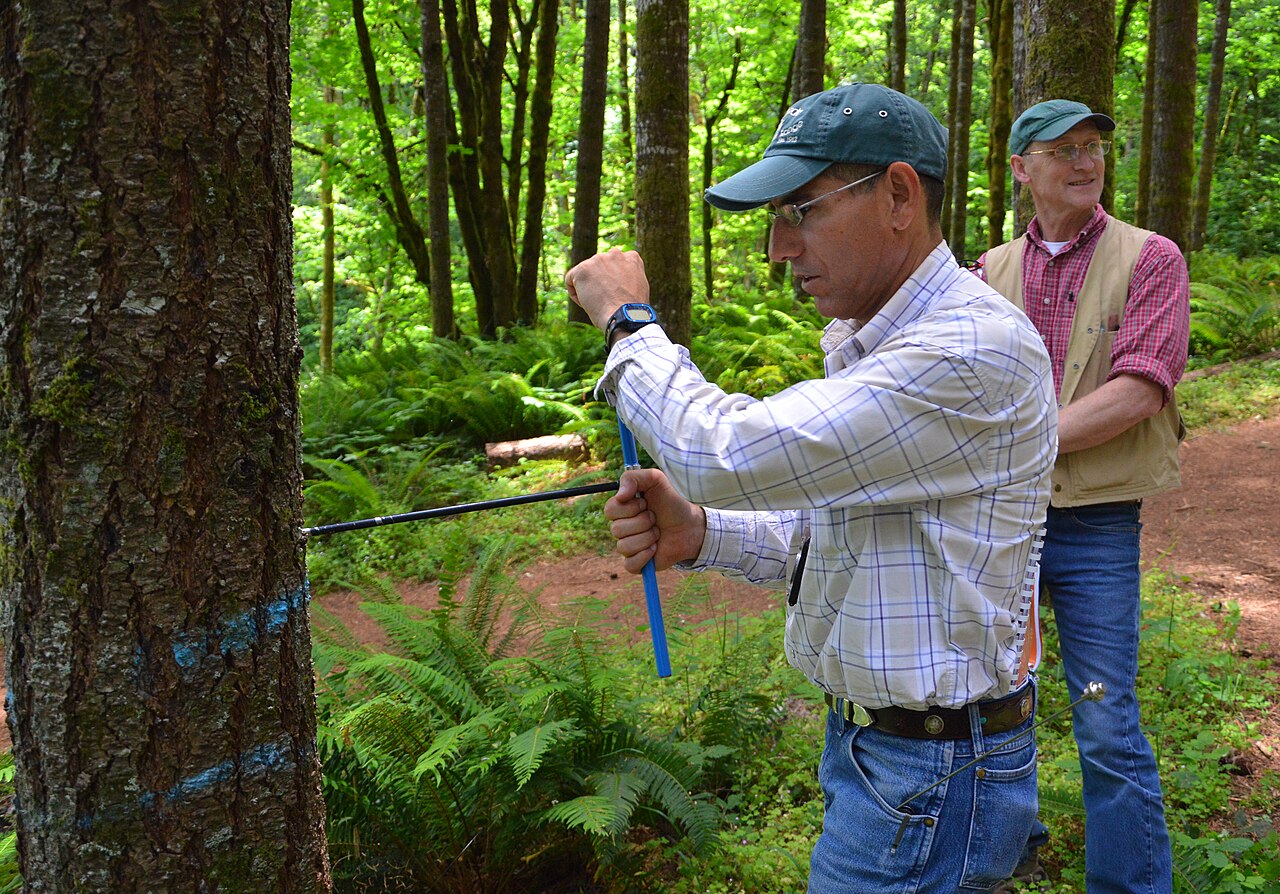
Field observations need a sampling frame, consistent measurements, and independent sampling units. Accessible locations alone can misrepresent the forest. This photograph illustrates fieldwork rather than supplying the numerical examples in this guide.
Photo: NRCS Oregon / USDA · Source · U.S. federal government public domain · Unmodified.PAUSE & TRY IT
Why can a predator affect a plant it never eats?
Reveal answer
Its effect on herbivores can indirectly change plant consumption and biomass.
Read a food web as a network of mechanisms
Specify the arrow convention before interpreting a food web. Arrows often point from food to consumer to show energy transfer. Removing a predator may release an herbivore from predation, reducing producer biomass, but omnivory and alternative prey can weaken or redirect the response. A defensible prediction names the intermediate interactions.
Field evidence often combines counts, biomass, nutrient measurements, and experiments. Counts alone can be misleading when body sizes differ greatly. Compare equivalent sampling effort and time periods, and distinguish a stock such as standing biomass from a rate such as annual productivity.
Read an ecosystem as connected budgets
Begin with a boundary: a pond, forest stand, or watershed. Energy crosses that boundary as sunlight, chemical energy in food, and heat; matter crosses in water, organisms, gases, and sediment. A budget separates inputs, outputs, and changes in storage. If nitrogen input exceeds output, nitrogen may accumulate, but you still need evidence about the reservoir receiving it. A food web cannot by itself show every storage pool.
Gross primary productivity is the total rate at which producers capture energy. Net primary productivity subtracts their respiration; it is the new biomass energy potentially available to consumers and decomposers. Write the subtraction before inserting numbers, and retain area and time units. A forest with high gross productivity can have lower net productivity than another system if its producers also respire much more.
Trophic transfer efficiencies are ratios of production at successive levels, not a universal physical constant of 10%. Use the stated efficiency at each step. Multiplying two 10% transfers gives 1% of the initial production. Matter in uneaten tissue can enter decomposer pathways, while respiratory energy becomes dispersed heat. Decomposers recycle nutrients, not a supply of usable energy that returns to the Sun.
Read figure values as text
Production: 1: 1000; 2: 100; 3: 10
Explain cycles by naming the reservoir and the process
In a carbon-cycle explanation, state both the starting reservoir and the destination. Combustion moves carbon from fuel into atmospheric carbon dioxide; photosynthesis moves inorganic carbon into organic molecules; respiration returns some organic carbon to carbon dioxide. Carbon burial and geological processes operate on different timescales from a daily photosynthesis–respiration cycle. A large reservoir need not have the largest annual flux.
Nitrogen availability depends on transformations. Fixation converts atmospheric nitrogen to usable compounds; nitrification converts ammonium through nitrite to nitrate; denitrification returns nitrogen to the atmosphere under suitable conditions. Leaching can move soluble nitrate into water. Phosphorus usually lacks a major atmospheric gaseous phase in the introductory cycle: weathering, erosion, uptake, and sedimentation are central.
A fertilizer problem may connect several cycles. Runoff supplies limiting nutrients, producer growth increases, dead organic matter increases, and aerobic decomposition consumes dissolved oxygen. Explain the intermediate steps; “fertilizer kills fish” skips the mechanism. Temperature, mixing, flow, and the identity of the limiting nutrient affect the outcome, so avoid claiming that every nutrient addition causes the same bloom.
PAUSE & TRY IT
Why can a bloom be followed by low dissolved oxygen even if algae photosynthesize?
Reveal answer
When organic matter dies or is consumed, aerobic respiration and decomposition use oxygen. At night photosynthesis stops while respiration continues; mixing and oxygen replacement may be insufficient.
Interpret biome and aquatic evidence
Read temperature and precipitation across the year, not just annual totals. Two places receiving equal annual rain may support different vegetation if one has a long dry season. Latitude, altitude, rain shadows, and ocean proximity can alter climate. A climograph supports a biome prediction but is not a complete inventory of species or soil chemistry.
For an aquatic system, ask about salinity, light, mixing, flow, and nutrients. The photic zone supports light-dependent production; deeper water can receive sinking organic matter. Dissolved oxygen is influenced by photosynthesis, respiration, temperature, and mixing. High productivity is not synonymous with high oxygen at every depth or every hour.
Connect ecosystem services to a physical or biological mechanism. Wetland vegetation slows water and promotes sediment settling; roots stabilize soil; some microbial processes transform pollutants. A wetland has finite capacity and can be damaged by excessive loading. A strong management claim identifies both the service and the conditions under which it operates.
Turn a food-web arrow into a causal prediction
Food-web arrows usually indicate energy or matter moving from a consumed resource to its consumer; confirm the diagram’s convention. If a predator declines, its prey may increase, potentially reducing the prey’s resources. This indirect sequence is a trophic cascade, but alternative food sources and competing interactions can modify it.
A prediction should specify direction and mechanism at each link. Removing an herbivore can release plants from grazing, while removing a decomposer affects nutrient return through another pathway. Do not assume every species one step away responds identically or immediately.
Distinguish a productivity measurement from standing biomass. A rapidly growing and rapidly consumed producer population can have modest standing biomass but high production over time. Biomass is a stored amount at a time; productivity is a rate. This distinction helps explain why some aquatic biomass pyramids look different from energy pyramids.
PAUSE & TRY IT
Is productivity an amount or a rate?
Reveal answer
A rate, typically expressed per area per time. Standing biomass is an amount present at a time.
Write a complete experimental response
State an independent variable that can actually be manipulated and a dependent variable that can be measured. Identify the control condition, important constants, independent replication, and how long measurements continue. A prediction should be testable and related to the mechanism under study.
For a nutrient experiment, several independently treated containers per nutrient level are stronger replication than many water samples from one container. Repeated samples reveal change within that container but do not create additional independent treatment units. Random assignment helps distribute uncontrolled differences.
Interpret an outcome at the level supported by the design. A response to added nitrogen supports nitrogen limitation under those conditions, not a claim that nitrogen limits every ecosystem in every season. A null result may reflect a different limiting factor, inadequate duration, or measurement limitations.
FROM IDEA TO APPLICATION
Worked examples
Productivity accounting
A marsh captures 2,400 g /year through gross production and producers respire 1,100 g /year. Calculate NPP.
Reveal worked solution
- Subtract producer respiration from gross production.
- 2,400 − 1,100 = 1,300.
NPP is 1,300 g /year. Consumer respiration is not subtracted in this definition.
Two energy transfers
Producers retain 80,000 kJ. Two successive trophic transfers are each 10% efficient. How much reaches the second consumer level?
Reveal worked solution
- First transfer: 80,000 × 0.10 = 8,000 kJ.
- Second transfer: 8,000 × 0.10 = 800 kJ.
800 kJ, assuming the specified transfer efficiencies.
A nutrient-addition experiment
Four plots receive no fertilizer, nitrogen, phosphorus, or both. Growth is 10, 11, 18, and 19 /day. What limitation is best supported?
Reveal worked solution
- Compare each treatment with the control using the same response units.
- Nitrogen alone changes growth little; phosphorus produces a large increase.
- Both nutrients together perform similarly to phosphorus alone.
The pattern supports phosphorus limitation under these conditions. Replication and uncertainty are needed to judge whether the small differences are meaningful.
Track two energy transfers
Producers have GPP of 24,000 /year and respiration of 14,000. Herbivore production receives 12% of NPP, and predator production receives 8% of herbivore production.
Reveal worked solution
- NPP = 24,000 − 14,000 = 10,000 /year.
- Herbivore production = 0.12 × 10,000 = 1,200.
- Predator production = 0.08 × 1,200 = 96.
96 /year reaches predator production under this model.
Production versus biomass
Two ponds each contain 100 kg of producer biomass. Pond A produces 10 kg/day and Pond B 30 kg/day.
Reveal worked solution
- Standing biomass is equal at the observation time.
- Production rates differ threefold.
- Consumption and turnover can maintain similar standing stocks despite different production.
Pond B has higher measured productivity; equal biomass does not imply equal productivity.
Choose independent replication
Twelve tanks receive a nutrient treatment and twelve control tanks do not. Three samples are taken from each tank.
Reveal worked solution
- The tank receives the treatment and is the experimental unit.
- There are 12 independent units per treatment, not 36.
The subsamples improve each tank’s estimate without tripling independent replication.
MAKE THE DISTINCTION
Common mistakes, clearer reasoning
The trapEnergy cycles through ecosystems in the same way as carbon.
The better explanationEnergy flows and dissipates as heat; carbon atoms can be reused.
The trapAll nitrogen in the atmosphere is directly usable by plants.
The better explanationMost plants require biologically available nitrogen forms produced through fixation and other transformations.
RETRIEVE BEFORE YOU REVEAL
Practice checkpoints
Revisit the quick checks from this guide without looking back. Explain why, then reveal the answer.
1. Why can paving increase flood peaks?
Reveal answer
It reduces infiltration and speeds runoff into drainage channels.
2. Why might an estuary be productive?
Reveal answer
Nutrient inputs, shallow lighted areas, and habitat variety can support production, though pollution and other limits matter.
3. What distinguishes a niche from a habitat?
Reveal answer
A habitat is where an organism lives; a niche describes its resource use and ecological requirements.
4. Why is producer biomass not identical to productivity?
Reveal answer
Biomass is a stock at a time; productivity is a production rate over an interval.
5. Why can a predator affect a plant it never eats?
Reveal answer
Its effect on herbivores can indirectly change plant consumption and biomass.
6. Why can a bloom be followed by low dissolved oxygen even if algae photosynthesize?
Reveal answer
When organic matter dies or is consumed, aerobic respiration and decomposition use oxygen. At night photosynthesis stops while respiration continues; mixing and oxygen replacement may be insufficient.
7. Is productivity an amount or a rate?
Reveal answer
A rate, typically expressed per area per time. Standing biomass is an amount present at a time.
Key language
- Biome
- A broad ecological region associated with climate and characteristic communities.
- Assimilation
- Incorporation of nutrients into living tissue.
- Denitrification
- Microbial conversion of nitrate to gaseous nitrogen forms.
- Productivity
- The rate of biomass or energy production per stated area and time.
Population growth and human resource use both depend on ecosystem energy and nutrient constraints.