
On this page0% through guide
The Living World: Biodiversity
Diversity provides options, functions, and resilience—but must be measured carefully.
What you’ll learn
- Distinguish genetic, species, and ecosystem diversity.
- Explain island biogeography and tolerance.
- Evaluate disturbance, succession, and conservation trade-offs.
Before you begin
A species is not the same as a population. Diversity can refer to genes within populations, species in communities, or ecosystems across a landscape.
Explain these starting ideas in your own words. Revisit them whenever a later step feels unclear.
Diversity has multiple dimensions
Genetic diversity is variation within populations, species diversity concerns species richness and relative abundance, and ecosystem diversity concerns different habitats and ecological systems. Two communities can have equal richness but different evenness. A population bottleneck can reduce genetic diversity without immediately changing local species count.
Biodiversity supports services such as pollination, nutrient cycling, water regulation, food supply, and cultural value. Assigning an economic value can help a decision but does not capture every ecological or ethical consideration. A useful argument identifies a particular service and the mechanism by which it is affected.
PAUSE & TRY IT
Why can low genetic diversity increase vulnerability?
Reveal answer
It can reduce the range of heritable responses to disease or environmental change and increase inbreeding risks.
Island size and isolation influence colonization and extinction
Island biogeography balances immigration and local extinction. Larger islands often support larger populations and more habitat types, reducing extinction risk. Islands closer to a source of colonists generally receive more immigrants. “Island” can also describe a forest patch in farmland rather than land surrounded by water.
A species count can remain similar while the identities of species change through turnover. The model does not guarantee that every large island has more species than every small island; habitat quality, history, disturbance, and species traits also matter. Fragmentation can isolate populations even when some total habitat remains.
PAUSE & TRY IT
What is an edge effect?
Reveal answer
A change in conditions or interactions near a habitat boundary, such as altered light, temperature, or predation.
Tolerance limits explain distributions
Organisms survive and reproduce within ranges of conditions such as temperature, salinity, and pH. Conditions near the edge of tolerance can reduce growth before causing immediate death. A factor that limits one species may not limit another, allowing community composition to shift.
Generalists use a broad range of resources or conditions, while specialists have narrower requirements. Specialists can perform well in stable suitable habitats but may be more vulnerable when those habitats disappear. Indicator species can provide evidence of conditions, but their absence alone may have multiple explanations.
Disturbance changes opportunities and constraints
Primary succession begins where developed soil is absent; secondary succession occurs where soil or other biological legacies remain after disturbance. Colonization, soil formation, facilitation, competition, and chance influence the trajectory. Succession need not reach one inevitable final community.
Resistance describes how little a system changes during a disturbance; resilience describes recovery afterward. A system can resist one disturbance but be vulnerable to another. Frequent or intense human disturbances can exceed recovery capacity, especially when combined with habitat loss or climate change.
Conservation design involves trade-offs
Habitat corridors can improve movement and gene flow, but their effectiveness depends on species behavior and corridor quality. Protected areas can reduce habitat loss but require management of edge effects, invasive species, and surrounding land use. Captive breeding may help a threatened population but does not replace suitable habitat.
Evaluate proposals by naming the threat, the mechanism addressed, a measurable outcome, and a limitation. For example, restoring a riparian corridor may reconnect habitat and filter runoff, but success can depend on landowner participation and continued maintenance.
PAUSE & TRY IT
How would you assess a corridor’s success?
Reveal answer
Measure relevant movement, gene flow, occupancy, or survival before and after, with suitable comparison sites where possible.
Separate diversity measurements from explanations
Species richness counts species; evenness describes how abundance is distributed among them. Two sites can have the same richness while one is dominated by a single species. Compare the sampling area, effort, season, and identification method before attributing a difference to an ecological mechanism.
Genetic diversity is variation within a population. A small population can retain its species identity while losing genetic variants through drift or a bottleneck. Reduced variation can limit responses to future disease or environmental change, but the specific consequences depend on which variation is lost and the conditions encountered.
Read figure values as text
Community A: 1: 25; 2: 25; 3: 25; 4: 25 • Community B: 1: 85; 2: 5; 3: 5; 4: 5
PAUSE & TRY IT
Why may equal species richness hide a biodiversity difference?
Reveal answer
Relative abundances and genetic diversity can differ even when species counts match.
Translate fragmentation into population consequences
A road can divide habitat into smaller patches, increase edge exposure, and limit movement. Smaller populations may face greater local extinction risk; reduced immigration limits recolonization and gene flow. A corridor aims to restore movement, but its width, vegetation, barriers, and the species’ behavior affect its usefulness.
Island biogeography predicts effects of area and isolation on immigration and extinction. A forest patch can function as an ecological island even without surrounding water. The model is a starting point, not a guarantee: habitat quality, disturbance history, and invasive species can alter its predictions.
PAUSE & TRY IT
What distinguishes resistance from resilience?
Reveal answer
Resistance is limited change during disturbance; resilience is recovery afterward.
Evaluate a conservation proposal with measurable outcomes
Name the threatened process, the proposed action, and an outcome that would indicate success. A riparian restoration project might improve stream shading, reduce bank erosion, and reconnect habitat. Measure temperature, sediment, or movement rather than relying only on the number of trees planted.
A before-and-after improvement may also reflect regional weather or another policy. A comparison site strengthens the evaluation. Include a limitation such as maintenance, land access, or delayed ecological response. A trade-off is a specific cost or competing outcome, not a vague statement that a solution is expensive.
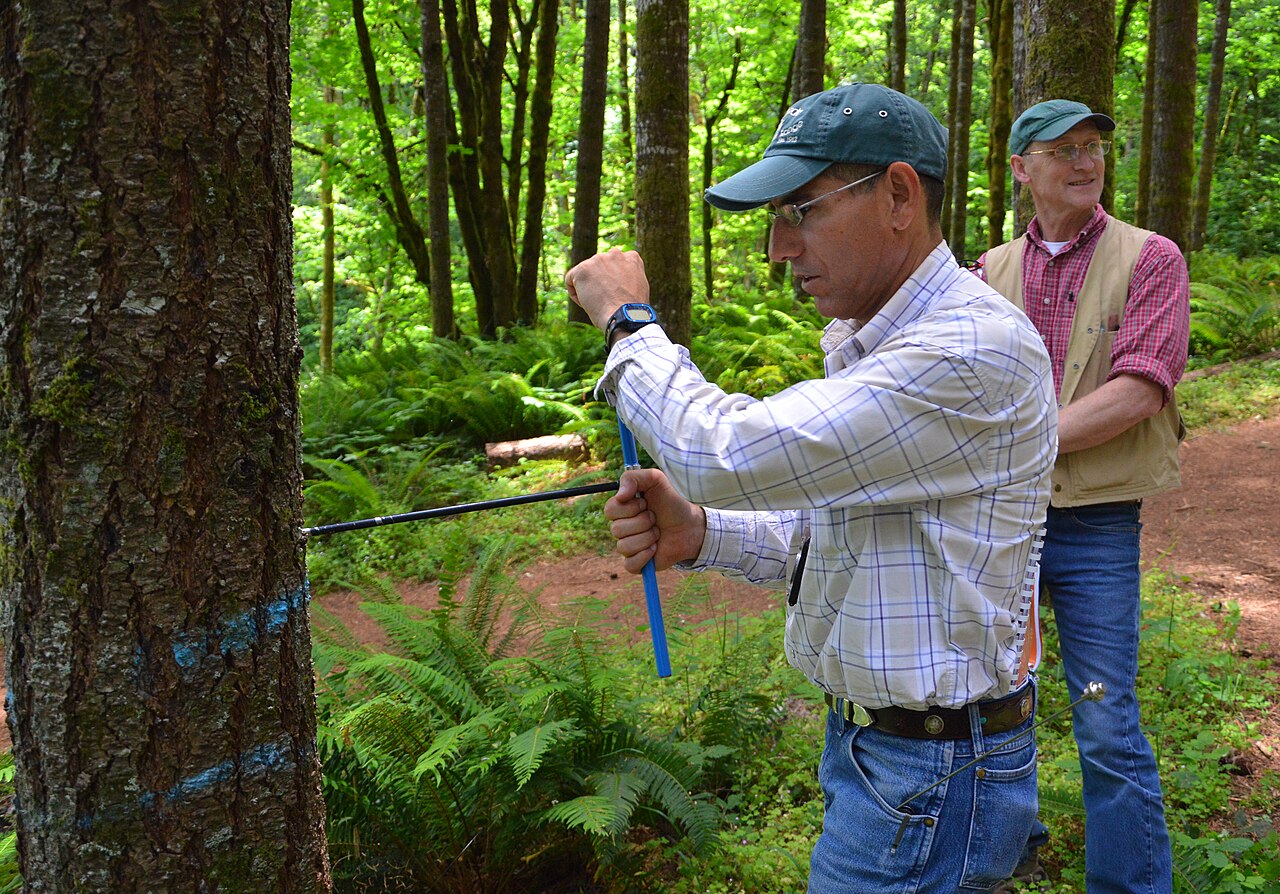
Field observations need a sampling frame, consistent measurements, and independent sampling units. Accessible locations alone can misrepresent the forest. This photograph illustrates fieldwork rather than supplying the numerical examples in this guide.
Photo: NRCS Oregon / USDA · Source · U.S. federal government public domain · Unmodified.Measure diversity at the right scale
Species richness counts species; evenness describes their relative abundance. Compare equal sampling effort and comparable areas before inferring that one site is more diverse. A larger sample can reveal more rare species even if the underlying community has not changed. Genetic diversity within a population and habitat diversity across a landscape answer different questions from a species count.
Biodiversity can support ecosystem functioning through differences in resource use and responses to disturbance. This is a mechanism, not a guarantee that adding any species improves every service. An invasive competitor might increase a local species count temporarily while damaging native populations. Explain whose abundance or function changes and why.
An indicator species is useful only in relation to its known tolerances and the sampling method. Absence may reflect pollution, unsuitable habitat, season, or failure to detect it. Repeated observations, multiple indicators, and physical measurements provide stronger evidence than a single missing organism.
Use island biogeography to reason about fragmented habitat
Treat a habitat patch as an island when surrounding land is difficult for its organisms to cross. Isolation reduces colonization; small area can reduce population sizes and habitat variety, increasing local extinction risk. The equilibrium species number represents a balance of processes, not a claim that community membership never changes.
Edges can differ from interiors in light, humidity, temperature, predators, and invasive species. A narrow reserve can have much of its area near an edge. Therefore equal total area does not guarantee equal interior habitat. The benefit of a corridor depends on which species use it and whether it also spreads disease, fire, or invasive organisms.
When evaluating a conservation design, state the objective first: maintain interior specialists, allow migration, protect a watershed, or preserve several habitat types. Then connect the proposed design to that objective. A corridor cannot compensate for every loss of habitat quality; protection must include management and surrounding land use.
Disturbance and recovery are processes, not a fixed script
Primary succession begins on a surface lacking developed soil; secondary succession retains soil or other biological legacies. Establishment depends on dispersal, available resources, competition, and disturbance history. Do not assume every disturbed site follows the same sequence or reaches one universal climax community.
Resistance describes limited change during a disturbance; resilience describes recovery afterward. A forest can resist a mild storm but recover slowly after a severe fire. Measure the property in question: biomass, species composition, water quality, and productivity may recover at different rates.
Conservation proposals should address the mechanism of the threat. Habitat restoration helps only if necessary environmental conditions can return; captive breeding helps only if release habitat and genetic management are adequate. State a measurable outcome and a realistic limitation rather than writing that a proposal simply “helps biodiversity.”
PAUSE & TRY IT
What would demonstrate resilience after a flood?
Reveal answer
Recovery of a specified measure, such as native plant cover, toward its pre-flood condition over time. Little initial change would instead indicate resistance.
Evaluate a conservation claim with measurable outcomes
Define the target before judging success. Species occupancy, population size, genetic exchange, vegetation cover, and water quality are different outcomes. A corridor may improve movement before a measurable increase in population size appears. State the expected time scale and mechanism.
Compare conditions before and after with suitable comparison sites where possible. A population increase after protection could also reflect favorable weather across the whole region. A reference site helps distinguish a broad regional change from the local intervention’s effect, although site differences still need consideration.
Restoration is more than increasing a count of planted individuals. Survival, reproduction, habitat function, and effects on existing communities matter. Planting an inappropriate fast-growing species can increase cover while reducing the intended biodiversity value.
PAUSE & TRY IT
Why report percentage points rather than percent when subtracting two percentages directly?
Reveal answer
The subtraction describes an absolute difference in percentages. Relative percent change instead divides by the initial percentage.
Connect genetic diversity with environmental change
Genetic variation supplies differences on which selection can act. A small isolated population can lose variation through drift and experience inbreeding effects. A corridor can enable gene flow, but its usefulness depends on whether organisms actually move and reproduce across it.
A specialist’s narrow requirements can create vulnerability when a key resource disappears, while a generalist may use alternatives. These categories are context-dependent tendencies, not rankings of evolutionary quality. A specialist can thrive in stable suitable habitat.
When discussing ecosystem services, name the benefit and the ecological process. Pollination connects animal movement to plant reproduction; flood mitigation connects storage and flow resistance to downstream peak water levels. A vague statement that biodiversity is good does not explain the service or its limits.
FROM IDEA TO APPLICATION
Worked examples
Richness versus evenness
Site A has four species with 25 individuals each. Site B has four species with counts 85, 5, 5, and 5. Compare diversity components.
Reveal worked solution
- Both sites contain four species, so richness is equal.
- Site A distributes individuals evenly; Site B is dominated by one species.
Site A has greater evenness. Equal richness does not mean identical species diversity.
A reserve prediction
Two otherwise comparable forest patches differ in size and isolation. Predict which has lower local extinction risk and explain.
Reveal worked solution
- Larger patches can support larger populations and more habitat variety.
- Less isolated patches can receive immigrants that replenish declining populations.
The larger, less isolated patch is generally predicted to have lower local extinction risk, with habitat quality and species traits held comparable.
Measure the effect of a corridor
A corridor connects two forest patches. Suggest evidence stronger than simply counting trees planted.
Reveal worked solution
- Identify the mechanism: improved movement between populations.
- Measure crossings or genetic exchange before and after construction.
- Compare with similar unconnected patches and account for sampling effort.
Increased successful movement or gene flow relative to comparison sites supports the corridor’s intended function.
Separate sampling from ecology
A survey finds 12 species in 100 samples at Site A and 8 in 20 samples at Site B. Can you conclude A is more species-rich?
Reveal worked solution
- Sampling effort differs fivefold.
- More samples can detect rare species.
- Compare standardized effort or a suitable species-accumulation analysis before judging the communities.
The observed counts alone do not establish a fair richness comparison.
Interpret a restoration comparison
Native cover rises from 20% to 50% at a restored site and from 20% to 35% at a comparison site.
Reveal worked solution
- The restored site gains 30 percentage points.
- The comparison gains 15 percentage points.
- The difference in changes is 15 percentage points, though comparability and replication still matter.
The comparison strengthens the inference but does not eliminate every alternative explanation.
A corridor outcome
Animals cross a new corridor, but genetic diversity has not changed after one month.
Reveal worked solution
- Movement is an early outcome.
- Gene flow requires successful reproduction and may take generations to detect.
The short-term genetic result does not by itself show the corridor failed.
MAKE THE DISTINCTION
Common mistakes, clearer reasoning
The trapMore species automatically means every ecosystem function improves.
The better explanationEffects depend on species identities, interactions, and the function measured.
The trapSecondary succession starts with no soil.
The better explanationThat describes a key feature of primary succession; secondary succession retains soil or other legacies.
RETRIEVE BEFORE YOU REVEAL
Practice checkpoints
Revisit the quick checks from this guide without looking back. Explain why, then reveal the answer.
1. Why can low genetic diversity increase vulnerability?
Reveal answer
It can reduce the range of heritable responses to disease or environmental change and increase inbreeding risks.
2. What is an edge effect?
Reveal answer
A change in conditions or interactions near a habitat boundary, such as altered light, temperature, or predation.
3. How would you assess a corridor’s success?
Reveal answer
Measure relevant movement, gene flow, occupancy, or survival before and after, with suitable comparison sites where possible.
4. Why may equal species richness hide a biodiversity difference?
Reveal answer
Relative abundances and genetic diversity can differ even when species counts match.
5. What distinguishes resistance from resilience?
Reveal answer
Resistance is limited change during disturbance; resilience is recovery afterward.
6. What would demonstrate resilience after a flood?
Reveal answer
Recovery of a specified measure, such as native plant cover, toward its pre-flood condition over time. Little initial change would instead indicate resistance.
7. Why report percentage points rather than percent when subtracting two percentages directly?
Reveal answer
The subtraction describes an absolute difference in percentages. Relative percent change instead divides by the initial percentage.
Key language
- Richness
- The number of species in a defined sample or area.
- Evenness
- How similarly abundance is distributed among species.
- Resistance
- The degree to which a system withstands change during disturbance.
- Resilience
- The capacity to recover after disturbance.
Biodiversity affects ecosystem functioning and shapes conservation responses to population and climate pressures.