
On this page0% through guide
Land and Water Use
Resource management changes yields, habitats, soils, and water budgets.
What you’ll learn
- Compare agricultural and forestry practices with trade-offs.
- Evaluate irrigation, mining, fishing, and urban development.
- Propose specific, measurable sustainability improvements.
Before you begin
A renewable resource can still be depleted when harvest exceeds replenishment. A watershed collects drainage into a common outlet; activities upstream can affect users downstream.
Explain these starting ideas in your own words. Revisit them whenever a later step feels unclear.
Agricultural yield has environmental costs and benefits
Mechanization, irrigation, fertilizers, improved crop varieties, and pest management can increase food production. They can also increase energy use, nutrient runoff, soil degradation, and dependence on purchased inputs. A comparison should specify yield per area, resource input, and off-site effects rather than declaring all technology good or bad.
Monocultures can simplify management but may increase vulnerability to particular pests and reduce habitat diversity. Crop rotation, intercropping, cover crops, and agroforestry can alter nutrient cycling, erosion, and pest dynamics. Their feasibility depends on climate, labor, markets, and crop requirements.
Soil conservation protects a slow-forming resource
Tillage can expose soil to erosion by wind and water. Contour farming, terracing, windbreaks, and cover crops reduce erosion through different mechanisms. Conservation tillage can retain cover but may involve trade-offs in weed management. Explain which pathway of soil loss the practice targets.
Fertilizer adds nutrients but does not automatically rebuild soil structure or organic matter. Excess application can move nitrogen and phosphorus into water. Applying an appropriate amount at an appropriate time and location can improve uptake and reduce loss, but requires information about soil and crop needs.
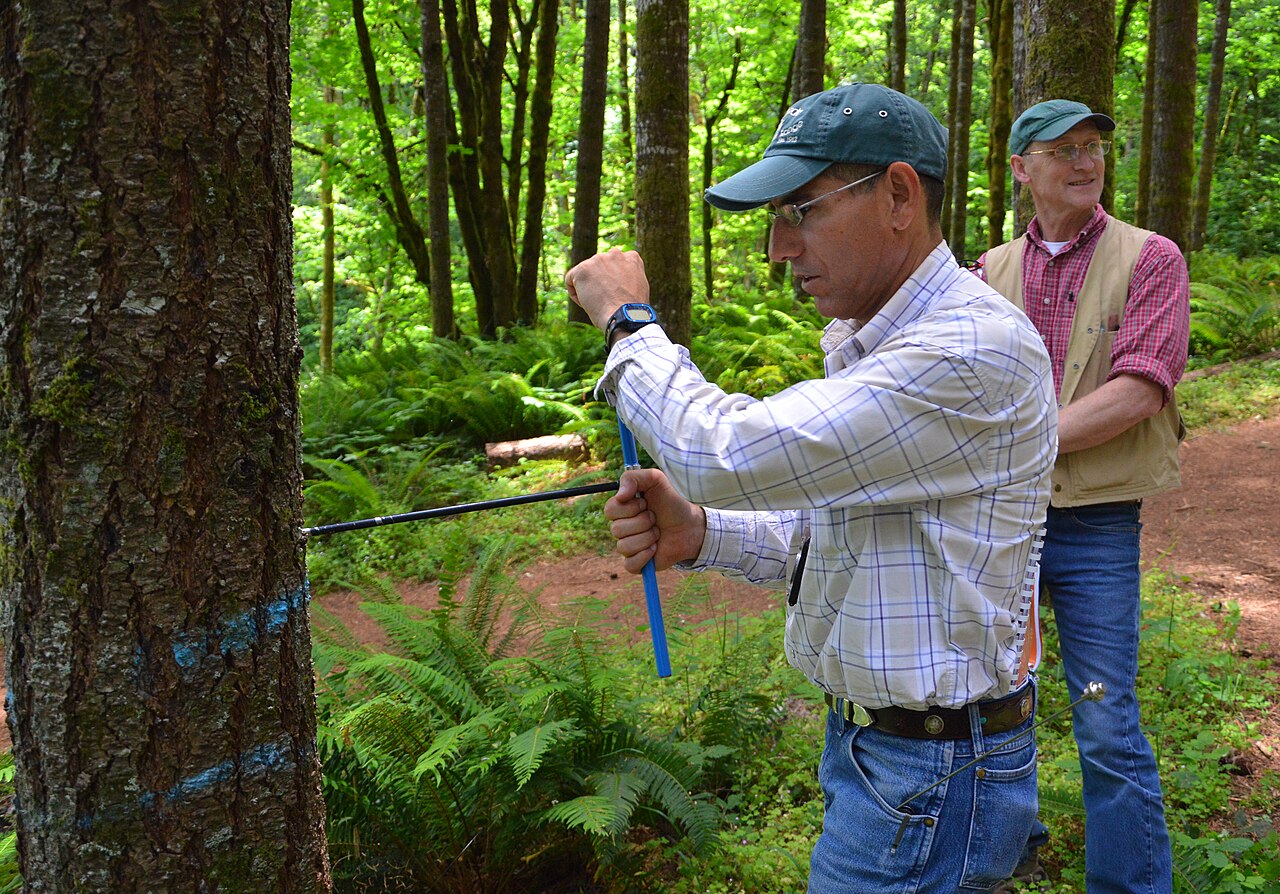
Field observations need a sampling frame, consistent measurements, and independent sampling units. Accessible locations alone can misrepresent the forest. This photograph illustrates fieldwork rather than supplying the numerical examples in this guide.
Photo: NRCS Oregon / USDA · Source · U.S. federal government public domain · Unmodified.PAUSE & TRY IT
How does a cover crop reduce erosion?
Reveal answer
Roots stabilize soil and surface cover reduces raindrop impact and runoff velocity.
Irrigation efficiency and groundwater sustainability differ
Flood and furrow systems can lose water to evaporation, runoff, or infiltration beyond roots. Sprinklers and drip systems can improve delivery efficiency under suitable conditions. Drip systems may have higher installation and maintenance demands and can clog.
Irrigation in dry climates can leave salts behind as water evaporates or is transpired. Poor drainage can worsen salinization and waterlogging. Improving field efficiency does not guarantee reduced basin-wide withdrawal if saved water is used to expand irrigated acreage. Track the actual water budget.
Read figure values as text
Water intensity: 1: 200; 2: 140
PAUSE & TRY IT
Why can irrigation increase soil salinity?
Reveal answer
Water leaves through evaporation and transpiration while dissolved salts remain, especially with inadequate drainage.
Harvesting and extraction alter more than the target resource
Clear-cutting can increase short-term timber access but remove habitat and increase erosion. Selective harvest can retain more structure but still requires roads and management. Overgrazing can remove protective vegetation and compact soil. Mining can disturb land, generate waste rock, and expose materials that produce contaminated drainage.
Fishing methods differ in bycatch, habitat damage, and selectivity. Aquaculture can supply food but may create nutrient waste, disease, escape, or feed-sourcing concerns depending on the system. Sustainable yield depends on population dynamics and uncertainty, not simply harvesting the same number every year.
PAUSE & TRY IT
What is a potential trade-off of aquaculture?
Reveal answer
It can increase food supply while creating waste, disease, escape, or feed-resource impacts depending on design.
Urban design changes flows and shared resources
Sprawl can increase habitat fragmentation, vehicle travel, and impervious cover. Compact development, transit, permeable surfaces, and green infrastructure address different impacts. A rain garden can slow and infiltrate runoff but needs suitable soil, sizing, and maintenance.
Shared resources can be overused when individual users receive benefits while costs are distributed. Rules, monitoring, community management, and economic incentives can change those incentives. An ecological footprint is a model of resource demand, not a complete measure of every environmental effect.
Follow an agricultural decision through several systems
Irrigation can increase crop production while reducing streamflow or groundwater storage. In dry settings, evaporation leaves dissolved salts behind; inadequate drainage allows salinization to damage crops. Efficient irrigation can reduce withdrawals per hectare, but expanded irrigated acreage can offset some total savings.
Fertilizers supply nutrients but runoff can contribute to eutrophication. Integrated pest management combines monitoring, thresholds, biological controls, crop practices, and selective pesticide use. It does not mean that pesticides are never used. Explain how a proposed practice reduces a particular environmental pathway.
PAUSE & TRY IT
Why does replanting not immediately replace an old-growth ecosystem?
Reveal answer
Complex habitat structure, soils, and ecological relationships take time to develop and may not return fully.
Distinguish harvest methods and their consequences
Clear-cutting removes most trees from an area, rapidly changing light, habitat, runoff, and erosion risk. Selective harvesting leaves more cover but still creates access roads and disturbance. Replanting trees does not immediately recreate the structure, species composition, or soil conditions of an old forest.
Fishing pressure can reduce target populations and affect food webs. Bycatch harms nontarget organisms, while bottom trawling can disturb habitat. Catch limits, gear changes, protected areas, and monitoring address different problems; choose a solution that matches the mechanism rather than listing unrelated policies.
PAUSE & TRY IT
How can irrigation cause salinization?
Reveal answer
Evaporation removes water while leaving salts, especially where drainage is inadequate.
Evaluate urban design and resource footprints
Impervious surfaces speed runoff and reduce infiltration. Green roofs, permeable pavement, rain gardens, and riparian buffers can slow or store stormwater, although capacity depends on storm intensity, soil, and maintenance. A design that manages a small storm may overflow during an extreme event.
An ecological footprint estimates resource demand in terms of biologically productive area under specified assumptions. It is useful for comparisons but does not summarize every environmental harm. When comparing alternatives, include a common functional basis such as per passenger-kilometer or per kilogram of food.
Vegetation and permeable soil encourage infiltration. Impervious surfaces shift more precipitation toward rapid runoff, increasing downstream flood and pollution risks.
Compare agricultural practices by mechanism and trade-off
Irrigation increases water availability but can deplete surface or groundwater supplies. In dry climates, evaporation leaves salts behind; poor drainage can worsen salinization. Waterlogging reduces air in soil pores and can damage roots. Drip irrigation can reduce some losses, but installation, maintenance, and water quality matter.
Fertilizer adds limiting nutrients, increasing yield under suitable conditions. Excess nutrients can leach or run off, promoting eutrophication. Pesticides can reduce crop losses but select for resistance and affect non-target organisms. Integrated pest management combines monitoring, thresholds, and multiple controls rather than applying chemicals automatically.
Crop rotation, cover crops, contour practices, and reduced tillage address different problems. Explain whether a practice reduces erosion, restores nutrients, breaks pest cycles, or improves structure. No practice eliminates every environmental cost, and a benefit in one location can depend on climate and soil.
PAUSE & TRY IT
Why does repeated use of one pesticide promote resistance?
Reveal answer
Susceptible pests are removed more strongly, while resistant survivors contribute disproportionately to later generations. The pesticide selects existing heritable variation rather than intentionally teaching pests to resist.
Follow resource extraction beyond the extraction site
Mining exposes material and can generate waste rock, habitat disturbance, and contaminated drainage. Acid mine drainage forms when suitable sulfur-bearing minerals react with oxygen and water; the resulting acidity can mobilize metals. Name the chemistry and transport pathway rather than assuming all mining impacts are identical.
Forest removal changes habitat, carbon storage, interception, runoff, and erosion. Selective harvesting can reduce some impacts relative to clear-cutting but still requires roads and management. Sustainable yield depends on regeneration and ecosystem functions, not simply planting one seedling for every harvested tree.
Overharvesting fisheries can reduce reproductive populations and alter food webs. Bycatch affects non-target species; destructive fishing can damage habitat. Aquaculture can reduce pressure on some wild stocks while creating nutrient, disease, feed, or escape concerns. Compare particular systems rather than treating all aquaculture as one method.
Evaluate urban land use across a full system
Urban sprawl can increase habitat fragmentation, vehicle travel, and infrastructure demand. Compact development and public transport may reduce per-capita land or fuel use, but local design and accessibility matter. Heat islands arise from surface properties, reduced vegetation, and waste heat; they are distinct from the global greenhouse mechanism.
An ecological footprint estimates resource demand in an area-based framework. It is useful for comparing consumption patterns but depends on accounting choices and does not capture every form of harm. A life-cycle comparison includes extraction, production, transport, use, and disposal, so a low-impact use phase does not automatically imply a low-impact product.
A strong recommendation states a specific action, its mechanism, and a measurable outcome. For example, riparian vegetation can intercept sediment and stabilize banks, but it does not make unlimited upstream nutrient application harmless.
Explain pesticide resistance as population change
A pesticide can remove susceptible individuals more effectively than resistant ones. If resistance is heritable, survivors contribute disproportionately to subsequent generations. The population’s trait frequencies change; individuals do not become resistant because they need to survive.
Integrated pest management uses monitoring and action thresholds to choose controls. Biological controls, crop rotation, habitat management, and targeted chemical use can reduce reliance on one mechanism. Introducing a biological control also requires evaluating non-target effects and the possibility of a new ecological problem.
A yield benefit must be compared with costs and external impacts. A practice that reduces one pesticide may increase labor or another input. A strong evaluation describes the particular crop, pest, environmental pathway, and management constraints.
Account for land-use impacts beyond the visible site
A road into a forest can fragment habitat, increase access for further extraction, and alter drainage beyond its immediate footprint. Edge effects and isolation mean the ecological impact is not captured by cleared area alone. Compare configuration and habitat quality as well as total hectares.
For mining or agriculture, follow sediment and dissolved contaminants into receiving waters. Erosion removes material from one location and deposits it elsewhere; sediment can reduce light and alter habitat. A buffer strip acts on transport pathways but may not capture every dissolved pollutant.
Sustainable management requires a time scale. Harvesting at or below a simple regrowth estimate may still damage soil, age structure, species composition, or habitat. Define what is being sustained, for whom, and over what interval.
PAUSE & TRY IT
Does a larger total harvest always indicate greater yield per hectare?
Reveal answer
No. Divide production by cultivated area to compare yield intensity.
FROM IDEA TO APPLICATION
Worked examples
Calculate an irrigation saving
A farm delivers 600,000 L of usable crop water. System A is 60% efficient and system B is 80% efficient. Compare required withdrawals.
Reveal worked solution
- Withdrawal A = 600, = 1,000,000 L.
- Withdrawal B = 600, = 750,000 L.
- Difference = 250,000 L.
B requires 25% less withdrawal for the same usable delivery, assuming the stated efficiencies and no expansion in demand.
Make a conservation proposal testable
Propose a way to reduce sediment entering a stream from a sloped field.
Reveal worked solution
- Install a vegetated buffer or use contour practices suited to the field.
- Explain that vegetation slows runoff and traps sediment or contouring reduces downslope flow.
- Compare sediment concentration or load during similar storms before and after.
A specific mechanism plus a measurable outcome is stronger than simply recommending “sustainable farming.”
Water savings with a common baseline
A farm currently uses 8,000 /year on 50 ha. New irrigation cuts use per hectare by 25%, but acreage rises to 60 ha. Compare total use.
Reveal worked solution
- Original total: 8,000×50=400,000 .
- New per-hectare use: 8,000×0.75=6,000.
- New total: 6,000×60=360,000 .
Total use falls by 40,000 , or 10%, rather than 25% because acreage expanded.
Water savings versus yield
A farm changes from 8,000 to 5,600 m3 of irrigation per season while yield remains 40 tonnes.
Reveal worked solution
- Water saved = 2,400 m3.
- Percentage reduction = 2,,000 × 100 = 30%.
- Water per tonne falls from 200 to 140 .
Water use falls 30% with unchanged measured yield; other impacts still require evidence.
Compare land productivity
Farm A grows 300 tonnes on 100 ha; Farm B grows 360 tonnes on 150 ha.
Reveal worked solution
- A yields 3 tonnes/ha.
- B yields 2.4 tonnes/ha.
B has greater total output but lower output per hectare.
A sediment-control mechanism
Explain how contour planting can reduce erosion on a slope.
Reveal worked solution
- Rows follow elevation contours rather than directing flow straight downhill.
- This can slow runoff and reduce its ability to detach and transport soil.
The mechanism is reduced runoff transport, with effectiveness depending on slope, storms, and maintenance.
MAKE THE DISTINCTION
Common mistakes, clearer reasoning
The trapMore efficient irrigation necessarily reduces total regional water use.
The better explanationExpanded acreage or changed demand can offset efficiency gains.
The trapA sustainable harvest is a fixed amount forever.
The better explanationPopulation growth, environmental conditions, and uncertainty change the harvest a system can support.
RETRIEVE BEFORE YOU REVEAL
Practice checkpoints
Revisit the quick checks from this guide without looking back. Explain why, then reveal the answer.
1. Why can irrigation increase soil salinity?
Reveal answer
Water leaves through evaporation and transpiration while dissolved salts remain, especially with inadequate drainage.
2. How does a cover crop reduce erosion?
Reveal answer
Roots stabilize soil and surface cover reduces raindrop impact and runoff velocity.
3. What is a potential trade-off of aquaculture?
Reveal answer
It can increase food supply while creating waste, disease, escape, or feed-resource impacts depending on design.
4. Why does replanting not immediately replace an old-growth ecosystem?
Reveal answer
Complex habitat structure, soils, and ecological relationships take time to develop and may not return fully.
5. How can irrigation cause salinization?
Reveal answer
Evaporation removes water while leaving salts, especially where drainage is inadequate.
6. Why does repeated use of one pesticide promote resistance?
Reveal answer
Susceptible pests are removed more strongly, while resistant survivors contribute disproportionately to later generations. The pesticide selects existing heritable variation rather than intentionally teaching pests to resist.
7. Does a larger total harvest always indicate greater yield per hectare?
Reveal answer
No. Divide production by cultivated area to compare yield intensity.
Key language
- Bycatch
- Unintended organisms captured during fishing.
- Salinization
- Accumulation of salts in soil or water.
- Integrated pest management
- A coordinated approach using monitoring and multiple pest-control methods.
- Impervious surface
- A surface that strongly limits infiltration.
Land management links biodiversity, population demand, energy use, and pollution prevention.