
On this page0% through guide
Force and Translational Dynamics
Use interactions and a defined system to explain acceleration.
What you’ll learn
- Construct correct free-body diagrams.
- Apply Newton’s laws in components.
- Analyze friction, circular motion, and gravitation.
Before you begin
A force is an interaction exerted by another object. Mass measures inertia; weight is gravitational force. A free-body diagram includes forces acting on the chosen system, not every force in the surrounding situation.
Explain these starting ideas in your own words. Revisit them whenever a later step feels unclear.
Draw forces acting on the chosen object
A free-body diagram contains forces exerted on the selected object by other objects. Weight, contact forces, tension, and friction are interactions. Velocity and acceleration are not forces, and a separate “force of motion” should not be added. Label the agent when a force could be ambiguous.
Newton’s second law relates net external force to the object’s acceleration. Balanced forces imply zero acceleration, not necessarily zero velocity. If several objects are selected as one system, internal action–reaction pairs cancel in the system force sum but can matter when individual objects are analyzed.
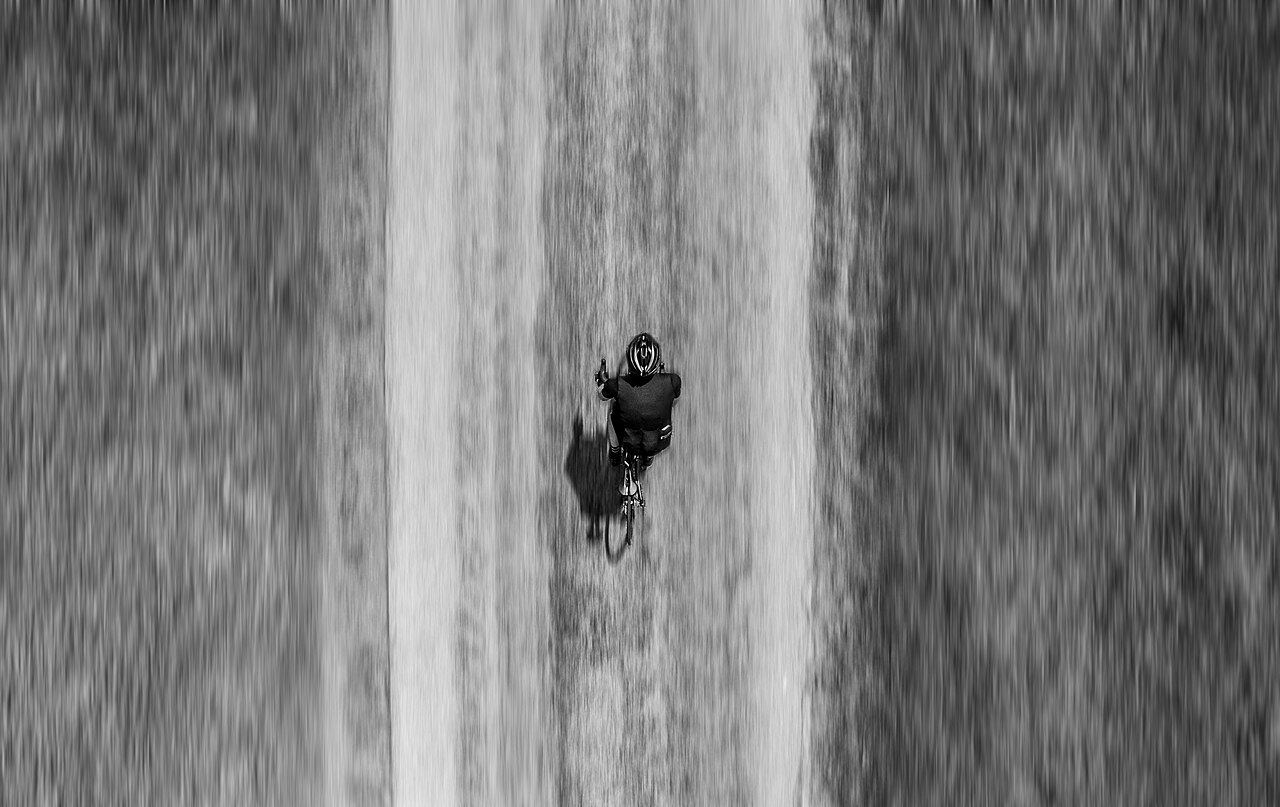
Choose a system boundary before applying force or energy reasoning. A photograph captures one instant; it cannot by itself determine velocity, acceleration, or net force.
Photo: Clemenspool · Source · CC0 1.0 · Unmodified.Only forces acting on the selected block appear. Compare vector components to find net force; do not assume the block is in equilibrium. Arrow lengths are illustrative.
Read figure values as text
Equilibrium friction: 0: 0; 0.4166666666666667: 0.4166666666666667; 0.8333333333333334: 0.8333333333333334; 1.25: 1.25; 1.6666666666666667: 1.6666666666666667; 2.0833333333333335: 2.0833333333333335; 2.5: 2.5; 2.9166666666666665: 2.9166666666666665; 3.3333333333333335: 3.3333333333333335; 3.75: 3.75; 4.166666666666667: 4.166666666666667; 4.583333333333333: 4.583333333333333; 5: 5; 5.416666666666667: 5.416666666666667; 5.833333333333333: 5.833333333333333; 6.25: 6.25; 6.666666666666667: 6.666666666666667; 7.083333333333333: 7.083333333333333; 7.5: 7.5; 7.916666666666667: 7.916666666666667; 8.333333333333334: 8.333333333333334; 8.75: 8.75; 9.166666666666666: 9.166666666666666; 9.583333333333334: 9.583333333333334; 10: 10; 10.416666666666666: 10.416666666666666; 10.833333333333334: 10.833333333333334; 11.25: 11.25; 11.666666666666666: 11.666666666666666; 12.083333333333334: 12.083333333333334; 12.5: 12.5; 12.916666666666666: 12.916666666666666; 13.333333333333334: 13.333333333333334; 13.75: 13.75; 14.166666666666666: 14.166666666666666; 14.583333333333334: 14.583333333333334; 15: 15; 15.416666666666666: 15.416666666666666; 15.833333333333334: 15.833333333333334; 16.25: 16.25; 16.666666666666668: 16.666666666666668; 17.083333333333332: 17.083333333333332; 17.5: 17.5; 17.916666666666668: 17.916666666666668; 18.333333333333332: 18.333333333333332; 18.75: 18.75; 19.166666666666668: 19.166666666666668; 19.583333333333332: 19.583333333333332; 20: 20
PAUSE & TRY IT
Can an object move when net force is zero?
Reveal answer
Yes. Its velocity remains constant in an inertial frame.
Third-law partners act on different objects
When object A exerts a force on B, B exerts an equal-magnitude opposite-direction force on A. The pair acts on different objects, so the two forces do not cancel on either individual free-body diagram. A truck and a small car exert equal contact forces on each other during a collision even though their accelerations can differ.
A normal force is perpendicular to the contact surface, not automatically vertically upward or equal to mg. On an incline, resolve weight into components parallel and perpendicular to the surface. A rope’s idealized tension may be uniform if the rope is massless and pulleys are ideal; otherwise additional modeling is needed.
Friction responds to the contact situation
Static friction can take values from zero up to a maximum; it is not always equal to μsN. It acts to oppose the relative slipping tendency at the contact. Kinetic friction in the simple model has magnitude μkN and opposes relative sliding. Determine whether slipping occurs before choosing the friction relationship.
Friction can accelerate an object in its direction of motion, as when a conveyor belt speeds up a box. The statement “friction always points backward” is therefore unreliable. Use relative contact motion, not just the object’s velocity relative to the room.
Circular motion requires inward net force
An object moving at constant speed in a circle still accelerates because its velocity direction changes. The radial acceleration has magnitude and points toward the center. “Centripetal force” names the inward net-force requirement; it is not an additional physical interaction to add beside tension or gravity.
Separate radial and tangential directions when speed changes. The radial net force controls curvature, while a tangential component changes speed. In a vertical circle, gravity’s radial contribution changes with position, so tension or normal force need not be constant.
PAUSE & TRY IT
Why does constant-speed circular motion require force?
Reveal answer
Velocity direction changes, so there is inward acceleration.
Gravity depends on separation
Newton’s gravitational model gives an attractive force proportional to the product of masses and inversely proportional to center-to-center separation squared. Near Earth’s surface, g can be treated as nearly constant over modest height changes. At orbital distances, use the distance from Earth’s center rather than height above the ground alone.
An orbiting object is in free fall and still experiences gravity. Apparent weightlessness can result from the absence of a supporting normal force, not the absence of gravitational force. For a circular orbit, gravity can supply the required inward acceleration.
PAUSE & TRY IT
What is the effect of doubling separation in the inverse-square gravity model?
Reveal answer
The gravitational force becomes one quarter as large.
Resolve forces along useful axes
For motion on an incline, axes parallel and perpendicular to the surface often simplify the equations. Weight has components mg sinθ parallel to the slope and mg cosθ perpendicular to it when θ is the incline angle. The normal force is perpendicular to the surface and need not equal mg. It equals the appropriate value required by the perpendicular acceleration equation.
Write a separate net-force equation for each axis. If the object has no acceleration perpendicular to the incline, that component’s net force is zero. Friction acts along the surface and opposes relative sliding or its tendency; it does not always oppose the object’s velocity relative to the ground. Check which surfaces interact before assigning its direction.
PAUSE & TRY IT
Why is the normal force on an incline not generally mg?
Reveal answer
It balances the perpendicular component of other forces when perpendicular acceleration is zero, not the full weight.
Connect objects without confusing internal and external forces
A massless inextensible string over an ideal pulley can impose a common acceleration magnitude on connected objects. Analyze each object with its own force diagram or choose the whole system to eliminate internal tension from the net-force equation. The tension can then be recovered from an individual object’s equation.
Equal tension on both sides is an idealization that may fail for a pulley with significant rotational inertia. Newton’s third-law pairs act on different objects and have equal magnitude even when the objects have different accelerations. A large and small object interacting do not exert unequal forces merely because one moves more dramatically. Their acceleration magnitudes differ because their masses differ.
PAUSE & TRY IT
What supplies centripetal force for an ideal satellite orbit?
Reveal answer
Gravity supplies the inward net force; no additional force is added.
Circular motion is acceleration, not an extra force
The inward acceleration required for circular motion is . The net inward force can be supplied by tension, gravity, friction, a normal force, or components of several forces. Do not add a separate “centripetal force” after already drawing the physical interactions; centripetal describes the direction of the net force.
For an orbit, gravity can provide the needed inward acceleration. For a car turning on a level road, static friction can supply it. At the top of a vertical circle, inward points downward; at the bottom, inward points upward. Choose the radial direction at the actual location before assigning signs, and distinguish changes in direction from changes in speed.
Draw forces on one selected object
Identify the object or system and draw only interactions exerted on it. Weight is the gravitational interaction, the normal force is perpendicular to a contact surface, tension acts along an ideal taut cord, and friction is tangent to contact. Velocity and acceleration are not extra forces. The force the object exerts on another object belongs on the other object’s diagram.
Newton’s third-law pair acts on different objects and therefore does not cancel on one object’s diagram. For a book on a table, the book’s weight and the table’s normal force can balance, but they are not a third-law pair. The gravitational partner is the book’s force on Earth.
Write component equations after choosing axes. A normal force is not automatically mg: other vertical forces or vertical acceleration can change it. Static friction adjusts up to a maximum; it is not always equal to μsN. Determine the required value from the motion or equilibrium conditions, then compare it with the limit.
Use Newton’s second law across connected systems
For constant mass, net force determines acceleration through ΣF=ma. Zero net force permits rest or constant velocity; it does not require zero velocity. For connected objects, draw separate diagrams when internal forces such as tension are requested. A combined-system equation can eliminate internal forces and simplify the acceleration calculation.
Ideal massless cords and frictionless massless pulleys impose useful constraints, but do not silently apply those constraints to a massive pulley. On an incline, resolve gravity parallel and perpendicular to the surface. The component down the slope is mg sin θ when θ is measured from horizontal; the perpendicular component is mg cos θ.
A force model should reproduce observed direction and magnitude. If a computed static-friction requirement exceeds its maximum, the assumed no-slip state is not feasible. If an acceleration sign is negative, interpret it relative to your chosen positive direction rather than discarding the result.
Recognize circular motion as acceleration toward a center
An object moving around a circle changes velocity direction even at constant speed. The radial acceleration magnitude is . “Centripetal force” names the net inward component of the actual forces; it is not an additional interaction to add beside tension, gravity or a normal force.
At the top and bottom of a vertical circle, write inward as the radial direction for each location and resolve the actual forces accordingly. A contact force can vanish at the threshold of losing contact. Circular-motion equations do not guarantee that the object can remain constrained to the circle under every speed.
For gravitational circular motion, equate the gravitational force to the required radial net force under the simplified two-body assumptions. Mass can cancel for the orbiting object. Check that radius is measured from the central body’s center rather than from its surface.
PAUSE & TRY IT
A car moves at constant speed around a curve. Is its net force zero?
Reveal answer
No. Its velocity direction changes, requiring an inward net force and radial acceleration.
A free-body diagram is a system-specific argument
Choose one object or a clearly defined system and draw only external forces acting on it. Weight is Earth’s force on the object; a normal force is a contact force perpendicular to a surface; friction is tangential contact force. Do not add a separate “force of motion” or treat ma as another physical force.
Newton’s third-law partners act on different objects, so they do not cancel in one object’s force sum. Within a larger combined system, internal force pairs cancel in the net external force calculation. This is a reason to choose a combined system when internal tensions are not the target.
Resolve forces along useful axes, often parallel and perpendicular to an incline. The normal force is not automatically mg; it follows from the perpendicular force equation and acceleration. A sloped surface, an extra applied force, or vertical acceleration changes it.
PAUSE & TRY IT
Why should a third-law reaction force not be placed on the same object’s diagram?
Reveal answer
It acts on the other interacting object. A free-body diagram contains forces acting on the selected object only.
Circular motion is an acceleration requirement
Centripetal acceleration points toward the center and has magnitude . The net inward component of actual forces must equal . “Centripetal force” names this resultant requirement, not a new force to add alongside tension, gravity, or normal force.
In a vertical circle, gravity’s radial contribution changes with position. At the top, it can point toward the center; at the bottom, away from it. Write the radial equation separately at each location using a consistent inward-positive direction. The minimum speed for maintaining contact depends on the physical constraint.
Uniform circular motion has constant speed but changing velocity direction. Tangential acceleration changes speed; radial acceleration changes direction. A force can have both components. A curved path alone does not tell you that the force magnitude is constant.
FROM IDEA TO APPLICATION
Worked examples
Static friction is adjustable
A 5.0 kg box rests on a horizontal floor with μs = 0.40. A 10 N horizontal push is applied. Use g = 10 . Find friction and acceleration.
Reveal worked solution
- Normal force is 50 N under the stated vertical conditions.
- Maximum static friction is 0.40 × 50 = 20 N.
- Only 10 N is needed to balance the push, which is below the maximum.
Static friction is 10 N opposite the push and acceleration is zero.
Do not add a new centripetal interaction
A 0.50 kg object moves at 4.0 in a horizontal circle of radius 2.0 m. Find the required inward net force.
Reveal worked solution
- Use .
- 0.50 × = 4.0 N.
- Identify actual forces in the physical setup to supply this net result.
4.0 N inward. This is the net radial requirement, not an additional force.
An ideal two-mass system
Masses 3.0 kg and 2.0 kg hang on opposite sides of an ideal pulley. Use g=10 . Find acceleration and tension.
Reveal worked solution
- The net driving force for the system is (3−2)g=10 N.
- Total mass is 5 kg, so acceleration magnitude is 2 .
- For the descending 3 kg mass, 30−T=3(2).
Acceleration is 2 , with the heavier mass descending; tension is 24 N.
Check whether static friction is sufficient
A 5.0 kg box is pushed horizontally with 12 N on a level surface. Let μs=0.40 and g=10 . Does it start moving?
Reveal worked solution
- The normal force is 50 N under the stated vertical conditions.
- Maximum static friction is 0.40(50)=20 N.
- Only 12 N is needed to balance the push, below the limit.
The box can remain at rest with 12 N of static friction, not 20 N.
Normal force in an accelerating elevator
A 60 kg person accelerates upward at 2 . Use g=10 .
Reveal worked solution
- Choose upward positive: N−mg=ma.
- N=60(10+2).
The normal force is 720 N, greater than the 600 N weight.
Tension in a horizontal circle
A 0.5 kg object moves at 4 in a horizontal circle of radius 2 m, with tension supplying the horizontal radial force.
Reveal worked solution
- Required radial force is .
- Substitute 0.5.
The radial tension component is 4 N.
MAKE THE DISTINCTION
Common mistakes, clearer reasoning
The trapThird-law pairs cancel on one object.
The better explanationThey act on different objects.
The trapNormal force always equals weight.
The better explanationIt depends on geometry and other forces and acceleration perpendicular to the surface.
RETRIEVE BEFORE YOU REVEAL
Practice checkpoints
Revisit the quick checks from this guide without looking back. Explain why, then reveal the answer.
1. Can an object move when net force is zero?
Reveal answer
Yes. Its velocity remains constant in an inertial frame.
2. Why does constant-speed circular motion require force?
Reveal answer
Velocity direction changes, so there is inward acceleration.
3. What is the effect of doubling separation in the inverse-square gravity model?
Reveal answer
The gravitational force becomes one quarter as large.
4. Why is the normal force on an incline not generally mg?
Reveal answer
It balances the perpendicular component of other forces when perpendicular acceleration is zero, not the full weight.
5. What supplies centripetal force for an ideal satellite orbit?
Reveal answer
Gravity supplies the inward net force; no additional force is added.
6. A car moves at constant speed around a curve. Is its net force zero?
Reveal answer
No. Its velocity direction changes, requiring an inward net force and radial acceleration.
7. Why should a third-law reaction force not be placed on the same object’s diagram?
Reveal answer
It acts on the other interacting object. A free-body diagram contains forces acting on the selected object only.
Key language
- Free-body diagram
- A representation of external forces on a selected object.
- Normal force
- A contact force perpendicular to a surface.
- Static friction
- A contact force that prevents relative sliding up to a limit.
- Centripetal acceleration
- The inward acceleration associated with curved motion.
Force can be analyzed over time through momentum or over displacement through work and energy.