
On this page0% through guide
Fluids
Pressure and flow connect microscopic interactions to large-scale forces.
What you’ll learn
- Calculate hydrostatic pressure and buoyancy.
- Use continuity to relate flow speed and area.
- Apply Bernoulli’s model with its assumptions.
Before you begin
Density is mass per volume. Pressure is force per area and acts normal to a surface. Gauge pressure is measured relative to atmospheric pressure; absolute pressure includes atmospheric pressure.
Explain these starting ideas in your own words. Revisit them whenever a later step feels unclear.
Pressure is force per area
Pressure describes normal force per unit area. In a fluid at rest, pressure at a point acts in all directions. Hydrostatic pressure increases with depth because lower fluid supports the weight above it. In a connected uniform fluid at rest, points at the same height have the same pressure under the usual conditions.
Distinguish absolute pressure from gauge pressure. Atmospheric pressure is included in absolute pressure; gauge pressure measures excess above a reference atmosphere. The container’s shape does not directly enter the simple depth relation, although it affects total forces on surfaces.
PAUSE & TRY IT
What happens to gauge pressure if depth doubles in a uniform fluid?
Reveal answer
It doubles under the hydrostatic model.
Buoyancy comes from a pressure difference
A submerged object experiences greater pressure on lower surfaces than on upper surfaces, producing an upward resultant force. Archimedes’ principle equates buoyant force to the weight of displaced fluid. Use displaced volume, which may be less than the object’s full volume when it floats partially submerged.
For a floating object at rest with no additional vertical forces, buoyant force equals weight. A fully submerged object need not be in equilibrium: compare buoyancy and weight to determine acceleration. The fluid’s density belongs in the buoyancy expression, not the object’s density.
Read figure values as text
P=9.8h kPa: 0: 0; 10: 98
PAUSE & TRY IT
Does a submerged object lose mass when its scale reading decreases?
Reveal answer
No. Buoyancy supplies part of the upward support, reducing the required scale force.
Continuity conserves mass flow
For steady incompressible flow through a pipe without leaks, volume flow rate Av is constant. A narrower section therefore has a greater average speed. This is an accounting statement about fluid passing through sections per unit time, not a claim that fluid is created or stored in the narrow region.
If density varies appreciably, use mass flow rather than the simplified equal-volume-flow relationship. Turbulence, leakage, or unsteady accumulation can invalidate a simple two-section model. State what is held constant before predicting a speed change.
PAUSE & TRY IT
Why does a narrower pipe section have faster ideal steady flow?
Reveal answer
The same volume per time must pass through a smaller area.
Bernoulli connects pressure, height, and speed
Along a streamline in the ideal steady, incompressible, nonviscous model, pressure energy per volume, kinetic energy per volume, and gravitational energy per volume sum to a constant. If height is unchanged and speed rises, pressure falls within this model.
Do not apply “faster fluid means lower pressure” without checking height, pumps, losses, and model assumptions. A pump can add energy, and viscosity can dissipate mechanical energy. The pressure difference required to drive real flow through a resistive pipe is not captured by loss-free Bernoulli alone.
Read figure values as text
ρgh: 0: 0; 0.10416666666666667: 1.0416666666666667; 0.20833333333333334: 2.0833333333333335; 0.3125: 3.125; 0.4166666666666667: 4.166666666666667; 0.5208333333333334: 5.208333333333334; 0.625: 6.25; 0.7291666666666666: 7.291666666666666; 0.8333333333333334: 8.333333333333334; 0.9375: 9.375; 1.0416666666666667: 10.416666666666668; 1.1458333333333333: 11.458333333333332; 1.25: 12.5; 1.3541666666666667: 13.541666666666668; 1.4583333333333333: 14.583333333333332; 1.5625: 15.625; 1.6666666666666667: 16.666666666666668; 1.7708333333333333: 17.708333333333332; 1.875: 18.75; 1.9791666666666667: 19.791666666666668; 2.0833333333333335: 20.833333333333336; 2.1875: 21.875; 2.2916666666666665: 22.916666666666664; 2.3958333333333335: 23.958333333333336; 2.5: 25; 2.6041666666666665: 26.041666666666664; 2.7083333333333335: 27.083333333333336; 2.8125: 28.125; 2.9166666666666665: 29.166666666666664; 3.0208333333333335: 30.208333333333336; 3.125: 31.25; 3.2291666666666665: 32.291666666666664; 3.3333333333333335: 33.333333333333336; 3.4375: 34.375; 3.5416666666666665: 35.416666666666664; 3.6458333333333335: 36.458333333333336; 3.75: 37.5; 3.8541666666666665: 38.541666666666664; 3.9583333333333335: 39.583333333333336; 4.0625: 40.625; 4.166666666666667: 41.66666666666667; 4.270833333333333: 42.70833333333333; 4.375: 43.75; 4.479166666666667: 44.79166666666667; 4.583333333333333: 45.83333333333333; 4.6875: 46.875; 4.791666666666667: 47.91666666666667; 4.895833333333333: 48.95833333333333; 5: 50
Design measurements around the model
A pressure sensor, water column, or force measurement can test hydrostatic predictions. Vary depth while holding fluid density fixed; a pressure-versus-depth graph should have slope ρg under the model. The intercept depends on the pressure reference.
Buoyancy can be investigated by comparing an object’s scale reading in air and while immersed. Account for support forces, contact with the container, trapped air, and whether the object is fully submerged. A lighter apparent weight is not a reduction in the object’s gravitational mass.
Hydrostatic pressure depends on depth, not container shape
For a fluid of constant density at rest, pressure increases by ρgΔh when moving downward. Points at the same depth in a connected resting fluid have the same pressure under the usual assumptions. A wide container and a narrow container can therefore have equal pressure at equal depth even though they contain different total masses of liquid.
Pressure is not the same as total force: multiplying pressure by the relevant surface area gives force when pressure is uniform over that surface. In a hydraulic system, an applied pressure change is transmitted through an ideal confined fluid, so a larger piston area can produce a larger force. The larger force is accompanied by a smaller displacement for the same displaced volume; energy is not multiplied for free.
PAUSE & TRY IT
Why does a floating object’s buoyant force equal its weight?
Reveal answer
It is in vertical force equilibrium when no other vertical forces act.
Buoyancy uses displaced fluid, not the object’s own mass
The buoyant force equals the weight of displaced fluid. For a fully submerged rigid object, that volume is the object’s submerged volume. For a floating object at rest, buoyant force balances weight, so the fraction submerged reflects the ratio of object average density to fluid density. An object can displace less than its full volume while floating.
If an object is held submerged by a string, include buoyancy, weight, and tension in its force diagram. Apparent weight can be smaller than actual weight because the fluid supplies an upward force. Changing fluid density changes buoyancy for the same submerged volume; changing depth alone in an approximately incompressible uniform fluid does not necessarily change it.
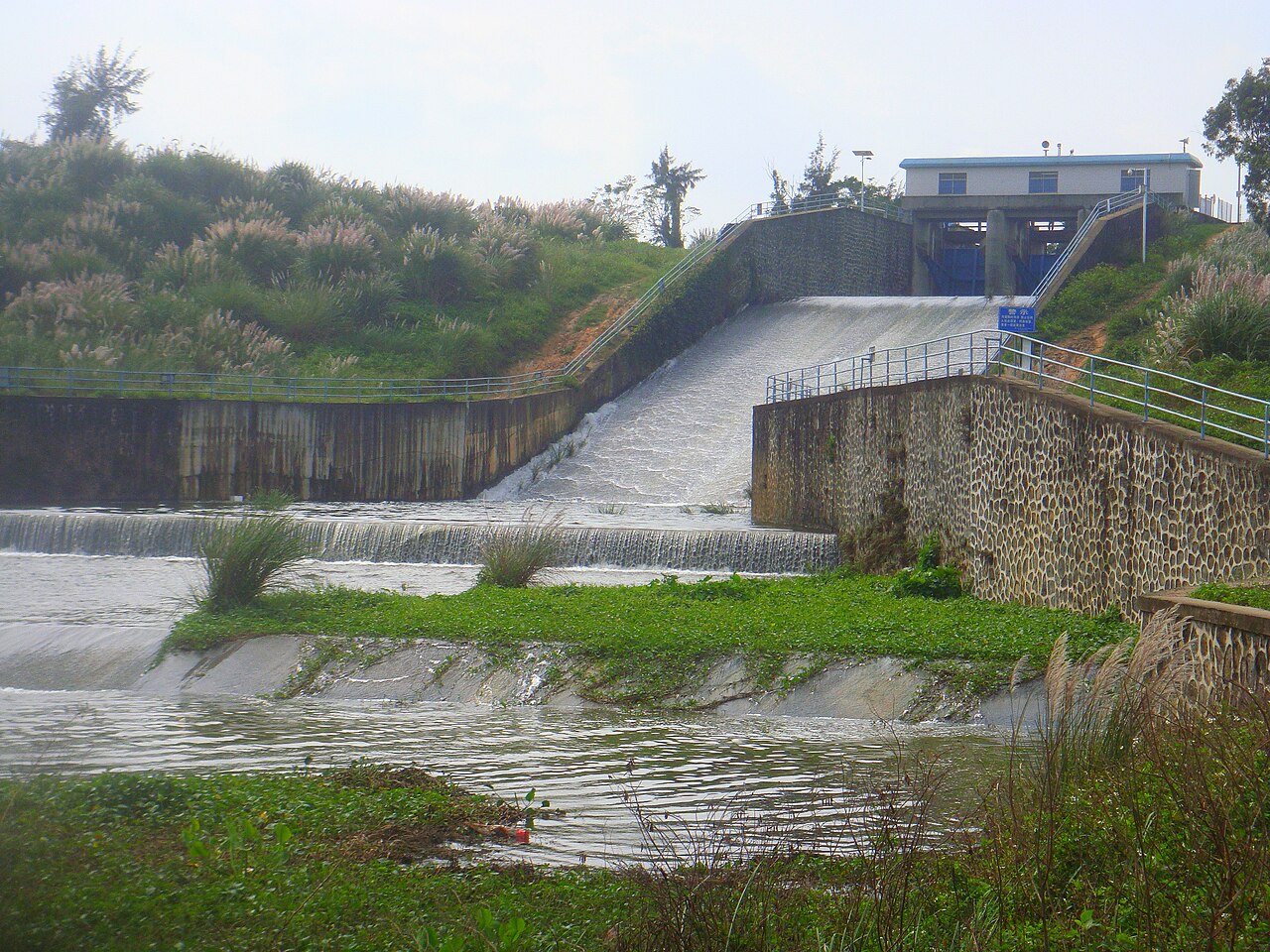
A reservoir’s stored volume depends on its initial volume and net flow over time. The photograph provides context; the small-system numbers used in worked examples are not measurements of this reservoir.
Photo: Anna Frodesiak · Source · CC0 1.0 · Unmodified.PAUSE & TRY IT
Does a narrow pipe automatically mean higher fluid pressure?
Reveal answer
No. In steady horizontal ideal flow, narrowing increases speed and decreases pressure.
Apply flow conservation before an energy relation
For steady incompressible flow through a pipe, volume flow rate Av is constant. A narrower section therefore has greater speed, provided there are no branches, leaks, or accumulation. Continuity expresses conservation of mass, not conservation of pressure.
Bernoulli’s equation connects pressure, kinetic-energy density, and gravitational potential-energy density along a streamline for the ideal assumptions. At equal height, greater speed corresponds to lower pressure within that model. A pump, viscosity, turbulence, or substantial energy loss can require additional terms or invalidate the simple application. State the assumptions rather than applying the equation to every fluid situation.
Distinguish pressure from the force on a surface
Pressure is force per area and acts normally on a surface in a fluid at rest. The same pressure on a larger area produces a larger force. In a static fluid of approximately uniform density, pressure increases with depth by ρgΔh. Absolute pressure includes the pressure at the reference surface; gauge pressure measures the difference from a chosen reference, often atmospheric pressure.
Pressure at a depth does not depend simply on the total amount of water in the container. Container shape can change wall forces and total weight while the hydrostatic pressure relation remains the same. Compare depths below the same surface under the same fluid and gravity conditions.
In a hydraulic idealization, an applied pressure change is transmitted through the confined fluid. A larger output area can produce a larger force, but the corresponding displacement is smaller under volume conservation. Force multiplication does not create energy.
Explain buoyancy through displaced fluid
Buoyant force equals the weight of displaced fluid. For a fully submerged object in a uniform-density liquid, the displaced volume is its submerged volume, not automatically the volume of the entire container. Buoyancy arises from the pressure difference between lower and upper surfaces, with lateral contributions balancing in the simple case.
A floating object in equilibrium displaces enough fluid to balance its weight. The submerged fraction depends on the ratio of average object density to fluid density under the ideal assumptions. An object can float even when some of its materials are denser than the fluid if its overall average density is sufficiently low.
A fully submerged object held by a string may have buoyancy, weight and tension all acting. Do not set buoyant force equal to weight unless equilibrium and the absence of other relevant vertical forces justify it. An apparent-weight measurement can reveal buoyancy through the difference in supporting force.
Connect flow speed, continuity and energy
For steady incompressible flow through a single unbranched passage, volume flow rate Av is constant. A narrower section has greater average speed under that model. This does not imply that every narrow pipe in every real network carries the same flow rate; boundary conditions and branching matter.
Bernoulli’s relation combines pressure, kinetic and gravitational terms along a streamline under suitable ideal conditions. Faster flow at the same height can correspond to lower pressure when those assumptions hold. Pumps, viscosity, turbulence and energy losses require additional accounting rather than blind use of the ideal relation.
Distinguish volume flow rate from speed: one measures volume per time, the other distance per time. State whether a pressure is static, a height is relative to a datum, and the fluid density is approximately constant. These choices determine whether the simplified equations answer the question.
PAUSE & TRY IT
If a steady incompressible stream enters a section with half the area, what happens to its average speed?
Reveal answer
It doubles if the same volume flow rate passes through the section: A1v1=A2v2.
Choose a fluid equation from its physical conditions
Hydrostatic pressure applies to fluid at rest under gravity. Pressure at a depth depends on the surface pressure, density, and depth, not simply the container’s total volume. Pressure is a scalar; the force it exerts on a surface is normal to that surface and depends on area.
Continuity relates flow through cross-sections when the modeled fluid is incompressible and flow is steady: Av is constant along the flow path. A narrower section then has greater average speed. It does not automatically have a larger volume flow rate, because the same flow passes through each section.
Bernoulli’s relation combines pressure, kinetic, and gravitational terms along an appropriate streamline under ideal steady conditions without relevant dissipative losses or added pump work. Faster flow can correspond to lower pressure when height is unchanged, but do not apply that shortcut when height or energy input differs.
Use buoyancy to distinguish floating from fully submerged cases
The buoyant force equals the weight of displaced fluid. The displaced volume is the submerged volume, which equals the object’s full volume only when fully submerged. For a floating object at rest without other vertical forces, buoyancy equals weight and the submerged fraction is object density divided by fluid density.
A fully submerged object can rise, sink, or remain in equilibrium depending on its weight and other forces. A scale supporting an object underwater can read an apparent weight smaller than its true gravitational weight because buoyancy supplies part of the support. The object’s mass has not decreased.
For a sealed rigid object in an approximately incompressible fluid, buoyant force is nearly independent of depth because displaced volume and fluid density remain nearly constant. Pressure rises with depth on all sides, but the pressure difference producing buoyancy is tied to the object’s vertical extent.
PAUSE & TRY IT
Does a floating object displace its entire volume of water?
Reveal answer
Only if fully submerged. A partly floating object displaces the submerged portion, with displaced-fluid weight balancing its weight.
FROM IDEA TO APPLICATION
Worked examples
A floating fraction
A uniform block has density 600 and floats in water of density 1,000 . What fraction of its volume is submerged?
Reveal worked solution
- At rest, ρwater gVsub = ρblock gVtotal.
- Divide by ρwater gVtotal.
- Vsub/Vtotal = ,000.
60% of its volume is submerged under the stated conditions.
A narrowing horizontal pipe
Steady ideal water flow enters a section whose area is half the original area. Initial speed is 2.0 . Find new speed and pressure change; use ρ = 1,000 .
Reveal worked solution
- Continuity gives v2 = 4.0 .
- At equal height, P2 − P1 = ½ρ(v12 − v22).
- ½(1,000)(4 − 16) = −6,000 Pa.
Speed becomes 4.0 and pressure decreases by 6.0 kPa in the ideal model.
Flow through a narrowing pipe
Water flows steadily through a horizontal ideal pipe. The area decreases from 6.0 cm2 to 2.0 cm2 and initial speed is 1.0 . Find the second speed and pressure change using ρ=1,000 .
Reveal worked solution
- Continuity gives v2=()(1.0)=3.0 .
- At equal height, P2−P1=()ρ(v12−v22).
- Substitute: 500(1−9).
v2=3.0 and P2−P1=−4,000 Pa under the ideal assumptions.
Calculate a floating fraction
An object has average density 600 and floats in water of density 1000 . Find its submerged volume fraction.
Reveal worked solution
- Floating equilibrium requires ρwater g Vsub=ρobject g Vtotal.
- Cancel g and divide by ρwater Vtotal.
- Vsub/Vtotal==0.60.
About 60% of its volume is submerged under the uniform-density model.
Apparent weight
An object weighs 30 N in air and displaces water weighing 12 N when submerged. A vertical string holds it at rest.
Reveal worked solution
- Buoyancy is 12 N upward.
- Vertical balance gives T+12−30=0.
The string tension is 18 N.
Continuity in a pipe
A pipe narrows from area 6 cm2 to 2 cm2. Initial speed is 1 for steady incompressible flow.
Reveal worked solution
- A1v1=A2v2.
- v2=()(1).
The narrow-section speed is 3 .
MAKE THE DISTINCTION
Common mistakes, clearer reasoning
The trapBuoyant force always equals object weight.
The better explanationThat equality requires vertical equilibrium without other relevant vertical forces.
The trapUse object density in Archimedes’ formula.
The better explanationUse displaced fluid density and displaced volume.
RETRIEVE BEFORE YOU REVEAL
Practice checkpoints
Revisit the quick checks from this guide without looking back. Explain why, then reveal the answer.
1. What happens to gauge pressure if depth doubles in a uniform fluid?
Reveal answer
It doubles under the hydrostatic model.
2. Why does a narrower pipe section have faster ideal steady flow?
Reveal answer
The same volume per time must pass through a smaller area.
3. Does a submerged object lose mass when its scale reading decreases?
Reveal answer
No. Buoyancy supplies part of the upward support, reducing the required scale force.
4. Why does a floating object’s buoyant force equal its weight?
Reveal answer
It is in vertical force equilibrium when no other vertical forces act.
5. Does a narrow pipe automatically mean higher fluid pressure?
Reveal answer
No. In steady horizontal ideal flow, narrowing increases speed and decreases pressure.
6. If a steady incompressible stream enters a section with half the area, what happens to its average speed?
Reveal answer
It doubles if the same volume flow rate passes through the section: A1v1=A2v2.
7. Does a floating object displace its entire volume of water?
Reveal answer
Only if fully submerged. A partly floating object displaces the submerged portion, with displaced-fluid weight balancing its weight.
Key language
- Pressure
- Normal force per area.
- Buoyancy
- The net upward force caused by a fluid’s pressure distribution.
- Volume flow rate
- Volume passing a cross-section per unit time.
- Streamline
- A curve tangent to the local flow direction.
Fluid equations reuse force balance, conservation of mass, and conservation of mechanical energy.