
On this page0% through guide
Work, Energy, and Power
An energy account can solve motion without tracking every instant.
What you’ll learn
- Choose a system and identify energy transfers.
- Relate work to kinetic-energy change.
- Analyze gravitational and spring energy and power.
Before you begin
Work transfers energy through a force acting over displacement. The system boundary determines whether an interaction is treated as external work or as a change in internal potential energy. Mechanical energy includes kinetic and relevant potential energies.
Explain these starting ideas in your own words. Revisit them whenever a later step feels unclear.
Work depends on force along displacement
For a constant force, work is the dot product of force and displacement. Only the component along the displacement contributes. A perpendicular force can change velocity direction while doing zero work on a point-like object. The signed area under a force-component-versus-position graph gives work for a variable force.
The net work on an object equals its change in translational kinetic energy in the particle model. Positive net work increases speed; negative net work reduces it. Individual forces can do positive, negative, or zero work even when the net work is zero.
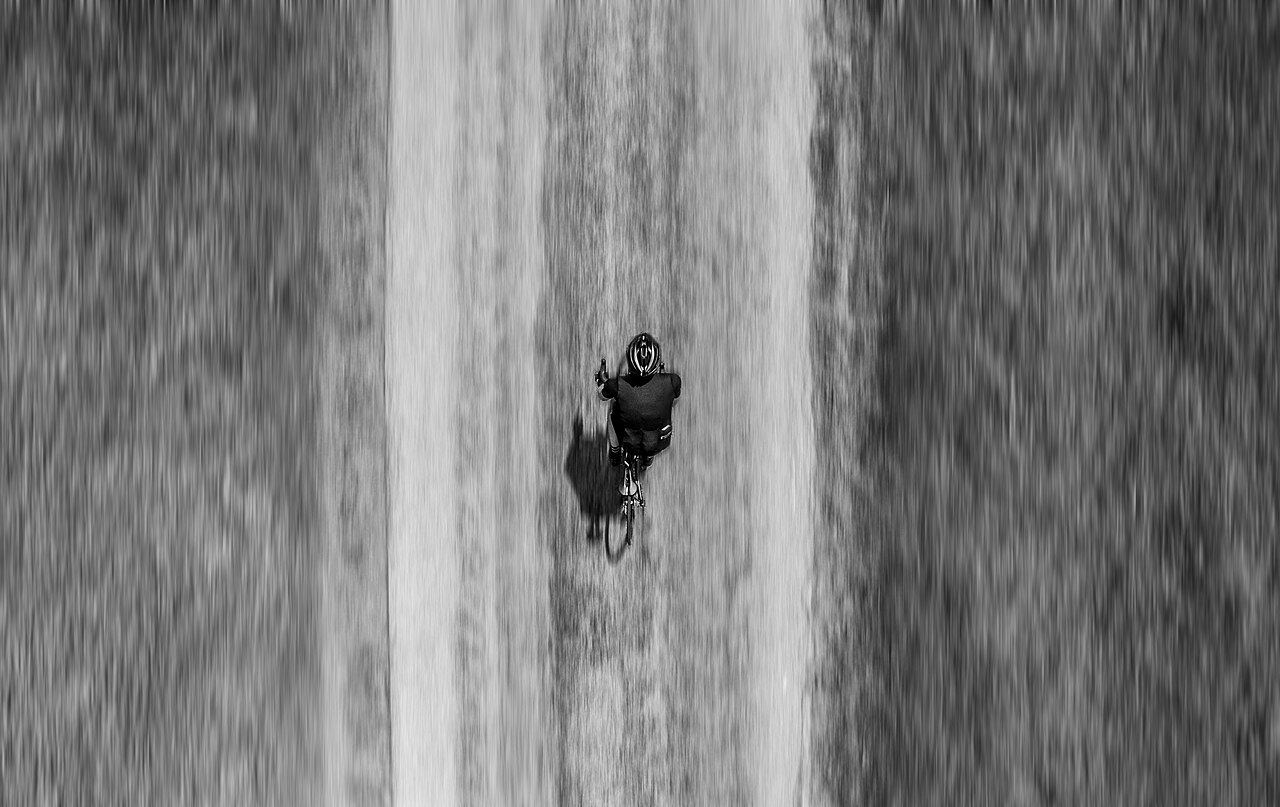
Choose a system boundary before applying force or energy reasoning. A photograph captures one instant; it cannot by itself determine velocity, acceleration, or net force.
Photo: Clemenspool · Source · CC0 1.0 · Unmodified.PAUSE & TRY IT
Why can a normal force do zero work on a cart following a stationary track?
Reveal answer
It is perpendicular to the cart’s instantaneous displacement in the ideal constrained model.
Potential energy belongs to an interaction
Near Earth, gravitational potential energy change can be written mgΔy for an object–Earth system with approximately constant g. A spring stores elastic potential energy ½kx2 relative to its unstretched state in the ideal Hooke’s-law model. A potential-energy zero can be chosen conveniently; differences determine physical predictions.
If Earth is outside the chosen system, gravity can be treated as an external force doing work. If Earth is inside, use gravitational potential energy instead. Do not count both gravitational work and the same gravitational potential-energy change as separate inputs in one account.
Read figure values as text
U=50x²: -0.4: 8; -0.38: 7.22; -0.36000000000000004: 6.480000000000002; -0.34: 5.78; -0.32: 5.12; -0.30000000000000004: 4.500000000000001; -0.28: 3.920000000000001; -0.26: 3.38; -0.24000000000000002: 2.880000000000001; -0.22000000000000003: 2.420000000000001; -0.2: 2; -0.18: 1.6199999999999999; -0.15999999999999998: 1.2799999999999996; -0.14: 0.9800000000000002; -0.12: 0.72; -0.10000000000000003: 0.5000000000000003; -0.08000000000000002: 0.3200000000000001; -0.06: 0.18; -0.040000000000000036: 0.08000000000000014; -0.020000000000000018: 0.020000000000000035; 0: 0; 0.020000000000000018: 0.020000000000000035; 0.040000000000000036: 0.08000000000000014; 0.06000000000000005: 0.18000000000000033; 0.08000000000000007: 0.32000000000000056; 0.09999999999999998: 0.4999999999999998; 0.12: 0.72; 0.14: 0.9800000000000002; 0.16000000000000003: 1.2800000000000005; 0.18000000000000005: 1.6200000000000008; 0.19999999999999996: 1.9999999999999991; 0.21999999999999997: 2.4199999999999995; 0.24: 2.88; 0.26: 3.38; 0.28: 3.920000000000001; 0.29999999999999993: 4.499999999999998; 0.31999999999999995: 5.119999999999998; 0.33999999999999997: 5.779999999999999; 0.36: 6.4799999999999995; 0.38: 7.22; 0.4: 8
PAUSE & TRY IT
What happens to ideal spring energy if compression doubles?
Reveal answer
It increases by a factor of four because energy is proportional to x2.
Conservation depends on what is included
Total energy is conserved, but mechanical energy K + U need not be. Friction can convert mechanical energy into thermal energy of contacting bodies. A motor or person can transfer energy across the system boundary. Identify these transfers before setting initial mechanical energy equal to final mechanical energy.
A broader system can include thermal energy and other stores. The phrase “energy is lost” should specify that energy leaves a chosen system or changes form; it is not destroyed. An isolated system can conserve total energy while its mechanical energy decreases.
Use energy to compare routes and turning points
For conservative interactions, potential-energy change depends on endpoints rather than path. On a frictionless track with the same starting and ending heights, an object’s final speed can be independent of track shape. With friction, path length and normal force can affect the transfer into thermal energy.
At a one-dimensional turning point, kinetic energy is momentarily zero, so total mechanical energy equals potential energy if no other relevant energy store is changing. The accessible region satisfies K ≥ 0. An energy diagram gives possible positions but does not alone give the time spent reaching them.
Read figure values as text
F=3x: 0: 0; 0.08333333333333333: 0.25; 0.16666666666666666: 0.5; 0.25: 0.75; 0.3333333333333333: 1; 0.4166666666666667: 1.25; 0.5: 1.5; 0.5833333333333334: 1.75; 0.6666666666666666: 2; 0.75: 2.25; 0.8333333333333334: 2.5; 0.9166666666666666: 2.75; 1: 3; 1.0833333333333333: 3.25; 1.1666666666666667: 3.5; 1.25: 3.75; 1.3333333333333333: 4; 1.4166666666666667: 4.25; 1.5: 4.5; 1.5833333333333333: 4.75; 1.6666666666666667: 5; 1.75: 5.25; 1.8333333333333333: 5.5; 1.9166666666666667: 5.75; 2: 6; 2.0833333333333335: 6.25; 2.1666666666666665: 6.5; 2.25: 6.75; 2.3333333333333335: 7; 2.4166666666666665: 7.25; 2.5: 7.5; 2.5833333333333335: 7.75; 2.6666666666666665: 8; 2.75: 8.25; 2.8333333333333335: 8.5; 2.9166666666666665: 8.75; 3: 9; 3.0833333333333335: 9.25; 3.1666666666666665: 9.5; 3.25: 9.75; 3.3333333333333335: 10; 3.4166666666666665: 10.25; 3.5: 10.5; 3.5833333333333335: 10.75; 3.6666666666666665: 11; 3.75: 11.25; 3.8333333333333335: 11.5; 3.9166666666666665: 11.75; 4: 12
Power measures the rate of transfer
Average power is energy transferred per time. For a force acting on an object, instantaneous power is the dot product of force and velocity. Two devices can perform the same work with different power if they take different times.
Efficiency compares useful output energy or power with input. Define what counts as useful for the device. A motor delivering a fixed power may exert less forward force as speed rises because P = Fv for aligned force and velocity.
PAUSE & TRY IT
What is the distinction between work and power?
Reveal answer
Work is an energy transfer; power is its rate.
Decide whether to use force or energy
A force approach is useful for acceleration, tension, and time-dependent motion. An energy approach often relates speeds and positions without needing elapsed time or the detailed force at every point. Neither method is universally better. Choose the approach matching the requested quantity and the information available.
For a block–Earth system, gravity can be represented by changing gravitational potential energy. For the block alone, gravity does external work. Both descriptions can be correct if used consistently. Counting gravity’s work and also adding the same potential-energy decrease as a separate input double-counts the transfer. Draw the system boundary before writing the energy balance.
PAUSE & TRY IT
What does area below the axis on a force–position graph represent?
Reveal answer
Negative work by that force component over the interval.
Interpret area on a force–position graph
For a force component along the displacement, work is the signed area under the force-versus-position graph. A positive area adds kinetic energy through that force; a negative area removes it. A changing force can be handled by geometric areas when its graph has simple segments. The height of the graph is force, not work.
For an ideal spring, force magnitude grows with displacement from equilibrium and elastic energy is . The square means compression and extension by the same magnitude store the same energy in the ideal model. The spring force points toward equilibrium, so its work depends on whether the spring moves toward or away from its relaxed length.
PAUSE & TRY IT
Can mechanical energy decrease while total energy is conserved?
Reveal answer
Yes. Energy can become thermal or another nonmechanical form.
Account for thermal energy and power
If kinetic friction acts, mechanical energy of the chosen system may decrease while internal thermal energy increases. Total energy is still conserved when the system and transfers are accounted for. “Energy is lost” should identify the form or destination rather than imply disappearance.
Average power is energy transferred divided by elapsed time. Instantaneous power from a force is the dot product of force and velocity, or Fv when they are parallel. Two motors can do the same work at different power if they take different times. Efficiency compares useful output energy or power with input, and should use the same type of quantity in numerator and denominator.
Choose an energy system and identify transfers
Kinetic energy depends on speed squared and is nonnegative. Work is a signed energy transfer through force acting over displacement. A force parallel to motion does positive work; one opposite motion does negative work; an exactly perpendicular force does no work at that instant. A large force can therefore do zero work if there is no displacement or if it is perpendicular to the motion.
For a selected particle, net work equals change in kinetic energy. For a larger system, interactions within the system can be represented by potential-energy changes. If Earth is included with the object, gravity can be treated through gravitational potential energy. If it is outside, gravitational work is an external transfer. Use one consistent accounting method rather than counting both the same work and potential change.
Mechanical energy need not remain constant when friction or other processes convert it into thermal energy. Total energy accounting can still be valid. State the system boundary and the transfer or conversion instead of saying energy “disappears.”
PAUSE & TRY IT
Why does doubling speed quadruple kinetic energy?
Reveal answer
K=½mv2, so at fixed mass replacing v with 2v multiplies K by four.
Read work and potential energy graphically
Area under force versus position gives work for the component along the displacement. This is different from area under force versus time, which gives impulse. For a spring, force changes with displacement, so using final force times distance overestimates the work magnitude by a factor of two in the simple linear case.
Potential-energy differences are physically significant; a zero level is chosen for convenience. Near Earth’s surface, mgΔy is useful when g is approximately constant. Elastic potential energy is ½kx2 measured from the spring’s relaxed length. A negative change in potential energy can supply an increase in kinetic energy when no other transfer intervenes.
A potential-energy graph helps identify allowed positions for a given total mechanical energy: kinetic energy is E−U and cannot be negative. At a turning point, kinetic energy can be zero. The graph’s slope indicates the direction of a conservative force: motion tends toward lower potential energy when released from rest.
Distinguish energy from power and test efficiency claims
Power is the rate of energy transfer. A machine can do the same work in less time and have greater average power. For a force and velocity, instantaneous power depends on the component of force along velocity. Energy units are joules; power units are joules per second or watts.
Efficiency compares useful output energy or power with the corresponding input. Choose the same time interval and system boundary for numerator and denominator. Lower efficiency does not violate conservation: other outputs, often thermal, account for the difference.
Energy methods often avoid detailed time dependence, making them efficient for speed after a displacement. They generally do not by themselves give elapsed time or every individual force. Choose Newton’s laws or kinematics when those quantities are the target, and combine methods when needed.
Choose energy when the path details are unnecessary
An energy approach connects initial and final states without necessarily finding elapsed time. Define a system so gravitational or spring potential energy is appropriate, then account for energy crossing the boundary through work or other transfers. A closed mechanical-energy model is valid only when dissipative transfers are negligible or explicitly included.
For gravity near Earth, ΔU=mgΔy depends on height change, not path length. A reference height changes individual potential values but not their difference. A negative chosen potential value is allowed; it reflects a reference, not negative mass or impossible energy.
Friction can transform mechanical energy into thermal energy. If the rough surface is outside the chosen system, account for its work; if included, track internal thermal energy. These are compatible bookkeeping choices when used consistently. Do not count the same transfer twice.
Relate work, graphs, and power
Work by a constant force is FΔr cos θ. Only the component along displacement contributes. For a varying force, the area under force-versus-position gives work in one dimension. The area under force-versus-time instead gives impulse, so axis labels are essential.
Power is the rate of energy transfer. For force and velocity, instantaneous power is the dot product F·v. The same amount of work can be done with different power if the time differs. A force can act without doing work when displacement is perpendicular to it.
A spring’s energy depends on displacement from its equilibrium length, not its absolute position. The energy change uses the difference between squared displacements. Doubling extension quadruples stored energy for an ideal Hooke’s-law spring, while doubling the force only doubles the extension within the model.
PAUSE & TRY IT
Does a normal force always do zero work?
Reveal answer
No. It does zero work when perpendicular to the object’s displacement. Moving contact surfaces can create other situations.
FROM IDEA TO APPLICATION
Worked examples
Energy down a track
A cart starts from rest 2.0 m above the bottom of a frictionless track. Use g = 10 . Find its speed at the bottom.
Reveal worked solution
- Include cart and Earth so gravitational energy converts to kinetic energy.
- mgh = ½mv2; mass cancels.
- v = √(2gh) = √40.
About 6.3 , assuming no rotational energy or other transfers need to be included.
A force–position triangle
A forward force decreases linearly from 12 N at x = 0 to zero at x = 3.0 m. Find its work.
Reveal worked solution
- Work is area under the force–position graph.
- The triangular area is ½ × 3.0 × 12.
18 J of positive work.
Spring energy becomes motion
A 0.50 kg cart is launched by an ideal spring of k=200 compressed 0.10 m on a frictionless level track. Find speed when the spring reaches its natural length.
Reveal worked solution
- Initial spring energy is ()(200)(0.10)2=1.0 J.
- Set this equal to ()(0.50)v2.
- Solve v2=4.0.
v=2.0 .
Use a spring to predict speed
A 0.50 kg cart is launched by a spring with k=200 compressed 0.10 m. Neglect losses and spring mass. Find speed at the relaxed position.
Reveal worked solution
- Initial elastic energy is ½(200)(0.10)2=1.0 J.
- At the relaxed position that becomes cart kinetic energy: ½(0.50)v2=1.0.
- Thus v2=4.0 and v=2.0 .
The predicted speed is 2.0 ; losses would reduce it.
Friction and stopping distance
A 2 kg block moving at 5 stops under a constant 5 N friction force on level ground.
Reveal worked solution
- Initial kinetic energy is ½(2)(25)=25 J.
- Friction work is −5d, equal to the −25 J kinetic-energy change.
Stopping distance is 5 m.
Power at constant speed
A motor pulls with 200 N parallel to motion at 3 .
Reveal worked solution
- P=Fv for parallel force and velocity.
- P=200(3).
Power is 600 W.
MAKE THE DISTINCTION
Common mistakes, clearer reasoning
The trapMechanical energy is always conserved.
The better explanationAccount for external transfers and conversion to thermal or other energy.
The trapA force must do work if it changes motion.
The better explanationA perpendicular force can change direction without changing speed or kinetic energy.
RETRIEVE BEFORE YOU REVEAL
Practice checkpoints
Revisit the quick checks from this guide without looking back. Explain why, then reveal the answer.
1. Why can a normal force do zero work on a cart following a stationary track?
Reveal answer
It is perpendicular to the cart’s instantaneous displacement in the ideal constrained model.
2. What happens to ideal spring energy if compression doubles?
Reveal answer
It increases by a factor of four because energy is proportional to x2.
3. What is the distinction between work and power?
Reveal answer
Work is an energy transfer; power is its rate.
4. What does area below the axis on a force–position graph represent?
Reveal answer
Negative work by that force component over the interval.
5. Can mechanical energy decrease while total energy is conserved?
Reveal answer
Yes. Energy can become thermal or another nonmechanical form.
6. Why does doubling speed quadruple kinetic energy?
Reveal answer
K=½mv2, so at fixed mass replacing v with 2v multiplies K by four.
7. Does a normal force always do zero work?
Reveal answer
No. It does zero work when perpendicular to the object’s displacement. Moving contact surfaces can create other situations.
Key language
- Work
- Energy transfer by a force acting through displacement.
- Conservative interaction
- An interaction with path-independent work between endpoints.
- Mechanical energy
- The sum of kinetic and relevant potential energies.
- Power
- The rate of energy transfer.
Rotating systems add rotational kinetic energy; momentum provides a different conservation tool for collisions.