
On this page0% through guide
Magnetic Fields and Electromagnetism
Electricity & Magnetism track · College Board Unit 12. Build the model, derive its consequences, and test the assumptions.
What you’ll learn
- Predict magnetic forces using cross products.
- Calculate fields from currents.
- Identify when Ampère’s law simplifies a magnetic field calculation.
Magnetic force changes direction of motion
A moving charge in magnetic field B experiences F=qv×B. The magnitude is |q|vB sinθ. Use the right-hand rule for positive charge, then reverse for negative charge. A stationary charge has no magnetic force from B alone.
Because magnetic force is perpendicular to velocity, it does no work on a point charge. In a uniform field, the perpendicular velocity component produces circular motion with radius r=mv_. A parallel component remains constant, creating a helix. Magnetic forces can change momentum without changing speed.
PAUSE & TRY IT
A charge moves parallel to B. What is its magnetic force?
Reveal answer
Zero because the cross product is zero.
PAUSE & TRY IT
If speed doubles in the same uniform B, what happens to circular radius?
Reveal answer
It doubles for the same mass and charge.
Crossed fields can select a speed
For mutually perpendicular E, B, and velocity, electric and magnetic forces can oppose. An undeflected particle then satisfies |q|E=|q|vB, giving v=. The cancellation direction must be checked; the magnitude equation alone does not determine which travel direction works.
A downstream magnetic region can separate particles by mass-to-charge ratio. In the nonrelativistic model, r=. If particles instead receive the same accelerating voltage, use |q|ΔV= first: equal voltage does not mean equal speed for different masses.
Currents experience force and loops experience torque
For a short wire segment, dF=I dl×B. In uniform field a straight segment gives F=I L×B. Forces on different sides of a loop may cancel translationally while forming a torque. A planar loop has magnetic dipole moment μ=IA n̂, or NIA n̂ for N turns.
The torque is μ×B with magnitude μB sinθ. The angle is between the loop’s normal and B, not between the plane and B. Stable alignment has μ parallel to B. A motor’s energy comes from its power supply; the magnetic field redirects forces while electrical energy is converted.
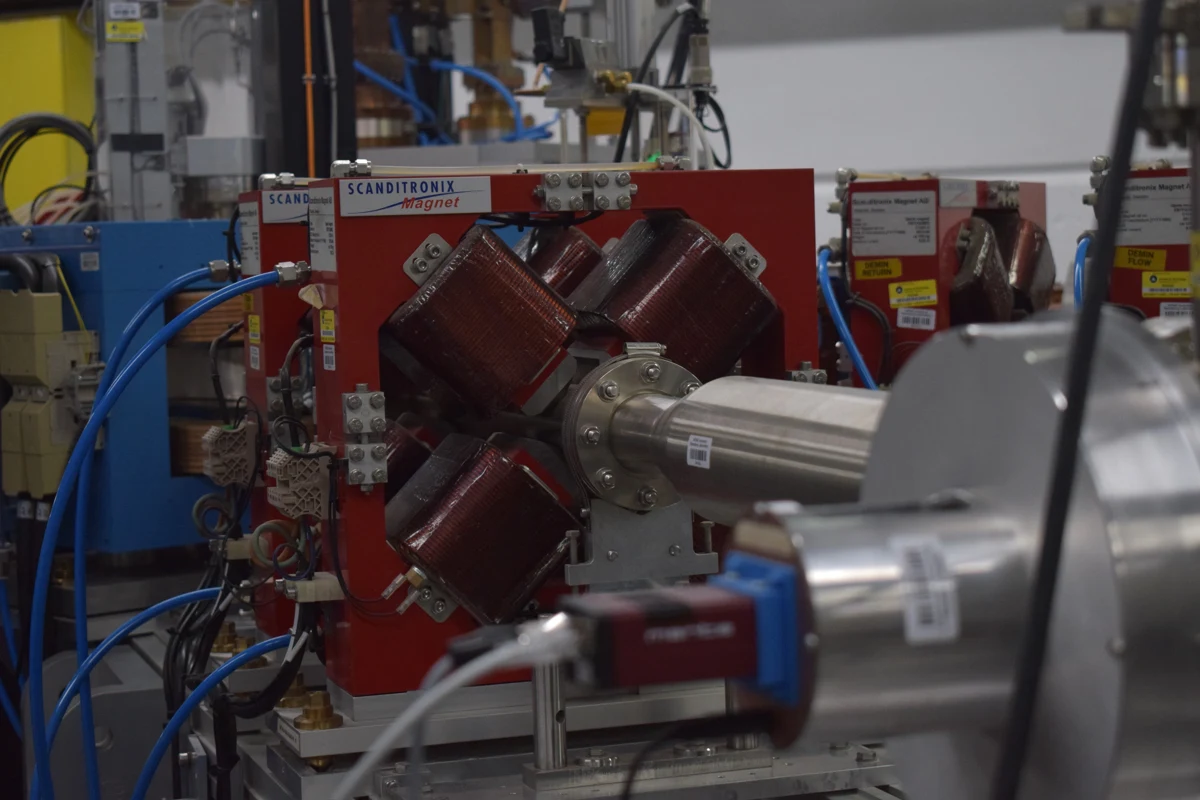
Current in coils produces fields used to control charged-particle beams. The photograph supplies real-world context; the ideal wire and solenoid equations describe simplified geometries.
Photo: Mystery Ray · Source · CC0 1.0 · Unmodified.PAUSE & TRY IT
Is loop torque greatest when the loop’s plane is perpendicular to B?
Reveal answer
No. Then its normal is parallel to B and torque is zero.
Biot–Savart adds the field of current elements
The Biot–Savart law gives dB=()I dl×r̂/r2 for a steady current element. Both the direction and distance vary with geometry. On the axis of a circular loop, transverse contributions cancel; at its center B= for one turn.
A long straight wire produces B=, tangent to circles around the wire. Choose the direction using the right-hand grip rule. Superpose fields from multiple wires as vectors; two parallel currents in the same direction attract, while opposite currents repel.
Read figure values as text
B∝1/r: 1: 1; 1.1041666666666667: 0.9056603773584905; 1.2083333333333333: 0.8275862068965518; 1.3125: 0.7619047619047619; 1.4166666666666667: 0.7058823529411764; 1.5208333333333335: 0.6575342465753424; 1.625: 0.6153846153846154; 1.7291666666666665: 0.5783132530120483; 1.8333333333333335: 0.5454545454545454; 1.9375: 0.5161290322580645; 2.041666666666667: 0.48979591836734687; 2.145833333333333: 0.4660194174757282; 2.25: 0.4444444444444444; 2.354166666666667: 0.42477876106194684; 2.458333333333333: 0.4067796610169492; 2.5625: 0.3902439024390244; 2.666666666666667: 0.37499999999999994; 2.770833333333333: 0.3609022556390978; 2.875: 0.34782608695652173; 2.979166666666667: 0.3356643356643356; 3.0833333333333335: 0.3243243243243243; 3.1875: 0.3137254901960784; 3.2916666666666665: 0.3037974683544304; 3.3958333333333335: 0.29447852760736193; 3.5: 0.2857142857142857; 3.6041666666666665: 0.27745664739884396; 3.7083333333333335: 0.2696629213483146; 3.8125: 0.26229508196721313; 3.9166666666666665: 0.25531914893617025; 4.020833333333334: 0.2487046632124352; 4.125: 0.24242424242424243; 4.229166666666666: 0.2364532019704434; 4.333333333333334: 0.23076923076923073; 4.4375: 0.22535211267605634; 4.541666666666666: 0.22018348623853215; 4.645833333333334: 0.21524663677130043; 4.75: 0.21052631578947367; 4.854166666666666: 0.20600858369098715; 4.958333333333334: 0.20168067226890754; 5.0625: 0.19753086419753085; 5.166666666666667: 0.1935483870967742; 5.270833333333333: 0.18972332015810278; 5.375: 0.18604651162790697; 5.479166666666667: 0.18250950570342203; 5.583333333333333: 0.17910447761194032; 5.6875: 0.17582417582417584; 5.791666666666667: 0.1726618705035971; 5.895833333333333: 0.1696113074204947; 6: 0.16666666666666666
Ampère’s law needs symmetry too
For steady currents, ∮B·dl=μ0I_enclosed. A circular path around a long straight wire works because the field is tangent with constant magnitude. Inside a uniform cylindrical current, enclosed current grows as r2, giving B proportional to r; outside, B decreases as .
Inside a sufficiently long ideal solenoid B≈μ0nI and the exterior field is negligible away from ends. A rectangular Amperian path exploits that model. A short coil still obeys the law, but end effects prevent simply treating B as uniform everywhere.
Current out of the page produces counterclockwise magnetic circulation.
PAUSE & TRY IT
Why is B proportional to r inside a wire with uniform current density?
Reveal answer
Enclosed current is proportional to r2 and the path length is proportional to r.
Check your magnetic-field model against a graph
For a uniformly filled wire of radius R, the field is zero at its center, rises linearly inside, and joins the inverse-radius outside solution continuously. The graph shape differs from the inverse-square exterior electric field of a charged sphere.
If current density is nonuniform, integrate J over the enclosed cross-section before applying Ampère’s law. The total current does not automatically belong inside a path of radius smaller than the wire. Always state the current direction when reporting a magnetic field direction.
Read figure values as text
Long wire with uniform current density: 0: 0; 0.05: 0.05; 0.1: 0.1; 0.15: 0.15; 0.2: 0.2; 0.25: 0.25; 0.3: 0.3; 0.35: 0.35; 0.4: 0.4; 0.45: 0.45; 0.5: 0.5; 0.55: 0.55; 0.6: 0.6; 0.65: 0.65; 0.7: 0.7; 0.75: 0.75; 0.8: 0.8; 0.85: 0.85; 0.9: 0.9; 0.95: 0.95; 1: 1; 1.05: 0.9523809523809523; 1.1: 0.9090909090909091; 1.15: 0.8695652173913044; 1.2: 0.8333333333333334; 1.25: 0.8; 1.3: 0.7692307692307692; 1.35: 0.7407407407407407; 1.4: 0.7142857142857143; 1.45: 0.6896551724137931; 1.5: 0.6666666666666666; 1.55: 0.6451612903225806; 1.6: 0.625; 1.65: 0.6060606060606061; 1.7: 0.5882352941176471; 1.75: 0.5714285714285714; 1.8: 0.5555555555555556; 1.85: 0.5405405405405405; 1.9: 0.5263157894736842; 1.95: 0.5128205128205129; 2: 0.5; 2.05: 0.48780487804878053; 2.1: 0.47619047619047616; 2.15: 0.46511627906976744; 2.2: 0.45454545454545453; 2.25: 0.4444444444444444; 2.3: 0.4347826086956522; 2.35: 0.425531914893617; 2.4: 0.4166666666666667; 2.45: 0.4081632653061224; 2.5: 0.4; 2.55: 0.3921568627450981; 2.6: 0.3846153846153846; 2.65: 0.37735849056603776; 2.7: 0.37037037037037035; 2.75: 0.36363636363636365; 2.8: 0.35714285714285715; 2.85: 0.3508771929824561; 2.9: 0.3448275862068966; 2.95: 0.3389830508474576; 3: 0.3333333333333333
Use the magnetic force as a vector relationship
The magnetic force on a moving charge is qv×B. Its magnitude is |q|vB sin θ, with θ between velocity and field. A stationary charge has no magnetic force from this term, and motion parallel to the field also gives zero force. Reverse the direction obtained for a positive charge when q is negative.
The magnetic force is perpendicular to velocity and therefore does no work on an isolated point charge through that force alone. It can change direction without changing speed. In a uniform field, a perpendicular velocity component can produce circular motion while a parallel component persists, producing a helical path.
For circular motion, equate magnetic-force magnitude to . The resulting radius depends on momentum magnitude divided by |q|B. Do not confuse this orbital relation with a statement that all particles in a beam have the same radius regardless of mass, speed or charge.
PAUSE & TRY IT
Can a magnetic field change a particle’s direction without changing its kinetic energy?
Reveal answer
Yes. A force perpendicular to velocity changes direction while doing zero work, so speed and kinetic energy can remain constant.
Connect currents to magnetic forces and torques
A current-carrying wire segment in a field experiences a force determined by current direction, segment orientation and B. A current loop can have zero net force in a uniform field but a nonzero torque. Its magnetic moment is associated with current, area and loop orientation.
The torque tends to align the magnetic moment with the field. The angle is between the moment vector, normal to the loop, and B—not necessarily between the plane of the loop and B. Draw the area normal to avoid a sine/cosine swap.
Two parallel currents exert forces through each other’s magnetic fields. Use the field of one wire and the force on the other rather than adding an invented attraction rule without direction. Parallel currents in the same direction attract in the standard long-wire geometry; opposite currents repel.
Choose Biot–Savart or Ampère’s law from symmetry
Biot–Savart builds a field from current elements, with direction set by a cross product and magnitude depending on source distance and geometry. As with electric-field integration, symmetry can cancel components. A current element is not an isolated point charge, so the electric inverse-square formula cannot simply be reused.
Ampère’s law relates circulation of B around a closed path to enclosed current in the magnetostatic setting. To extract a field magnitude easily, use a symmetry that makes B tangent and constant along suitable parts of the path. A long straight wire supports a circular path; an ideal long solenoid supports an appropriate rectangular path.
A zero enclosed current gives zero net circulation, not necessarily zero field everywhere along the path. External currents can contribute locally. Inside a current-carrying wire with a stated uniform current density, enclosed current depends on the fraction of cross-sectional area inside the chosen loop.
Test magnetic-field expressions against physical limits
Outside a long straight wire, field magnitude decreases as . Inside a uniformly conducting cylindrical wire with uniform current density, enclosed current grows as r2, so the field grows proportional to r. These are different regions with different enclosed-current expressions.
The ideal long-solenoid interior field is approximately uniform away from ends, while edge fields require a more detailed model. A photographed electromagnet is not automatically an ideal solenoid; coils, cores and gaps can alter the field distribution.
For every direction problem, identify whether the requested arrow is current, field, force or magnetic moment. A correct right-hand rule applied to the wrong pair of vectors still gives the wrong answer. Label each vector before using the rule.
A magnetic force changes direction without doing particle work
For a particle, F=qv×B is perpendicular to velocity, so its instantaneous power F·v is zero. A static magnetic field alone can bend a trajectory without changing speed. Electric fields can change kinetic energy, so do not extend this statement to a region containing both fields.
For velocity perpendicular to a uniform field, equate |q|vB to to obtain r=. The sign of charge changes the bending direction, not this positive radius. A component parallel to the field remains unchanged in the ideal model, producing helical motion when combined with circular perpendicular motion.
The magnetic force on a current segment is I dℓ×B, integrated when needed. A loop can experience torque even when its net force is zero. The magnetic dipole moment points according to the current’s right-hand rule, and torque tends to align it with the field. Distinguish net translation from rotation.
PAUSE & TRY IT
Why can a static magnetic field bend a charged particle without changing its speed?
Reveal answer
The magnetic force is perpendicular to velocity, so it does no work on the particle while changing the velocity direction.
Choose between Biot–Savart and Ampère using symmetry
Biot–Savart builds a field from current elements, including direction through a cross product and distance dependence. It is suited to geometries such as a finite arc or a ring when their contributions can be integrated. Source-element direction and observation-point geometry both matter.
Ampère’s law relates circulation of B around a closed path to enclosed current in the magnetostatic situations studied here. To solve easily for B, justify constant magnitude and alignment along the chosen path, as for an ideal long straight wire or long solenoid. Choosing a circular path around an arbitrary circuit does not create circular symmetry.
For a long solenoid, the ideal internal field is approximately μ0nI and the external field is small away from ends. A real finite solenoid has fringe fields. State the approximation and avoid interpreting an ideal diagram as proof that the outside field is exactly zero everywhere.
FROM IDEA TO APPLICATION
Worked examples
A field measurement near a wire
At 0.020 m from a long wire, B=30 μT. Find current magnitude. Use μ0=4π×10-7 T·.
Reveal worked solution
- B=.
- I=2π(0.020).
I=3.0 A.
A cylindrical current distribution
Inside radius R, axial current density is J(r)=Cr2. Find B at r<R.
Reveal worked solution
- I_enclosed=∫0ʳCs2(2πs)ds=.
- B(2πr)=μ0I_enclosed.
B=, with azimuthal direction from the current.
Find a charged-particle orbit radius
A particle with mass m and charge magnitude q enters a uniform field perpendicular to B with speed v. Derive r.
Reveal worked solution
- Magnetic-force magnitude is qvB.
- Uniform circular motion requires .
- Equate qvB= and solve.
r=. The charge sign changes the bending direction, not this positive radius magnitude.
Magnetic radius and period
A particle with mass m and charge magnitude q enters a uniform B perpendicularly at speed v. Derive its orbital period.
Reveal worked solution
- The radius is r=.
- Period T=.
- Substitution cancels v, giving T=.
In the nonrelativistic ideal model, period is independent of speed even though radius increases with speed.
Long-solenoid scaling
A solenoid’s turns per length doubles while its current is halved.
Reveal worked solution
- B≈μ0nI.
- The product (2n)()=nI remains unchanged.
The ideal interior field remains the same; finite-geometry effects are outside this approximation.
MAKE THE DISTINCTION
Common mistakes, clearer reasoning
The trapA magnetic field increases a charged particle’s kinetic energy.
The better explanationMagnetic force alone is perpendicular to motion and does no work.
The trapUse all of a wire’s current for every interior Amperian loop.
The better explanationUse only current enclosed by that loop.
RETRIEVE BEFORE YOU REVEAL
Practice checkpoints
Revisit the quick checks from this guide without looking back. Explain why, then reveal the answer.
1. A charge moves parallel to B. What is its magnetic force?
Reveal answer
Zero because the cross product is zero.
2. If speed doubles in the same uniform B, what happens to circular radius?
Reveal answer
It doubles for the same mass and charge.
3. Is loop torque greatest when the loop’s plane is perpendicular to B?
Reveal answer
No. Then its normal is parallel to B and torque is zero.
4. Why is B proportional to r inside a wire with uniform current density?
Reveal answer
Enclosed current is proportional to r2 and the path length is proportional to r.
5. Can a magnetic field change a particle’s direction without changing its kinetic energy?
Reveal answer
Yes. A force perpendicular to velocity changes direction while doing zero work, so speed and kinetic energy can remain constant.
6. Why can a static magnetic field bend a charged particle without changing its speed?
Reveal answer
The magnetic force is perpendicular to velocity, so it does no work on the particle while changing the velocity direction.
Key language
- Magnetic field
- Vector field producing qv×B force on a moving charge.
- Magnetic moment
- IA times the loop-normal unit vector.
- Biot–Savart law
- Integral relation connecting current elements to their magnetic field.
- Ampère’s law
- Closed-loop magnetic circulation equals μ₀ times enclosed steady current.
- Solenoid
- A closely wound coil whose long interior approximates a uniform magnetic field.
- Cyclotron radius
- Radius mv_perp/(|q|B) of uniform-field circular motion.
Connect the equations to the physical assumptions. Explain directions, signs, limiting cases, and units before accepting a numerical result.